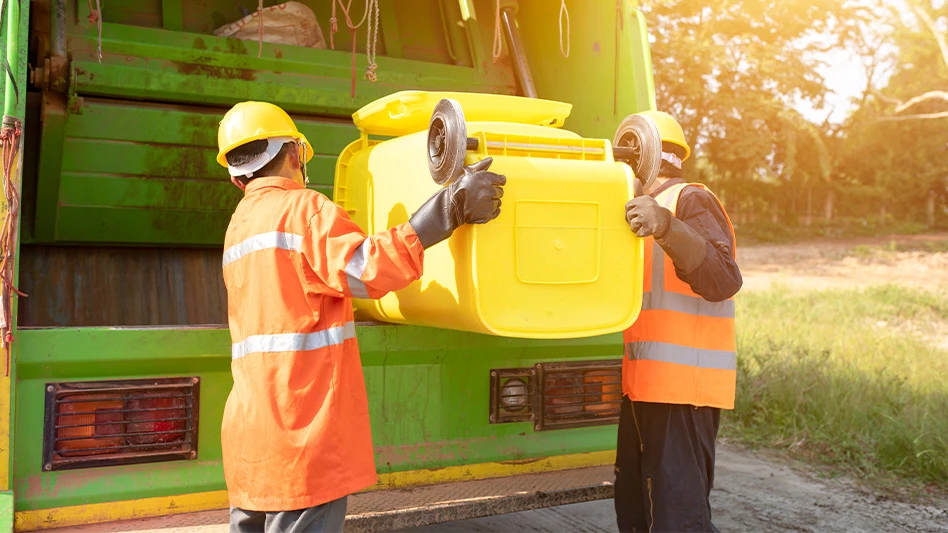
When most people think of waste collection, they think of the weekly waste pickup at the curb outside the home. For most of us, the typical waste collection truck loaded by men picking up individual trash cans and dumping them in the back of the truck is all there is to waste collection. What most of us do not realize is that weekly residential waste collection is only one of many wastestreams. In fact, residential waste is often not the largest wastestream in terms of total tons disposed of at the local landfill.
Commercial collection, in all of its varieties, is the wastestream generated by industry and business that is often unseen by the average person. Furthermore, instead of going to the community’s municipal solid waste landfill, these wastestreams are often sent to their own uniquely constructed and operated landfills that have been specifically designed to receive these wastes. Being out of the public eye is the result of commercial waste being collected by its own specialized bins, rolloff boxes, and similar containers, and transported by specialized vehicles.
The differences between waste sources and waste types can get confusing. But it is necessary to understand them so as to differentiate the needs of the various types of waste collection operations. The resulting contrast will go along way to explain need for specialized commercial waste collection practices.
Sources of Waste
Waste sources fall into one of two broad categories: residential and nonresidential. Residential waste collection is properly defined as being an operation limited to single-family dwellings, either rural or urban. Residential waste does not normally include multifamily dwellings, though each source is a residence and produces the same type of municipal solid waste.
A single-family residence is typically defined either as a detached structure (such as an individual house on a lot or on a more extensive rural property, surrounded by open space) or as town houses and row homes. Though these latter structures are physically attached, each unit is typically considered to be a single-family dwelling, since they are each occupied by only one family and have individual trash collection services being provided for each dwelling.
On the other hand, the term multifamily dwellings usually refers to multiple attached structures (apartments, condominiums, dormitories, etc.) sharing a centralized community trash disposal system and are provided with joint waste collection services. Multifamily dwellings, even though they are residential sources and also produce municipal solid waste, are commercial in nature. They typically represent large blocks of rental units, making them commercial operations. As such, the waste containers and collection procedures at apartment complexes will differ from those of suburban neighborhoods.
In addition to multifamily dwellings, nonresidential waste sources include commercial businesses, retail outlets, institutions, offices, farms, industries, energy generation, forestry, and mining operations. These nonresidential waste sources are defined as commercial, industrial, or medical. Commercial waste is generated by premises and locations used for trade or business activities. Factories, mines, power plants, lumber operations, and agriculture create industrial waste (which can be further classified as either hazardous or nonhazardous). Medical waste is generated by health care facilities such as doctor’s offices and hospitals.
A commercial bin with tipper is seen in action.
Types of Waste
Residential waste sources produce municipal solid waste almost exclusively. The types of waste generated by nonresidential waste sources can each be further divided into two types, municipal and industrial. This later designation is a much broader category encompassing many types of industrial activities, not just factories.
The first type, municipal solid waste, includes wastes such as scrap paper, foodwaste, yardwaste, used corrugated cardboard, pieces of plastic, scrap metal, glass shards, wood fragments, and other waste objects (including durable goods, nondurable goods, containers and packaging, appliances, automobile tires, clothing, or wood pallets) generated by residential (both single-family and multifamily households) and commercial sources.
Industrial waste is generated by industrial processes and activities, not by individual humans. It includes everything that is not considered municipal solid waste. It contains an even wider range of waste types than municipal solid waste, including: compostable organic waste and other biodegradable waste, construction and demolition debris, fly ash and other coal combustion byproducts, industrial sewage sludge, industrial slag, electronic waste, hazardous waste of all kinds (metals, volatile organic compounds, semivolatile organic compounds), nuclear and radioactive waste, and sharps and other medical waste. In general, while municipal solid waste is generated by both residential and nonresidential sources, only nonresidential sources can produce industrial waste. Of these nonresidential sources, industrial waste is almost always generated by noncommercial activities.
Types of Waste Collection Operations
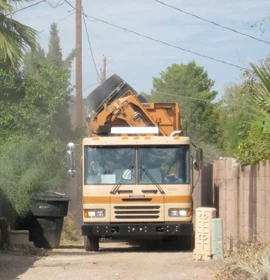
All waste has to be physically picked up from a designated loading point (either the curb in front of your house, a container behind a restaurant, or a community bin located in an apartment complex parking lot). Each location and waste source relies on a specialized collection vehicle that has been matched to the waste container. There are seven major types of waste collection vehicles (frontloaders, rearloaders, recycling trucks, rolloff trucks, pneumatic collection trucks, automated sideloaders, and grapplers) but only the first four are used extensively for most residential and commercial waste collection. The other types are specialized for specific operations.
Rearloaders typically collect residential waste from individual waste cans. These are loaded manually into the rear of the truck, though some models come with partially automated loading mechanisms to handle larger waste cans called toters. Once placed in the truck bed, waste is compacted within the truck by a hydraulically powered sweep-and-slide blade. The blade sweeps the waste forward to the front of the truck, increasing its density and making room for additional loads.
Front loaders are the mainstay for most commercial waste collection fleets. Using a hydraulically powered forklift, the front-end loader lifts and flips the large waste bin so that it empties into a hopper located in the rear of the truck. The waste is then compacted by a packer blade, similar in operation to the rearloader’s sweep-and-slide blade. The operation is usually fully automated, though the truck operators often use spotters for safety purposes.
For the most part, frontloaders collect waste from large dumpsters that temporarily store waste generated by nonresidential businesses or residential waste from multifamily housing units (apartments and condos). These trucks use a forklift to deposit waste into a hopper for containment during transport. Inside the hopper, the waste is compacted by a packer blade to increase its density and free up additional capacity the next load. Typically, these trucks can operate without the need for manual loaders, though they often use spotters.
Though not strictly considered waste collection vehicles, rolloff trucks are used to collect and place the larger rolloff boxes used to collect waste from industrial and construction sites. In an operation similar to that of the working of a dump truck, a rolloff truck can raise its bed to a steep angle (with the low end near the rear tires) or lower its bed to a flat horizontal position by means of a hydraulically operated mechanism. As the bed is raised, the rolloff box it caries can then slide backwards to the ground. Once its rear end touches the ground, the truck moves forward to allow room for complete movement and placement of the rolloff box. Conversely, a rolloff truck can back up to an already in place (and filled) rolloff box, raise its bed once again so that the box may slide back on to the truck and be pulled into a horizontal position for transport once the truck bed is lowered.
The sliding movement of the box as it is placed and retrieved in a controlled manner is achieved by means of either a winch or a hook lift system. A winch system attaches a cable line to the rolloff box and then rewinds to pull it onto the raised bed, or unwinds to lower it safely off the bed. Hook lift systems are typically used for smaller rolloff boxes (20-cubic-yard capacity and smaller). It is comprised of a 90-degree, hydraulically operated, extendable arm with a hook on the end that grabs the rolloff box as it is being moved. Working in tandem with the hydraulically raised and lowered truck bed, the hook lift ensures safe placement and retrieval of the rolloff box.
This emphasis on safety is absolutely necessary since commercial waste removal operations are neither simple nor inherently safe. Factors affecting commercial waste collection include the positioning of the bin or rolloff box, the type of waste container, its capacity, frequency of service, and final destination (landfill, transfer station, or material recovery facility). Problems that can occur during waste collection and transport include overflow and spillage during collection, blown debris from the back of the truck during transport, fire and ignition due to sparks cause by metal striking pavement, illegal or improper dumping of unacceptable waste into the container prior to pickup, and contact with overhead power lines. To guard against these occurrences, spotters usually direct the truck operator during loading and off loading, tarps are placed to cover the waste and prevent blown dust and debris, waste containers are located to minimize the chance of an accident or fire, and the bins may be locked or chained to prevent unwanted access.
Characteristics of Rolloff Boxes
As the largest waste transport containers, rolloff boxes are in a category by themselves. Essentially open-top trash bins with a rectangular shape and large holding capacity, rolloff boxes are typically used for bulk waste or such potentially hazardous waste as construction-and-demolition debris, or industrial solid waste. Rolloff boxes can also be sued to haul storm debris, bulk agricultural waste, and such building materials as sand or structural fill soil. The shape and size of the rolloff box determines the size and model of truck used to haul and place it.
Typical storage capacities range from 10 cubic yards to 40 cubic yards. The cost of renting or purchasing a rolloff box is based on its size. However, size is not the only cost factor. With weight limitations being imposed on most hauling routes, overfilling or carrying high-density wastes can result in overage charges or other fines. In addition to rental costs and transport costs, there are costs with the actual disposal of the waste. Tipping fees at landfills are based on tons received and measured by weighing the rolloff truck as it enters the facility full and then again when it leaves empty.
Being heavy and bulky metal containers, rolloff boxes are prone to causing damage to paved surfaces (asphalt or concrete). To avoid this liability, most rolloff boxes are equipped with heavy-duty metal wheels at each corner. Since even these can scratch paved surfaces, it is accepted practice to place protective plywood or other sheeting under the wheel locations. A dirt surface is not considered an acceptable location for placing rolloff boxes, though gravel is suitable. For most projects, local permits have to be acquired to allow for delivery and placement of the boxes.
Commercial Collection Equipment Suppliers
Autocar/Grand Vehicle Works is a company with a proud history, going back to the early 20th century as a manufacturer of cars and trucks. A part of Grand Vehicle Works since 2001, Autocar carries on its long tradition as a producer of LCF Class 8 trucks for waste hauling. The company’s Xpeditor product comes standard equipped with improved ergonomic cabs, integrated body controls, improved body-to-chassis interface as well as a hybrid drive version. For frontloader applications, Autocar engineered a stronger, lighter front end and moved the front axle position forward in the Xpeditor to accept heavier engines and still maintain the ability to haul large payloads.
Big Truck Rental LLC is a truck dealer with a broad selection of frontloader, sideloader, rearloader, and rolloff truck rentals. The company’s rolloff fleet includes late-model Mack Granites, Kenworth M2 T-800s, and IHC 7500s. These come equipped with 78,000 GAWR triaxles, Heil’s KwikLift hoist systems, automatic tarp-deployment systems, and a 60,000-pound-strength cable in an outside rail hoist. Operated by either automatic or manual transmissions, they utilize 405-horsepower Mack engines. Safety, rider comfort, and ease of operation are enhanced by auto-adjusting back up alarms, mid-body turn-and-clearance lights, and integral air conditioners with heater/defroster features.
Crane Carrier is a leading manufacturer of heavy-duty, custom-built, specialty vehicles including commercial refuse collection trucks, rolloff container haulers, mobile drill-rig chassis, terminal tractors, airport refueling vehicles, as well as custom chassis serving the construction and agricultural vocations. Its CCC LET (low-entry-tilt) and LET2 truck chassis are the mainstays of the company’s refuse truck fleet. The LET models are low-entry-tilt crew cabs with low door openings. Powered by 385-horsepower Cummins engines, these chassis provide the foundational framework for multiple kinds of refuse truck configurations.
Heil Environmental has developed a KwikLift cable hoist, a member of their family of roll-off hoists. Their system can load and unload rolloff containers in half the time of conventional hoists. The KwikLift’s free cable length is 10 feet, while needing only 28 feet of cable versus typical cable hoists that require 78 feet of cable. This is achieved by the design of the hoist’s traveling carriage. The carriage is hydraulically powered to travel the entire length of the hoist. Because the cable sheave is attached to the carriage, every foot of carriage travel (either extending or retracting) produces 2 feet of cable movement. This is why its loading and unloading time is half that of standard roll-off hoists. Additionally, the carriage can be cycled back and forth in a manner that produces rapid container movement to help shake loose stubborn loads and materials stuck to the box sides in less time. The carriage can also pull a container far forward on the hoist, making it safer to haul shorter containers. The container rollers do not interfere with the tandem fenders.
One of its major safety features is the increased visibility during operation. Typically, an operator in the cab of a truck operating a rolloff hoist must deal with visual obstructions from the hoist frame, cylinders, and hoist mechanism. The KwikLift’s center-mounted cylinder and traveling carriage eliminate these obstructions, leaving a clearer view between the hoist rails and enabling the operator to view the container and lifting operation. Another safety feature is that the extended cable length is always less than the distance to the cab while a housing surrounds the cable sheave. If a cable failure does occur, the restraint mechanism and the shorter length of the cable act together to prevent the whip-like action of a broken cable from reaching the cab and possibly injuring the operator. John Elliott, the owner of JFE Transport in Andover, NH, has this to say: “The KwikLift cable hoist system proved to be the ideal match for the contract’s non-stop, ash-handling requirements. The cycle times were much faster than any other hoist systems that I’ve ever run. In fact, we can operate the system at full speed just a few notches above idling. In spite of the high utilization, heavy loads, and abrasive ash, the rollers and wear pads held up very well.”
Complementing the KwikLift are Heil’s DuaLift and LowLift hoist systems. The DuaLift, in effect, provides the performance of two trucks in one. It can service both hook and cable containers with a single chassis. With many of the same operational features as the KwikLift, the DuaLift provides twice the alignment forgiveness as standard reeving hoists while unloading containers more quickly. Their LowLift is designed to operate at shallower loading angles, resulting in a smaller operational footprint with shorter loading and offloading cycle times. Because the LowLift has a rotating tail section, container loading and unloading can be performed without the need to fully extend the lift cylinders. This makes the LowLift model ideally suited for indoor applications and those with low overhead clearance. Like the DuaLift and KwikLift, the LowLift utilizes an efficient traveling carriage design. One satisfied customer is J.R. Pesek, owner, Town & Country Disposal, of Kansas City: “Initially, I was a skeptic. … Quickly, I realized it was one of the best business decisions I’ve ever made. The flexibility to handle any type of container with one truck was very appealing. I did my homework and had one of my best drivers put the DuaLift to the test. … On average, we can count on one-and-a-half to two extra pulls per truck per day.”
The Heil family of hoists uses the same design for both diesel and CNG-powered units. This serves the customer in two ways: commonality among parts and low container roller heights. Avoiding the need to raise the container rollers minimizes the overall height of the vehicle in transit and enables a lower center of gravity.
Marrel Corp. (Ampliroll) is a hoist system provider with 30 years of experience in the design and manufacture of hook lifts that have been used in construction, roofing, landscaping, waste, truck maintenance, agriculture, military, firefighting, and general transportation applications. It has a unique design that reduces the cycle time in loading and unloading, but also allows one truck to be used for multiple applications. All new products are tested for an industry-leading 24,000 cycles in the company’s test facility, using a weight calculation program to determine the correct hook lift and installation parameters for the appropriate application. The advanced design uses high-pressure hydraulics to achieve a strong, maintenance-free hook-lift system with a high degree of safety. As a result of this design, the company’s Ampliroll hook lift is often as much as 1,000 pounds lighter than competitive hook lifts.
McNeilus Companies Inc., an Oshkosh Corp. company, is a leading manufacturer of refuse truck bodies and concrete mixers. With an extensive network of factory-owned service and support centers, McNeilus provides its customers with superior aftermarket support. Within the refuse industry, McNeilus is an industry-leading manufacturer of garbage trucks and fields a complete line of rear-loading, front-loading, and automated side-loading units to augment any refuse collection operation. Each product line offers multiple models to fit your specific needs. Innovative technologies such as Excalibre cylinders and command zone controls are models of providing continuous improvement. Through the company’s Next Generation Initiatives (Ngen) campaign, McNeilus has been a leading producer of alternatively fueled compressed-natural-gas-powered vehicles.
New Way manufactures the Mammoth and West Series Mammoth front-end loaders. The Mammoth features one-piece body sides for superior strength and appearance, along with a curved hopper that adds strength in a critical area, strong steel specs, heavy-duty arms, and torque tube assembly designed for the heavy lifting. Weighing between 16,100 and 18,300 pounds, it has a holding capacity of 34 to 40 cubic yards. The Western Series Mammoth is similar to the standard Mammoth, but fills the niche for a lighter weight, fast cycling, and high-compaction front-load body for use in areas where local Department of Transportation weight concerns are an issue. With over 10% less weight, the WS Mammoth, has a similar design and performance.
Premier Truck Sales Inc. has been in business for over 25 years and has grown into a well-recognized provider of used high-quality equipment for work-related applications. The company line features a truck and trailer inventory of over 200 units. Chief of these for commercial waste collection is the Kenworth T800. This truck comes equipped with a 485-horsepower Cummins ISX engine delivering power to an Ultra Shift transmission. A Galfab hoist with a capacity of 80,000 pounds and a Pioneer automatic tarp-deployment system complete its capabilities.
The Rantoul Truck Center has one of the largest assortments of rolloff trucks in the Midwest. Its fleet includes trucks manufactured by Mack, Freightliner, International, and Volvo. All its rolloff trucks come with an automatic tarp system as standard equipment. In addition to its general-purpose rolloff trucks, Rantoul has a large assortment of refuse truck rentals, including rearloaders, frontloaders, and grapple trucks.
This cart tipper offers extra mobility.
Rush Refuse Systems, a subsidiary of Rush Enterprises, is a dedicated business developed to solely support the refuse industry with a work-ready inventory and dedicated sales specialists. It is backed by Rush Truck Centers, the largest network of commercial vehicle dealerships in the United States, with 78 dealer locations around the country. Rush Truck Centers represents industry-leading truck brands. Its locations serve as one-stop centers offering an integrated approach to meeting customer needs, from sales of new and used vehicles and equipment to aftermarket parts, service, and body shop operations, plus a wide array of financial services, including financing, insurance, leasing, and rental. The company also provides vehicle upfitting, custom modifications, chrome accessories, and tires.
Wayne Engineering has been a leading manufacturer%2
Latest from Waste Today
- Vermeer announces plan to build new facility in Des Moines metro area
- Buffalo Biodiesel shares updates on Part 360 application to DEC, Tonawanda facility progress
- Capstar Disposal expands roll off dumpster rental services
- Supreme Court strikes down IEEPA tariffs
- Casella details facility closures, expansion efforts
- Zero harm: Building a SIF prevention program for waste and recycling operations
- Casella posts a loss in Q4 2025
- McNeilus names Haaker Equipment first Dealer Partner of the Year