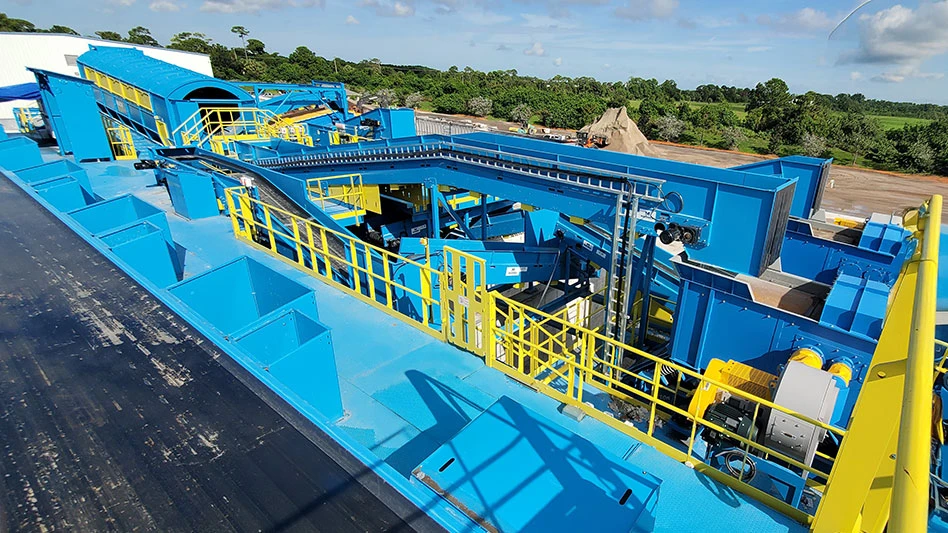
Controversy swirls around the recent contract between the city of Indianapolis, IN, and Covanta to allow the building of a $45 million materials recovery facility to sort recyclables from municipal solid waste. Commonly referred to as “dirty MRFs,” these facilities enable residents to throw trash and recyclables into one curbside receptacle.
The argument begins with semantics. While James Regan, director of communications for Covanta, and Marc Lotter, director of communications for Mayor Greg Ballard, consider the contract a “14-year extension of the current agreement,” Carey Hamilton, executive director of Indiana Recycling Coalition (IRC), expresses concern that it’s being handled as a contract amendment/extension instead of a new contract, because that means it can circumvent city council approval.
No matter how it’s described, the contract, which runs through 2028, raises issues with its detractors, who complain that they had little time to review it and that it didn’t go through a public vetting process before it went up for vote by the Board of Public Works, most of whom were appointed by the mayor.
What opponents dub an “unproven recycling system,” the mayor’s office has defended as a low-cost method to improve diversion rates in a city with a historically low recycling record.
Contractual Agreements and Disagreements
The Recycling Industries Coalition (RIC), a group of organizations and corporations that have been engaged in recycling for over 100 years, representing recyclers of glass, paper, plastic, rubber, textiles, steel, aluminum, and other nonferrous metals companies across the country, issued a statement explaining that the new contract makes the Covanta Advanced Recycling Center (ARC) the only effective option available to Marion County residents.
The new contract effectively gives Covanta a monopoly through 2028 by specifically prohibiting the city from expanding its current recycling program or allowing any new haulers. Under the terms of the contract, if the city pursued a different municipal recycling program, it would be obligated to pay Covanta $333,000 per month.
This clause will prohibit the city from improving its recycling program for 14 years, Hamilton says. Innovative resources, new possibilities, and improved approaches will be closed to the city for the duration of the contract. Recycling efforts will stagnate.
Lotter insists that the Covanta contract will have no impact on anyone who chooses to use one of the recycling services and says detractors bring up that point as part of their “scare tactics.” Residents “can continue to pay for recycling pickup or drop off recycling for free,” he says.
However, while Covanta has agreed to the status quo regarding existing curbside and drop-off programs, Regan admits they “may make adjustments later to protect our investment.”
Hamilton contends that the new contract contains a hidden quota, because if subscription recycling collects 5% more than the year prior to the facility opening, the city will be financially penalized. Thus, clean residential recycling is disincentivized by the new contract. “It’s still a put-or-pay contract.”
She doesn’t expect to see an increase in subscriptions, though. Nor does the RIC, which argues that the new program could discourage participation in voluntary (paid) recycling. Lower-income families don’t have transportation to drop-off locations, and the average annual fee of $72 for curbside recycling is cost-prohibitive, especially if the alternative is free.
But it’s not really free, according to Julie Rhodes, Julie L. Rhodes Consulting. “Indianapolis charges a solid waste fee on the tax bill of $32 per year, although it’s not the true cost of collection and disposal. The difference is made up from the general fund. The Covanta contract already costs taxpayers money; it’s just not transparent.”
Under the current contract with Covanta, the city is “locked into feeding the incinerator,” says Rhodes. When it doesn’t meet the quota of at least 60,000 tons of trash per quarter, the city is fined—which it has been consistently, to the tune of $500,000 per year—because not enough solid waste has been generated. That ends with the new contract, she points out. “The new contract has no penalties, no minimum threshold for the amount of trash collected.”
The lack of a threshold generates even more criticism. Governor Pence set a statewide recycling goal of 50%, but Hamilton says the Covanta contract’s goal is only 18%, with no penalty for shortfalls. Furthermore, it is a 23% decrease from the original 23.5% goal presented in the marketing proposal. Similarly, the RIC expressed disappointment at the absence of any specific recycling mandates or flexible voluntary targets.
Rate of Recycling
Indianapolis residents recycle approximately 10% of their trash. “Recycling struggles here,” observes Regan, calculating the national average at 30%.
Rhodes says studies have been conducted on why the city does not recycle, but seem to reveal no solid answers. “Indianapolis has one of the worst recycling rates in the US. [Smaller cities like] Columbus and Tipton are more effective.”
She blames the lack of public education and leadership. “We need a leadership policy decision to shift investment from trash to recycling. As long as people think trash is free and recycling is expensive, there’s no incentive to reduce trash, no incentive to divert by recycling. Recycling appears to be a luxury. There is no compelling reason to recycle.”
She says that cities with successful recycling programs incentivize with free recycling and charge by weight for trash. But with little incentive driving local subscription recycling programs, few participate. “Most successful programs run on volume. It’s an economy of scale.”
Hamilton blames the lack of an efficient subscription system. “Recycling only works when it’s convenient and people know what to put in the cart.”
Whatever the cause, the historic low rate of participation serves as the basis for the mayor’s choice of the mixed-waste MRF. “After decades of trying, we will get 100% participation with no additional effort from residents [with the Covanta program],” says Lotter. “We’ll increase the amount of material 500% at no cost to the taxpayer.”
None of the waste will go into the landfill, he adds—although under the current contract with Covanta, no waste is landfilled now. Currently, residential trash from the city of Indianapolis is incinerated, and the steam is sold to Citizens Thermal, a member of the Citizens Energy Group. The city earns a percentage of revenue generated from the sale. “We combust 250,000 tons of waste for steam energy to power Indianapolis,” says Regan. It generates 50% of the heating and cooling for the city, he says, and creates 80 jobs.
Profit sharing in steam revenue will continue under the new contract, with additional income from recyclables after six years. Regan says Covanta anticipates recycling 18,000 tons of metal and that this program will pull 80–90% of paper, cardboard, plastic, and metal out of the wastestream. He equates the energy savings from the new plant with removing 38,000 cars from the road.
Contentious Confusion
Despite Regan’s impressive numbers and the promise of diverting waste that is currently landfilled, Rhodes expresses concern about the plan to bring in more out-of-county waste to make up for diverted waste because it means that “more trash will travel farther to feed the system.”
The ARC is projected to recover 65,000 tons of recyclables per year. With a weighted value per ton of $189, the value is approximately $12.3 million annually.
The RIC prepared an “Economic Analysis of ARC Proposal to the City of Indianapolis.” Inbound tons of recyclables commingled in solid waste would equal 65,000, according to the analysis. This, when multiplied by the tipping fee (the city pays $30.04 per ton gate fee on everything that goes into the MRF) would come out to $1,952,600. Taking into account a credit of $400,000 for the elimination of annual penalties for not meeting quotas and subtracting $50–$60 per ton for processing costs, the economic loss from recyclables is projected as $1,552,600, or roughly $120 per ton.
The RIC also calculates future revenue from profit sharing after year six. The city will only receive revenue if there is a minimum of 18% recovery of material. In 2023, the blended value per ton of recyclables would need to be at least $225 for the city to earn any money. In a statement, the group said: “The average blended value of curbside recyclables has never met or exceeded $225 per ton in a full calendar year. In reality, the city may never reach the threshold for revenue sharing.”
Even with additional waste brought in from neighboring communities, the IRC claims the total amount of projected recycled materials will amount to less than one-quarter of the trash Covanta collects. “The … amount of material that is recovered when you combine recycling with waste is much less than what can be collected through a source-separated curbside recycling program.”
Covanta anticipates collecting 120,520 tons of recyclable material, but the RIC says only 65,000 tons will be recycled. The rest will be incinerated.
Displeased with those numbers, the RIC states that over 92% of what gets thrown away in Indiana is recyclable or compostable material. The group hints at Covanta’s need to feed the incinerator as a possible reason for not working harder to recover recyclables.
Hamilton confirms their concern, stating that the new contract locks in tonnage for steam generation. “Sending all waste to a dirty MRF will not result in more recycled material. Citywide recycling will result in more recycled material.”
During a Board of Public Works public comment session on the proposed Advanced Recycling Center in July, Jeremiah Shirk, on behalf of the mayor’s office, stated that the national average for residual materials from MRFs, including unrecyclable material, is 15–27%. The RIC challenged that statistic, claiming that the Environmental Protection Agency does not track residual material from MRFs, and that there have been no national studies.
On the flip side, one of Rhodes’ concerns is that the “throw it all in” approach will result in items Indiana has banned, such as cathode ray tubes, electronic devices, and household hazardous waste, showing up in the wastestream. “That side hasn’t been discussed. Now they’re telling people to throw it all in one bin. The average resident doesn’t discern a computer from bleach from paper. Some supporters are not passionate about recycling; they’re just tired of taxes.” She says a complex public education campaign will be necessary to prevent undesirable items from infiltrating, and contaminating, the wastestream.
Contamination
“With any recycling process, there’s some contamination,” states Regan. But unlike “old dirty MRFs,” he says, the ARC’s highly automated, state-of-the-art technology will separate materials quickly, decreasing contamination. “It works in Europe.”
The ARC will be different than other facilities, he predicts. “It’s an Advanced Recycling Center with a waste energy facility. All residual material makes electricity and steam. It’s unique—the first in America. We hope this will be a model for other cities.”
“Contamination rate is a myth spread by competitors,” claims Lotter. “At $45 million, it’s incumbent on Covanta to pull out materials; it’s in the best interests for Covanta to recycle as much material as possible.”
Although it may be in Covanta’s best interest, not everyone agrees that it’s feasible. The RIC counters a claim made by the governor’s office that contamination of 5% is standard across the industry by noting that there is no data to support that figure.
“There’s no technology to clean material contaminated with human, food, and hazardous waste,” says Rhodes. “There’s no way to clean paper. There is no new technology for highly contaminated material. It requires hand picking by highly skilled workers on the front and back end.”
Commingling all forms of waste degrades the quality and quantity of recyclable material and makes the recycling process more difficult. Recycling works best when quality material is returned to the manufacturers.
Markets
It’s estimated that Indy’s wastestream contains $15 million worth of commodities, but opponents to the ARC raise a question about how much will actually be recycled. In addition to loss due to contamination, there are some items that won’t even be addressed.
“Glass,” says Regan. “Our initial analysis indicates there’s no real market to handle the volume and type of glass; we would have to ship it [to other facilities].” Instead, they will incinerate as much of it as they can.
The fact that Covanta’s plan doesn’t include glass is a point of irritation. Regan hopes to include it one day, but for now says they “don’t want it; it has no energy value.”
“We plan to add glass as technology and the marketplace demand,” confirms Lotter.
The attitude puzzles opponents of the MRF because Indiana currently has a sizable glass industry that is begging for more of the energy-saving recycled material in order to keep up with robust demand. “It’s a strategic material,” says Hamilton, “but this plan guarantees that zero glass will be recycled.”
The RIC estimates that 60,000–90,000 tons of glass will first be incinerated and then landfilled, rather than be recycled into new products. That negatively affects the budget: Every ton of glass sent to the landfill incurs a tipping fee of $30. “Glass is a small percentage by volume, but a large percentage by weight,” says Rhodes. It represents 85% energy savings to manufacturers if it is recycled. “There’s a ready-made market in Indiana.”
Unfortunately, Rhodes adds, Covanta’s plan “shifts the focus from recycling to the importance of providing a commodity.” Glass is not a high-value commodity at $5 per ton, compared with paper at $60 per ton.
Indiana also has a large cardboard box recycling facility; Hamilton says they are alarmed by this proposal. “It has a negative impact on Indiana. Recycling is going backwards.”
An Endless Loop
Among other groups, Hamilton says, the aluminum and steel associations oppose this plan. “Expect pushback. Expect legal action.”
Regan shrugs it off, saying, “There is a small but vocal opposition, a lot of which is from direct competitors.” He and Lotter verify that they have confirmed markets and signed deals with companies to receive materials from the MRF.
“The reality is that there is no financially viable alternative,” maintains Regan.
In support, Lotter indicates that the city put out an RFP in 2010 asking for ideas, partners, and proposals to increase recycling rates: No financially viable proposals were submitted. “Covanta was the only one with no additional costs or effort.”
Hamilton disputes that claim. “We asked for three months to come up with a new plan. The answer was ‘no.’” She contends that a $100 million, 0% long-term interest fund from the Closed Loop Fund, a national public-private partnership, was not only available, but that “they wanted to work with Indianapolis.” There are also state grants available.
Shirk, on behalf of the mayor, argue that the Closed Loop Fund is unavailable, but its executive director, Ron Gonne, says otherwise. Lotter and Regan respond that the loan has a high interest rate and up-front costs and that such a plan would require more trucks and bins. “There are additional costs involved,” says Regan.
The RIC estimates that a citywide curbside-recycling program would require $13 million to $15 million in upfront capital for 96-gallon carts (adjusted to $10 million—$11 million if it were to include households that already have carts) and $3.8 million to $4.1 million in additional costs per year. With public education campaigns, Indianapolis should expect a 65% participation rate within one to two years, eclipsing Covanta’s projections.
The RIC points out that the money to pay back the loan would be generated from the recycling revenue stream that source-separated recyclables would create.
In their open letter to the mayor, the RIC stated: “This valuable revenue stream would be totally unavailable to the city under the contract. There is little or no incentive to recycle materials back into commerce because the project is based on the ability to generate energy from the residuals, giving them little to no incentive to properly recycle. Those materials are the lifeblood of our industries.”
Seventy-seven facilities in Indiana manufacture recycled material, employing 35,000 workers. The RIC fears the potential loss of jobs, as well as the possibility of shrinking amounts of recycled materials and “the loss of untold environmental benefits that flow from using recycled materials to manufacture new basic materials.”
“This will create 130 jobs,” promises Regan—70 new (temporary) construction jobs and 60 new (permanent) operations jobs. In addition, he says, the recycled material will support other jobs. “It’s a good idea. Other cities are going to these kinds of facilities, where they’ll capture more on the back end.
“Dig down and look at the opposition,” adds Regan. “They are direct competitors.”
Republic Services and Ray’s Trash Service, two subscription-based recyclers operating in Marion County, declined to comment about the impact of the Covanta contract on their businesses.
Parting Shots
John Barth, an at-large member of the Indianapolis-Marion County City-County Council who chairs the council’s community affairs committee, says the mayor’s office is oversimplifying a complex problem. He calls for a multifaceted plan to integrate curbside recycling into a system that currently involves many haulers with different contract terms. “The mayor has an affinity for one-size-fits-all solutions, but in a complex city of nearly one million people, one-size-fits-all is not always the right decision.”
Houston received a $1 million grant to explore a one-bin-for-all system, Rhodes states. They concluded that “the industry says it’s the wrong way to go,” she says. In fact, dirty MRFs have nearly vanished in the US and only work where curbside recycling is not offered or disposal fees are high. “Three [Indianapolis] mayors promised curbside recycling. Is this an easy way out?”
There are differing philosophies, Regan believes. “Covanta has provided a next-generation solution with a zero-cost option to the city.” There’s no risk for the city. Covanta assumes the risk that it can capture and resell enough material to recoup their investment. Covanta expects to increase Indianapolis’ recycling rate by five times, for an estimated 13,000 tons per year.
Shirk, representing Mayor Ballard, declares that the goal “has and will continue to be to increase recycling in the city of Indianapolis and Marion County,” and says the ARC is “a piece of that recycling puzzle.”
The RIC declares that “participation in this mixed-waste procession all-in-one bin system is not a recycling program.” But Rhodes says, “This deal is too good to be true. We’re paying Covanta a lot to run it. If the city educated folks on the cost of trash collection and diverted money to recycling, we’d be better stewards of the environment. It’s all about image.”
It’s a marketing opportunity for the city, Hamilton concurs.
Marketing opportunity, or simple solution to Indy’s recycling problem, Lotter says Covanta is in the process of obtaining permits and hopes to start construction in 2016.
Lori Lovely focuses on topics related to recycling and technology.
Latest from Waste Today
- Vecoplan to present modular solutions at IFAT 2026
- Terex Ecotec appoints Bradley Equipment as Texas distributor
- My Green Michigan expands depackaging capacity
- Washington selects Circular Action Alliance as PRO
- Ten-8 Industrial opens new central Florida service center
- Triumvirate Environmental acquires Environmental Waste Minimization
- Official NYC Bin availability expands ahead of deadline
- US Food Waste Pact’s 2025 Impact Report shows decrease in food waste