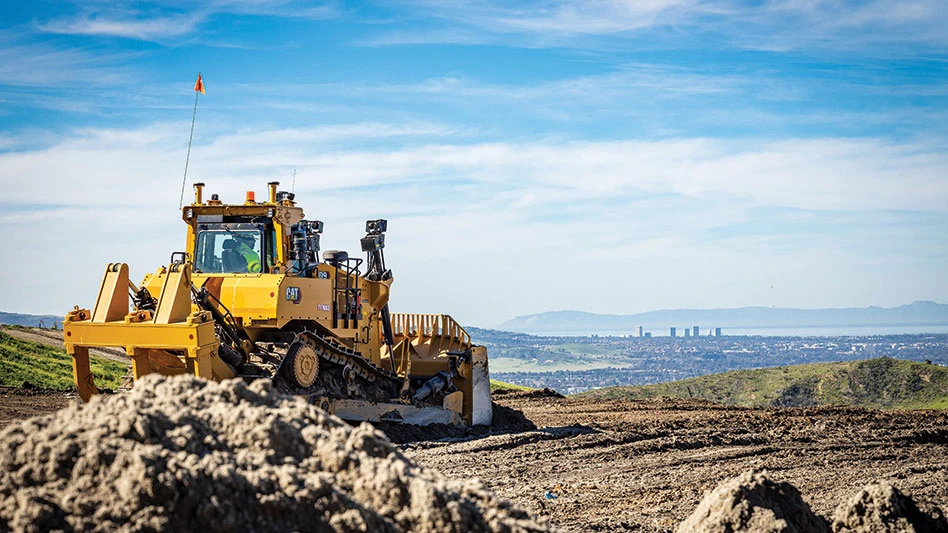
Servicing the waste disposal and recycling needs of California’s Orange County since the 1940s, OC Waste & Recycling (OCWR) has committed itself to providing landfill and resource recovery systems that safely manage waste, recycle materials and protect the local environment.
As a government agency serving the county, OCWR is a critical part of Orange County’s waste management infrastructure, managing three active landfills and composting operations, four household hazardous waste centers and 20 closed sites. These facilities serve 3.2 million residents, and OCWR receives about 5 million tons of muncipal solid waste and 40,000 tons of organic waste per year.
Tom Koutroulis, director of OCWR, has been with the agency since 2017. Formerly a senior manager for Houston-based WM for 13 years, he brings more than 30 years of experience, focusing on safety, operational efficiency, technology implementation, recycling infrastructure and providing research and development in organics recycling.
“I grew up [in] a family trash business, so … my friends were going to surf camp, and I was going to trash camp,” Koutroulis says of his introduction to the industry. “I grew up on the trucks in operations, … and very long story short, my uncle and father sold the business. I stayed in the business and ended up getting recruited by Orange County.”
Under Koutroulis’ leadership, OCWR has played a critical role in shaping the region’s organics waste management infrastructure to support state-mandated recycling goals. He’s also helped pivot the county from primarily landfilling to a more sustainable resource recovery model.
“We are in a renaissance in many ways,” he says. “There’s a need for additional infrastructure for organics recycling, there’s diminishing disposal capacity, there are fickle recycling markets, and this is definitely a time in the industry where there are great [opportunities], but it’s met with very high regulatory requirements and driven by legislation.”

Meeting requirements
In California, various regulatory goals are associated with waste and recycling, including diversion bill A.B. 939—first implemented in 1989—and more recent legislation like S.B. 1383, targeted toward methane reduction at landfills.
Passed in 2016 by then-Gov. Edmund G. Brown, S.B. 1383 established a statewide effort to divert 50 percent of organics by 2020 and then 75 percent by 2025. This has been a major driver for OCWR’s organics operations, Koutroulis says, with the agency overseeing three compost facilities (known as greeneries) that process organic materials, such as yard waste, food waste and manure.
Located at the county’s three active landfills in Brea, Irvine and San Juan Capistrano, California, the greeneries are open for public/self-serve, municipal and commercial drop-off, receiving 200 to 500 tons of feedstock per week. These facilities feature windrow turners, screens and conveyor belts; however, Koutroulis says OCWR has future expansion plans.
“The next phase of our transition, as we expand, is to start using a covered aerated static pile system, where rather than managing Mother Nature in her own element, we are now creating … the perfect conditions,” he explains, “covering it, tucking it in and using blowers to force air into it to maintain moisture content and [being] able to use the best available technologies for monitoring temperatures, moisture and airflow so we can expedite what happens naturally.”
He adds that Orange County also is having active discussions with wastewater treatment facilities to explore the potential of co-digestion systems.
“We have been in discussions with the sanitation agencies … to use excess digester capacity at the wastewater treatment facilities to process food waste, clean it up [and] homogenize it … so it can be used to increase their biogas production,” Koutroulis says.
With its current operations, OCWR was able to meet S.B. 1383 requirements for both residential and commercial organics compliance in 2023 and exceeded its 2024 procurement goals.
In 2024 alone, the agency distributed nearly 15,000 tons of compost and mulch for beneficial reuse and diverted more than 40,000 tons of organic waste and manure from landfills.
Additionally, all three greeneries have received the U.S. Composting Council’s Seal of Testing Assurance, signifying that OCWR’s compost meets all applicable federal, state and local regulations and permitting requirements. OCWR’s products also are registered with the California Department of Food and Agriculture.

Increased recovery
Out of the 58 counties in California, Orange County ranks No. 3 in terms of total volume of waste landfilled and, according to 2024 U.S. Environmental Protection Agency data, No. 5 in the nation.
Given the large amount of materials the county receives, OCWR has increased emphasis on finding recoverable items in the waste stream, including mattresses, scrap metal and green waste.
“We are looking at other materials that we can recover that actually have a market,” Koutroulis says. “So, we are now part of the mattress recycling [effort] here in the state, where we recover and receive mattresses, [which are] then [sent] to the recycling market through a processing center in [Los Angeles].”
As for scrap metal, Koutroulis describes this market as “low-hanging fruit,” noting that crews try to recover as much metal as they possibly can. Recovered scrap is then sent to third-party recyclers with which OCWR has contracts.
Green waste, meanwhile, is incorporated back into the agency’s compost facilities.
In 2024, OCWR recovered 33,414 mattresses, 3,174 tons of scrap metal and 40,000 tons of organic waste. Koutroulis credits the buy in from front-line staff for many of these successful efforts, adding that they are the “boots on the ground” that make these processes happen.
“We will be looking at various pieces of equipment and technologies to incorporate to increase our efficiencies, and not only our efficiency of recovery but also to increase the amount of material recovered in new waste streams, such as chip and grind, wood, things of that nature, that we can divert from landfill,” he says.
OCWR has sought to recover a more hidden stream, as well—landfill gas (LFG). Efforts are underway to build two new LFG-to-renewable natural gas (RNG) facilities, one at the closed Coyote Canyon Landfill in Newport Beach and one at the Frank R. Bowerman Landfill in Irvine.
Two LFG-to-electricity units are already active at the Olinda Alpha Landfill in Brea and the Frank R. Bowerman Landfill.
The Irvine LFG-to-energy facilities are contracted with Pittsburgh-based Montauk Renewables, and the Brea facility is contracted with Australia-based EDL.
“We’ll have two different revenue streams associated with landfill gas,” Koutroulis says. “One’s going to be for energy, and another will be for renewable natural gas.”
Spreading the word
With the county’s waste stream on its shoulders, OCWR has directed diversion efforts toward not only its own operations but the behaviors of its residents, as well.
To amplify the reach of its programs, the agency has developed partnerships with Discover Cube OC, a nonprofit children’s science center in Orange County, the Orange County Department of Education, the Los Angeles Angels and the Anaheim Ducks Hockey Club. OCWR also attends and hosts various speaking engagements, landfill tours and community events to educate residents, including for Earth Day, International Compost Awareness Week and America Recycles Day.
Outside of the classroom, OCWR has encouraged organics diversion through two annual free compost giveaways, providing more than 450 tons to residents in 2024.
“We look for those opportunities to talk about what we’re doing, what’s happening in the industry, to educate people and get them engaged, and I’ll say our team members do the same thing,” Koutroulis says.
The rate at which the waste and recycling industry is changing has created chaos and a lack of trust among the general public, he says, largely because of inconsistencies in messaging.
“These are the challenges facing the industry because there’s a lot of, I’ll say, mistrust. … There are also [regulatory] challenges that continue to have impacts on how things are done, whether it’s operations or reporting,” Koutroulis says, adding that some regulations don’t always support innovation.
“We need to create a system where innovation is promoted and supported by the regulators because [for] the rules that were written 30 years ago, the technologies didn’t exist back then,” he continues. “So, now the use of these technologies goes outside of the scope of what’s required and is not accepted currently by the regulators.”

The years ahead
With S.B. 100 on the horizon, which will require renewable energy and zero-carbon resources to supply 100 percent of electric retail sales by 2045, OCWR has begun looking into developing solar farms at its closed landfill sites.
“We could help support local energy creation because of where we are in California—we do get quite a bit of sun,” Koutroulis says. “There’s an opportunity for us to help augment the need for renewable energy by using solar in those areas that are feasible for us to have solar energy storage.”
Operating under a “kaizen” philosophy, a Japanese concept of continuous improvement, Koutroulis says OCWR is constantly seeking ways to improve its operations. Looking toward the future, he says the agency hopes to further its diversion efforts and preserve landfill airspace.
“This philosophy of … continuous improvement is meant to have us continually look at what we’re doing and ask the question, ‘Can we do better?’ So, by developing, or at least promoting, that philosophy, it’s allowed us to help with this transition to resource recovery,” Koutroulis says.
Explore the January/February 2025 Issue
Check out more from this issue and find your next story to read.
Latest from Waste Today
- New York finalizes greenhouse gas emissions reporting regulations
- EPA selects 2 governments in Pennsylvania to receive recycling, waste grants
- NWRA Florida Chapter announces 2025 Legislative Champion Awards
- Yolo County reports fatality at Central Landfill
- New Way expands Canadian presence with Joe Johnson Equipment partnership
- Buffalo Biodiesel shares updates on facility modernization, NYSDEC compliance
- CETY launches HTAP platform for anaerobic digestion facilities
- Terex Ecotec announces Blue Machinery as distributor