Multifamily recycling could help divert significant quantities of materials from the solid wastestream. Nationwide, roughly 16% of all residences are in buildings with five or more units. In the past, recycling programs typically bypassed multifamily dwellings. However, with heightened awareness of the need to conserve and recycle our resources by reducing what goes into the wastestream, many communities are now addressing the issue at locations with concentrated populations.
Yet even where recycling programs are in effect, they are not always effective; waste diversion rates in MFD recycling programs remain lower than those serving single-family residences. A recent study of municipal MFD recycling programs (Multifamily Recycling: Costs, Diversion, and Program Characteristics, US Conference of Mayors, 1999) indicates that the average program diverts, through recycling, only 15% of residents’ waste from disposal. Only 11 of the 40 communities studied achieved recycling rates higher than 20%. In California, where state regulations require cities to divert 50% of waste from landfills, this shortfall in MFD recycling programs is problematic.
Conversely, according to the US Environmental Protection Agency, the curbside diversion rate for MFD programs is comparable to that of single-family units (14.6% average versus 16.0%, respectively). The EPA funded a national study conducted by the US Conference of Mayors and ECODATA Inc.-Multifamily Recycling: A National Study-to document the costs, diversion rates and aspects of MFD recycling programs. Detailed information was gathered from 40 communities that had MFD recycling programs in place for at least one year. Together, the communities provide services to 3.9 million multifamily households, with New York City accounting for just over 3 million of that number.
The study’s findings indicated that each multifamily household set out an average of 0.14 tons of recyclable materials annually, while single-family households put out 0.23 tons. The EPA believes that if recycling was made available to all the 13.2 million multifamily housing units in the US, 847,000 additional tons of materials could be diverted from landfills.
Benefits and Costs
Unmistakably, diverting materials from the wastestream via recycling reduces the amount of material sent to landfills. It can even diminish the prevalence of pests and vermin by keeping trash bins from overflowing. Additionally, if the volume in the bins is decreased, the bins won’t have to be emptied as frequently. In communities where solid waste services costs are based on container size and/or collection frequency, reducing the wastestream will positively impact the bottom line as well as the environment.
In some cases, costs for the owners of these housing communities can be further reduced because in some regions, the cost of recycling is less than the cost of disposal. When recyclables are diverted from the wastestream, less refuge is going to the landfills; therefore, lower tipping fees result. Contract haulers often pass along these savings to multifamily residences-sometimes because they are also making up the difference by selling recyclables.
For that reason, some haulers collect recyclables at a lower cost than trash. A few even provide this service to existing customers at no additional cost. Blossom Hill Estates, a multifamily complex in San Jose, CA, reduced its trash disposal fees by nearly $60,000 in 1997 by taking advantage of free recycling programs.
The combination of trash collection and recycling is mutually beneficial and economical. East Orange, NJ, can provide both services to its 6,236 MFD households for less than the cost of trash collection alone because reduced tip fees offset the cost of the city’s recycling collection program. Trash disposal tip fees average nearly $75 per ton, but the city pays no tip fee for recyclables.
To encourage residents to participate, the Blossom Hill Estates management instituted a system of economic penalties for failure to comply. Positive encouragement is also effective. Since building management at the Commodore Club in Key Biscayne, FL, saves money on waste management costs because of participation in its recycling program, it passes along the savings to its residents via reduction in rent or fees.
The Ins and Outs of an MFD Recycling Program
Establishing a cost-effective, convenient recycling program for MFD residences has been challenging because there is no single model for success. Private haulers have different equipment. Landfills have different requirements and fees. Variations of community size and layout, as well as differences in trash disposal systems require individualized plans to suit each site. Some communities have centralized collection locations; others provide curbside or doorway collection.
Even deciding what to collect has sometimes been difficult. For example, some communities include yard debris in their programs; others pick and choose from a list of plastics, metals and other materials. What is collected determines the number and type of collection bins needed, as well as the space needed.
The more materials that are collected, the higher the potential recycling rate. In addition to the standard list of newspapers and aluminum and steel cans, programs that include old corrugated cardboard, high-density polyethylene and polyethylene terephthalate plastics and glass have higher participation rates.
Successful programs provide convenience for the residents and merge with the community’s existing waste management program. When properly planned and implemented, recycling programs can be effective, achieving up to 50% waste diversion levels. According to the 1999 multifamily recycling study, the Central Contra Costa Solid Waste Authority in California achieved a 29% waste diversion rate in its MFDs that year. The Richmond, a 121-unit, 23-floor condominium on the East Side of New York City, achieved 46%, while Leisure World in Laguna Hills and Blossom Hill Estates in San Jose reached 50% recycling rates.
Critical aspects of a successful MFD recycling program include participation of residents, building management, maintenance staff, and haulers. Other factors for success include site assessment and education and outreach to ensure resident participation
Educational programs provide residents with the knowledge and skills to recycle correctly. They also explain the importance of recycling. Research indicates that people who understand the issues of resource conservation and environmental protection have more motivation to participate in recycling programs. Targeted outreach efforts to update residents contribute to a program’s success.
However, no amount of education is totally effective. Ninety percent of the highest-performing programs rely on mandatory participation, with some incorporating fines, liens, or other sanctions against complexes that violate local regulations.
Clearly labeled or identifiable recycling containers that are as easy to use as garbage containers encourage residents to sort recyclable materials. Central Contra Costa uses color-coded carts for collection of recyclables at many of its MFD complexes. Providing at least three containers per setout allows for adequate sorting and discourages contamination. Placing them in frequently accessed areas such as laundry rooms and mailrooms increases usage.
Because many MFD complexes don’t have enough space for the 14- to 20-gallon recycling bins commonly used in single-family curbside programs, some offer small containers that fit under sinks. Others provide large outdoor collection bins.
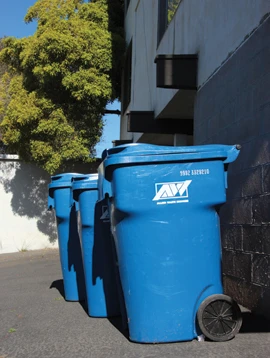
While a centralized container is convenient, most large complexes designate multiple collection stations. Providing a set of containers for each group of 15 to 19 households makes recycling more accessible and results in higher participation. Most communities use 90-gallon carts because they provide sufficient storage while taking up minimal space-leaving enough room to walk amongst them for sorting. They also allow accessible service by semiautomatic side loaders.
High-rise apartment buildings like the 187-unit Commodore Club in Key Biscayne, FL, often use a chute for trash and recyclables. At the Commodore Club, computer controls ensure that source-separated materials drop into the proper receptacle, allowing residents to dispense both trash and recyclables at a single location. At other high-rises, residents receive door-to-door pickup of recyclables, but must take trash to a chute that empties into a basement compactor.
Some MFD facilities provide curbside service, or its apartment equivalent. The Syracuse Housing Authority in Syracuse, NY, brought the convenience of curbside service to some of its public housing residents. Where space allows, residents receive door-to-door pickup of both trash and recyclables.
Case Study: Charlotte
Instead of curbside or door-to-door service, the City of Charlotte Solid Waste Services provides centrally located dumpsters for weekly garbage, recyclable and bulky item collection for its multifamily communities in Charlotte, NC.
Funded primarily through property taxes, since the 1990s the City of Charlotte Solid Waste Services has been providing curbside service for approximately 210,000 single-family homes and dumpster and compactor service via a private hauler for 110,000 multifamily units.
Multifamily properties with fewer than 30 units are serviced as part of the city’s curbside biweekly single-stream recycling program. Properties with 30 or more units that receive garbage collection from dumpsters or compactors are also eligible to receive weekly single-stream recycling collection from stations of rollout carts, explains Ellen Price.
The rollout cart stations were determined to be the best approach due to spatial issues at many properties. One to five 95- or 96-gallon rollouts are used at each station, which is conveniently located in the dumpster area. Price says that properties with a shorter walking distance between residences and recycling stations have better participation rates, although it averages about 5.3% for multifamily complexes with more than 29 units.
Participation is measured by the number of tons collected…and by customer satisfaction and complaint tracking, Price indicates. “Properties that recycle are satisfied,” she states. But the city of Charlotte isn’t. It hopes to increase the diversion rate and the number of complexes that recycle. Twenty per year is the self-imposed goal.
The program is currently voluntary, and expected to remain so. To encourage participation, the City of Charlotte Solid Waste Services reminds property managers that the service is provided at no additional cost. It provides educational brochures and signage in recycling areas. It also performs site visits and work with property managers about issues that arise.
While the city seeks input about the program from property managers, the choice of materials collected is based on an inter-local agreement with the county that owns the materials recycling facility and that are subsequently incorporated into the hauler’s contract.
Case Study: Los Angeles
The Bureau of Sanitation for the City of Los Angeles has been providing curbside recycling for over 4 million residents since the late 1980s, offering single and small multifamily customers recycling, greenwaste, and trash collection each week. “[The bureau] services over 745,000 customer locations each week,” states Karan Coca, division manager, Solid Resources Citywide Recycling Division. Of those locations, about 43,000 are multifamily complexes with more than four units. Permitted private waste haulers collect from the remaining 597,000 multifamily households.
In 2002, the city of Los Angeles adopted the permitting structure for private waste haulers and implemented the AB939 compliance fee. These fees were restricted for use to administer the program, but also to educate and implement waste diversion programs for the multifamily, commercial and industrial businesses in Los Angeles. These special purpose funds are used to support the multifamily recycling program.
“Since our permitted private haulers are currently not required to provide recycling services to their customers,” Coca says, “the bureau began developing pilot programs in 2004 to examine the types of service models that may work for large multifamily complexes.”
They looked at many of the models used by other municipalities. “Most other jurisdictions have exclusive hauler arrangements, where the level of service for recycling can be directed,” Coca explains. “With an open market for services in Los Angeles, we investigated options that could be implemented on a voluntary basis.”
After undergoing an extensive series of pilot programs to test the effectiveness of different recycling models, as well as testing the level of education needed to achieve steady participation and low contamination, the bureau found that a blue bin collection system, with educational reminders and oversight, would best mirror the existing recycling and education programs in both single-family households and in LAUSD schools.
Multifamily recycling is provided to all households that request service. Trash hauling from the complexes can still be provided by any permitted private hauler, but the bureau collects and delivers over 180,000 tons of blue bin recyclables to a network of recycling facilities throughout the city. These recycling facilities bid on the processing and marketing of city-collected recyclables.
Diversion rates vary, depending on the demographics of the population in different neighborhoods. Therefore, diversion rates are not used as a measure of the success of the program. Nevertheless, Coca says, “The implementation of this significant, citywide program has exceeded our expectations for a voluntary program.” More than 430,000 units are participating in weekly recycling collection services.
Other numbers indicate success, such as the amount of different materials the bureau collects, including many that other jurisdictions may find more difficult. For example, Los Angeles was the first city to add all film plastics, mixed plastics and expanded polystyrene (Styrofoam) in 2007. More recently, it included all cartons.
New areas are also being added. “The city’s commercial multifamily recycling program was expanded citywide after a request for proposals process, through contracts with three waste haulers serving different geographical areas of the city,” Coca says. Staff members are the direct contacts for service issues and customer requests, and monitor contractor requirements through field audits and complaint investigations.
Currently, the multifamily recycling program is voluntary. The bureau encourages participation through an extensive outreach program that includes large media buys, municipal bus advertisements and multilingual posters, flyers, and other information.
In November 2012, the Los Angeles City Council adopted a policy directing the bureau to move forward on a plan to begin the process of establishing exclusive franchise agreements for the multifamily and commercial sectors. It is anticipated that a transition period will begin in early 2017 after the execution of contracts and changes to the city ordinances. Under a franchise system, each exclusive hauler will provide recycling services to all multifamily households, instead of the current voluntary program.
The franchise system might help the city of Los Angeles achieve its goal of zero waste (90% waste diversion from landfill) by 2025. This goal led to the adoption of the RENEW LA plan, which encompasses the introduction of policies, implementation of new waste diversion programs, and infrastructure development, which includes development of alternatives to landfill disposal.
Latest from Waste Today
- Vecoplan to present modular solutions at IFAT 2026
- Terex Ecotec appoints Bradley Equipment as Texas distributor
- My Green Michigan expands depackaging capacity
- Washington selects Circular Action Alliance as PRO
- Ten-8 Industrial opens new central Florida service center
- Triumvirate Environmental acquires Environmental Waste Minimization
- Official NYC Bin availability expands ahead of deadline
- US Food Waste Pact’s 2025 Impact Report shows decrease in food waste