Dust can play a major role in impeding visibility and contributing to odor. While not a safety issue per se, it is a concern in indoor air quality and thus for employee health and comfort.
The waste industry has continually been in the top 10 rankings for dangerous professions by the US Centers for Disease Control for a number of years, with at least 25% of vehicle accidents attributed to the blind spot, according to PreView Radar Systems.
The company notes an increase in the number of pedestrian/truck collisions, “probably due to the ever-growing inattentive pedestrian and bicyclist who are more in tune with their smart phones than they are with their surroundings.”
To address that, PreView Radar Systems is a proximity awareness system developed to detect objects in the operator’s blind spot, notifying him or her of its presence. The system is used worldwide.
PreView WorkSight for Waste provides drivers with an active warning solution. The PreView Blind Spot Safety System’s patented pulsed radar sensors are designed to consistently detect objects 20 feet away and provide an active audible and visual warning through an in-cab display unit to give drivers the extra seconds needed to react and avoid a collision.
The company indicates that its customers report reductions of more than 75% in blind spot accidents as a result of installing PreView on their fleet.
Two radar sensors mounted in the rear detect objects in the operator’s blind spots. A display unit mounted in the cab actively alerts drivers to objects with an audible and visual notification. LEDs represent incremental ranging to objects in the blind spot. A cable system is designed to withstand rugged site conditions and extreme weather.
“Our system was built to handle the rugged conditions common with waste vehicles,” notes Teresa Prisbrey, the company’s marketing director. “Even with all the dirt and debris buildup, machine vibrations, and extreme temperatures, the driver gets a consistent and accurate detection alert.”
Prisbrey says her company has learned from end users that those working in solid waste trucks are doing so in neighborhoods, construction zones, and commercial areas where nobody is paying attention to them anymore. They listen to electronics through ear buds. They’re not listening to the backup alarm, or they don’t hear it anymore.
An overhead array of high-pressure nozzles provides mist to help reduce the atmospheric dust.
“Our zones are developed by machine types and work environment, so it’s not a one-size-fits-all. They come in different shapes and patterns in order to ensure that we hit the problem area without giving off alarms for things we don’t care about.
“The driver has been tasked with not only doing his job but maneuvering around a lot of people who are distracted walkers, bikers, and drivers,” she says. “They’ve literally stopped paying attention to what’s going on around them, and these people have never been behind a wheel of this large of a machine, so they really don’t know that they’re in danger at all. They just assume that the drivers can see them, and they can’t. Our technology was created for the sole purpose of giving the one person who has the ability to make a difference-the driver-the extra information he needs to prevent an accident.”
Global Sensor Systems offers an infrared sensor system that is energized off of the backup light relay on the transmission of a truck or a vehicle that is put into reverse.
There are three sensors across the back of the truck to ensure the entire back has coverage without any missed lines of sight. The sensors are set to cover 6 feet to the rear.
The system is activated by placing the gearshift lever in reverse. When an object is detected while backing up, the brakes are automatically applied, instantly activating a sonalert and a warning light on the driver’s control box.
The sounding of the sonalert and the warning light mounted on the driver’s control box are also activated in a vehicle without automatic braking.
Moving the gearshift to any other position will turn off the system.
“There’s no reason to stop the truck unnecessarily if it’s not about to collide with something, but if it is going to collide with something, we want to put the brakes on and stop it immediately,” says Ray Glenn, general manager of Global Sensor Systems.
The company’s active modulated system differs from other infrared technologies that are heat-sensing, such as is used in police, military, and motion-detecting situations, Glenn points out, adding that passive systems do not offer automatic braking.
“It doesn’t matter to our technology whether the object is hot or cold, moving or stationery,” he says. “When our sensor is energized, it emits an invisible infrared light that is reflected off any object that comes within the given area or the area that you have set up to protect. It doesn’t matter whether it’s a person, a car, a chain link fence or a building-if a person walks in behind it, it will slam the brakes on.”
Drivers can be “legitimately distracted,” notes Glenn.
“The driver can miss something and have a very serious backing accident, whereas our system is going to put the brakes on and cover that without any driver intervention to make sure he doesn’t have that accident,” Glenn says. “The performance is quite different in terms of not requiring any driver intervention to stop before he hits something.”
In situations where drivers must back up closer than 6 feet to an object and the truck is in reverse, the system picks that up and applies the brakes.
“The driver just needs to be absolutely sure that it’s safe to back closer than 6 feet,” Glenn notes, adding that there is an override switch on the control box enabling the driver to do so.
When the driver activates the override switch, he or she will get an intermittent audible warning from the sonalert on the control box in the cab that changes to a solid audible warning-in addition to light signals-if anything enters the protected area of 6 feet behind the vehicle.
What employees wear can make a difference in safety.
Reflective Apparel Factor manufactures high-visibility safety apparel, including such items as vests, T-shirt, polo shirts, jackets, sweatshirts, and hats. All apparel is ANSI-approved.
“The earliest adopters of ANSI-approved, high-visibility clothes were waste haulers,” points out Sally Boven, the company’s chief executive officer. “It wasn’t road construction or police officers or any of those other people you might think would have led the pack, but those who operated waste hauling operations who decided that their people were worth protecting and they put them into high visibility clothes and pre-dated the standards.”
It’s essential that employees wear high-visibility apparel from a liability standpoint, Boven points out.
“If they don’t have it, they’re playing with fire,” she says. “It is the standard that they need to be in high-visibility apparel, so if an employer doesn’t give this to their employees and anything were to happen, it’s a pretty enlightened group out there that would say my husband’s boss thought so little of him that he didn’t give him the $8 vest and because of that I’m widowed.”
Additionally, it’s a factor of morale, Boven says.
“The employees know they are being valued,” she says. “You aren’t quite as aware as you drive down the street if somebody has on safety glasses or hearing
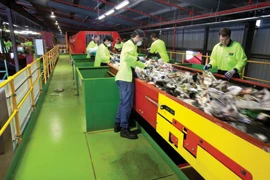
Lime green safety vests are often favored for their quality of relative brightness.
protection, but it’s so obvious, even to the outside observer, if the employee has not been provided high visibility gear. That gear is a very visible reminder that their employer cares enough about them that they don’t get run over.”
There are some in the solid waste industry who may say the standards are meant for traffic conditions to ensure employees are not hit by vehicles driving down the road at high speeds, Boven says.
But the apparel is equally important in enclosed situations, such as material recovery facilities, she adds.
“They may think, “˜I’m inside a building and now traffic is moving slowly or there is very little traffic,’ but an awful lot of “˜friendly fire’ accidents occur inside some closed spaces when somebody is backing a truck up and they can’t see the person,” Boven says. “It isn’t just for expressway and neighborhoods where traffic is driving past. It really is for closed quarters inside a recycling area where there is equipment moving and there are additional reasons to make sure people are seen there.”
There are two colors approved for use in the United States for safety apparel: orange and what Boven calls lime and others may call yellow or green.
While there used to be an even split on color preferences, Boven notes that the lime is being selected more often.
“The reason that lime has become more popular is that lime really is technically brighter,” says Boven. “If you measured it with equipment, you’d find that it has a brighter hue to it. If you’re a safety guy and you get to pick the one you want, usually you’ll pick the one that’s brighter.”
There also is the issue of color-blindness, she says, adding that the lime color is easier to detect than orange.
Fogco Systems offers a high-pressure
suppression system for dust and odor control.
Another issue is that roadway cones are orange and “people wearing orange from a distance can look like a cone and nobody seems to mind running over a cone,” Boven says. “So over time, people have started to move away from orange. It sort of represents an inanimate object.”
Boven says she takes issue with employers purchasing cheap safety apparel.
“There is a lot of competition, so it’s come down in price, which is great and with how dirty these guys get, it makes a lot of sense to go with an inexpensive, almost disposable kind of garment,” she says. “But there’s a big problem with noncompliant counterfeit gear. 3M did a study and bought things randomly at stores and sent them to labs and found one in three are counterfeit or noncompliant.”
Buffalo Turbine offers a product line of dust, odor and smoke control equipment for indoor and outdoor use.
The Buffalo Turbine Monsoon features a turbine-driven Gyratory Atomizing Nozzle in a misting system designed to immediately control and suppress dust, odor, and smoke in industrial or commercial applications where improved air quality, lower health risks, and environmental compliance is desired.
The Gyratory Atomizing Nozzle can mist water volumes from less than one gallon per minute up to 25 gallons per minute.
The Monsoon misting systems are available in electric, gas, power takeoff, and hydraulic models.
There are several safety benefits when utilizing a Buffalo Turbine Monsoon, notes Jody Smith, sales and customer service for Buffalo Turbine.
“The most obvious benefit to the product is an immediate mitigation of fugitive, airborne dust particulates,” says Smith. “Depending on ambient conditions, Buffalo
NCM’s odor and dust control services are
provided throughout North America.
Turbine Monsoon products are able to cover approximately 14,500 square feet. Another added benefit is an instant drop in ambient temperatures as a result of evaporative cooling. This will cool the machines as well as cool the employees nearby.”
Improved employee working conditions is another benefit, Smith notes.
“Not only will they be in a cooler environment, the employees will be breathing fewer particulates as a result of the dust suppression,” says Smith. “As a result of less dust in the air, the equipment’s air intake systems will take in less dust in turn, increasing the longevity of the vital components of the machines.”
NCM Odor Control manufactures products used to treat odors and dust, reduce ammonia in leachate, and reduce biochemical oxygen demand and chemical oxygen demand levels. Odor and dust control services are provided throughout North America.
The custom odor and dust control systems are manufactured in NCM Odor’s UL-certified plant, which is certified ISO 9001. The company’s chemists assist end users in creating site-specific approaches.
Jesse Levin, president of NCM Odor Control, says his company has teamed up with Fogco to bring the industry a turnkey portable odor control fan spray system, the Spraystream, adding that the NCM staff can team up with any misting system company to provide odor control products or service as needed.
The Spraystream “fog cannon” is designed to suppress dust and odor in most commercial and industrial applications. The system provides a column of air that exits the “cannon” at high velocity, traveling distances in excess of 150 feet.
A mister works to diffuse odors close to the source.
The dense spray of properly atomized water introduced into the air column creates the odor and dust suppression.
The product range includes pole- and wall-mounted units, portable cart units, and a self-contained trailer unit that includes a generator, a tank, and a pump.
The Spraystream products are available in a variety of voltages and different product features, including oscillation, variable frequency drives, and chemical injectors.
Fogco Systems offers a high-pressure suppression system engineered primarily for dust and odor control.
The system is composed of such components as a pump, high-pressure line, and fog line nozzles that are specially assembled for the facility and its layout.
“We will analyze the requirements and then assemble a system from there,” notes Dana Pack, national sales manager. “It’s all made specifically for whatever the project is.”
Fogco’s high-pressure system atomizes the water molecules to the same size particle as the dust molecule, attracting the dust in the air and knocking it out.
OMI’s Ecosorb system provides municipal solid waste operations with nonhazardous and nontoxic
odor control solutions, blending essential plant oils, food-grade surfactant, and water.
“At that point in time, the dust and the moisture fall to the ground, which keeps it a little more stable than airborne particulate matters throughout the plant,” Pack says.
There are a few benefits to the application, the primary one being dust suppression, Pack points out.
“Keeping the airborne dust out of the environment means it’s clear air, healthier air to breathe, and there are not as many concerns from a respiratory standpoint,” he says. “The other benefit is it minimizes the static of electricity within the air. When you have dust matter, it will spark combustible materials that are of concern. This will minimize that concern from a safety standpoint as well.”
The same technology can also be used for the odor suppression, Pack says.
“There are two benefits to the same system where you are suppressing the dust but also adding the neutralizers, which gives you the benefit of the odor suppression as well on top of that,” he adds.
All of which leads to employee morale.
“Working without the impact of odors or minimizing it has more of productive impact,” Pack says. “There’s an ROI to the company from a productive work standpoint. The other benefit is the concern of the neighbors in the community in that the odor suppression will keep those complaints to a minimum.”
Odotech’s website points out that odors account for 70% of environmental complaints.
“While odor can be foul, it is not hazardous,” says Marv Garellek, international sales manager for Odotech. “But some gases are, like H2S.”
Odotech is a Cleantech company that manufactures an electronic nose specializing in the measurement and monitoring of odors at wastewater treatment plants, composting sites, landfills, rendering plants and industrial odor producing plants. The company provides odor audit services, installation, and maintenance.
The system alerts operators when odors begin to reach threshold values, allowing a proactive response before an odor problem occurs. The system tracks and monitors odor, dust, H2S, ammonia, CO, MH3, and other gases in real time using electronic noses.
St. Croix Sensory is a testing and training company that receives odorous source air samples in gas sample bags from such industries as municipal solid waste and evaluates the odor strength, intensity, and descriptors.
The company also trains engineers and operators to monitor, inspect, and investigate odors from MSW facilities and other community facilities.
Of the products offered by St. Croix Sensory, the company’s Nasal Ranger is an olfactometer used to quantify the ambient odor strength on site and surrounding a facility. To see how the Nasal Ranger works, check out the St. Croix Sensory You Tube video clip from a History Channel Modern Marvels January 2012 STINK episode that includes MSW facilities: http://goo.gl/iyzUIN.
The Nasal Ranger Field Olfactometer measures Dilution-to-Threshold values of ambient odors associated with a facility.
The Odor Track’r odor inspection system database stores data and maps the odors for visual results for the benefit of stakeholders.
St. Croix Sensory’s Ac’scent Olfactometer is a laboratory olfactometer used for measurement of odor detection and recognition thresholds according to ASTM International and European CEN methods.
The Vac’scent Vacuum Chamber collects odorous air samples without the sample contacting pump components, the Emission Isolation Flux Chamber for collection of emissions samples off a solid or liquid surface, and the Passive Sampling Chamber for collection of emissions off of an aerated surface such as a biofilter.
Yann H. Contratto is an odor expert and CEO of Montreal-based Olfacto Expert, a new company in the odor market.
Some 30% of the company’s client base is in the solid waste market, where Contratto notes challenges not only from existing MSW facilities with respect to odor, but proposed projects that face public opposition over the potential for such a problem.
Existing plants are being targeted by a number of class action suits and other legal actions linked to odor annoyances, says Contratto.
Contratto and his colleagues have represented owners of many industrial and other odor-generating facilities in Europe and Canada at trials and class action suits regarding odors. Olfacto
Olfacto Expert has also worked in the establishment of odor regulations for municipalities.
“Odors are objective,” says Contratto. “It’s easy to measure the
Latest from Waste Today
- Vermeer announces plan to build new facility in Des Moines metro area
- Buffalo Biodiesel shares updates on Part 360 application to DEC, Tonawanda facility progress
- Capstar Disposal expands roll off dumpster rental services
- Supreme Court strikes down IEEPA tariffs
- Casella details facility closures, expansion efforts
- Zero harm: Building a SIF prevention program for waste and recycling operations
- Casella posts a loss in Q4 2025
- McNeilus names Haaker Equipment first Dealer Partner of the Year