Landfill Equipment and Maintenance
Landfill operations require their own fleet of equipment. At minimum, a landfill would require a front end loader, a medium-sized dozer, a steel wheel trash compactor, water spray trucks, a backhoe, scrapers, road graders, and utility vehicle–like pickup trucks and tool vans. A front end loader is useful for transporting small quantities of materials such as sand and gravel on an as-needed basis, and for small earthwork projects. The dozer is used to spread dirt cover and place waste on the working face. (Though it needs to be modified with a trash rack.) The steel wheel compactor (basically a modification of the standard soil compactor, but equipped with special cleats to compact and shred deposited waste) is used to reduce the volume and increase the density of the in-lace waste.
Equipment indirectly involved in the waste disposal operations can be equally important. Water spray trucks are used to minimize dust formation on areas of unvegetated soil cover and along vehicle operational roads. Backhoes perform small-scale excavation and runoff collection ditch maintenance. Sand road graders are use to smooth soil cover, remove ruts from dirt access roads, and perform general regrading. Site personnel use pickup trucks and other utility vehicles for personal transport across the site and for moving small equipment and tools.
The size and number of landfill equipment varies with the size of the landfill. Landfill size is determined by the amount of waste it receives as measured by tons per day. A small landfill receives less than 250 tons per day (tpd), a medium-sized one takes in 250–500 tpd, and a large landfill is any facility rated higher than 500 tpd. (Super-sized landfills operating at all times can receive more than 1,000 tpd.) Smaller landfills do not require much more than a medium-sized dozer (Cat D6 or equivalent), a small steel drum waste compactor (such as a Cat 816H), and one tracked front end loader with a multi-purpose bucket equipped with bolt-on adaptors and extended tips to manage large loads. Medium landfills should upgrade to a medium to heavy dozer (Cat D7 or heavier), heavier waste compactor (Cat 826H at least), and a larger front end loader (Cat 963D or better). For large landfill operations, not only does the size of the equipment increase, so does the amount of equipment (at least two medium to heavy dozers, two or more waste compactors, and a large track dozer). Some very large landfills using barge or rail transport to receive and offload waste may also utilize special equipment.
A much harsher working environment than the typical construction site, a landfill working face presents extreme wear and tear potential on its operating equipment. Excessive wear and tear is to be expected for equipment, engines, cooling systems, drive trains, undercarriages, compaction wheels, rubber-tired wheels, axles, and tractor treads. This equipment has often been specially modified from its original earth-working configuration for work on a landfill, and still an operator has to deal with potentially expensive repair headaches and maintenance needs.
Landfill dozers are modified with trash racks on their blades, and striker bars attached to the body. Pushing waste usually requires a modified semi-universal or universal blade with trash racks directly welded along the top of the blade. These are welded steel beams connected at right angles to the blade with cross beams added for structural support. The vertical bars and additional screens effectively double the height of the blade without obscuring operator’s visibility or significantly adding to its weight. This increase in volume capacity is important since waste is relatively low-density material, often consisting of large objects. The screen catches tumbling and blowing waste that could clog the radiator or damage the operator’s cab. Front and rear striker bars prevent waste from being carried over and into the tractor tread, clogging them and either reducing the dozers movements, or even stopping it all together. Operating on steep waste slopes can be made more efficient and safer by the addition of counterweights to provide improved balance.
Track loaders operating on the working face require similar upgrades. These are equipped with guard packages that protect vulnerable operating points such as idlers, pivot shafts, drive seals, and such. Pre cleaners provide protection to intakes and the carburetor from clogging. Radiators are modified to allow for quick cleaning of accumulated waste, paper, and dust. The loader bucket is larger than normal to manage low-density waste materials and the large objects it contains.
Compactors apply high pressure to the waste through a series of 20–40 cleats attached to the rolling drum in a staggered pattern that insured complete coverage. The actual contact area is greatly reduced by the small size of the cleats tips. These cleats differ from the cleats used by soil compactors. Their length is short, compared to soil cleats being only 6–6.5 inches long. Their shape is modified to resemble teeth that can chop through and shred the waste. Waste compaction results in accelerated war and tear, necessitating easy replacement.
Transfer Station Equipment and Maintenance
A transfer station is an enclosed structure encompassing a tipping floor, and including loading bays and access ramps where waste is offloaded by local waste collection trucks and loaded onto large waste transportation trucks. Once the waste is deposited on the tipping floor, a wheeled front end loader is used to push, lift, and load the waste to the next stage. The next stage usually involves compaction of the waste in preparation for transport—though some transfer stations perform waste separation and recycling like a material recovery facility (MRF). Compaction reduces the volume of the waste, which in turn reduces the number of truck trips needed for transport. Compaction occurs in a lower level of the tipping floor called the surge pit, also used for temporary storage of waste from peak flows. In the surge pit, heavy equipment operating in this confined space can be used to achieve compaction by pushing the waste up against a side wall.
Some transfer stations utilized hydraulic equipment to achieve waste compaction. These include hydraulic rams and pre-compactors. These are installed in one wall of the surge pit and apply high pressures as they push waste up against the opposite wall. Pre-compactors push waste into tubes that for high-density waste logs. These logs are then extruded into the bed of the transfer trailer for transport.
Waste an also be fed into a baler for compaction. Compaction and wrapping with wire mesh results in a high-density bale with a rectangular shape, dimensions varying in size from 3 to 8 feet. Like the logs, bales are mechanically lifted into place in the transfer trailer. In general, waste can be loaded directly into the top of the transfer truck, or into the rear in the form of compacted waste.
Maintenance at a transfer station is not as heavy a burden as on a landfill, but it requires attention to a wider variety of equipment and structures. The structures themselves, especially the walls of the surge pit where compaction occurs, are susceptible to damage from equipment impacts over time. This is in addition to the standard maintenance requirements all buildings face from electrical and plumbing, to HVAC, to foundational settlement to drainage. The hydraulic systems operating the compaction rams, pre-compactors, and balers will also need tending to in accordance with manufacturers requirements. Lastly, the heavy equipment operating within the confines of the transfer station (wheeled dozers and front end loaders) will also need regular maintenance—though this equipment is not always as heavily modified as waste management equipment operating on a landfill’s working face.
MRF Equipment and Maintenance
There are two types of MRFs: multi stream and single stream. Multi-stream MRFs receive waste that has already been largely sorted and separated at their source. Since these receive multiple streams of neatly separated waste, they are often referred to as “clean” MRFs, with the waste already mostly separated. This type needs relatively little in the way of complicated equipment, and thus has comparatively smaller maintenance needs.
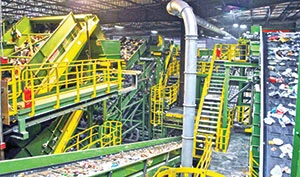
Single-stream MRFs are far more complex. They receive a single stream of messy, mixed waste loads that are often referred to as “dirty” MRFs. Like transfer stations, MRFs are enclosed buildings with tipping floors for receiving waste and loading bays for offloading separate recyclables unto transfer trucks for final delivery. They also rely heavily on complicated waste separation equipment to extract valuable recyclables from the mixed wastestream delivered to their doorstep.
This equipment operates sequentially, each extracting a different kind of material from the wastestream as it passes through the MRF on conveyor belts. The conveyor belts themselves are an integral part of the separation operation and are not just a means of moving waste from one stage in the process to another. Waste is loaded onto conveyor belts by front end loaders. There are many types of conveyor belts depending on the quantity and characteristics of the waste being processed (slider-belt, chain-driven, roller-type, steel-belt, or rubber-belt). The vibratory motion of the belts helps spread out the accumulated waste, making for easier observation and extraction.
The separation equipment is mostly modified mining equipment originally designed to separate slag from ore, but now repurposed and refined to extract particular materials. So, the number and type of separation equipment utilized can vary with the anticipated waste-stream. Magnetic separators are used to extract ferrous metals, while eddy current separators to do the same for non-ferrous metals. Large, lightweight objects, such as cardboard boxes, are removed by disc screens that create a wave motion, carrying these objects to the top of the wastestream. Small objects and particles of contamination are removed via rotating trommels—basically large canisters with perforations. Air classifiers and air knives are used to remove lightweight paper. Some MRFs use high-force jets of water to hydro pulp pare to turn it into feedstock for fuel producing anaerobic digesters. And color separators using visible light and infrared are used to separate various colors of glass and types of plastic.
The simplest extraction device is the magnetic separator. Using either fixed or electromagnets that are mounted either in an overhead position above the waste conveyor belt or below it, magnetic separators remove ferrous by means of magnetic attraction. In the overhead position, the magnets pull the metal out of the wastestream. When located under the conveyor belt, it allows the metal to stick to the belt while the rest of the wastestream falls off into a hopper.
Eddy current separators remove non-ferrous metals (like aluminum) by using rapidly rotating magnets to induce an electric current in the metal. This then creates a magnetic field of its own of the same polarity, which results in a repulsive force. This force causes the metal to literally jump off the conveyor belt and into an adjacent collection hopper.
Disc screens mechanically remove large and lightweight objects. These are large hoppers with a wide floor lined with discs. These discs come in different sizes and shapes (round, oval, star, etc.) depending on the type of motion to be induced in the waste mass entering the floor. As they rotate, hey churn and turn over the waste, not unlike clothes in a washing machine. This motion carries the large, light object to the top of the waste mass where they can be easily removed.
Small, heavy objects are removed by rotating trommels. These are perforated, rotating drums usually set at an angle. Waste enters near the top of the drum, cascading down inside. Removal is usually aided by the installation of vanes further deflecting larger waste objects. Small particles and contaminants fall through the perforations to be removed and disposed. This leaves a cleaned-up wastestream for further processing.
The bulk of any residential wastestream consists of various types of paper and newsprint. These can be extracted and even sorted to a large degree by air pressure. Air classifiers and air knives perform this function. Classifiers are large chimney stacks with a blower attachment installed at the top. The blower draws air up the stack. Waste is fed into the chimney at its midpoint, with heavier objects falling below as lightweight paper is pulled to the top. A second stage cyclone can then segregate paper grades according to size and density. Air knives are a more refined approach with blowers applying sheets of thin high-pressure airs streams (“blades”). While operating in parallel, these air flows allow for separation of objects with only slightly different densities.
Hydro-pulping is a take on the recycling mantra to create new products from old. In this case, the new product is energy. High-pressure streams of water crush and pulp paper and other organic materials (such as food and yard waste). This creates a wet organic pulp residue, which can be fed into anaerobic digesters produce methane.
Lastly, color separators utilize LSP meters to read the wavelengths of light reflected from the surfaces of glass and plastic waste. There are various colors of glass (clear, amber, green, cullet, etc.) and multiple types of commercially available plastic (PET, HDPE, PVC, etc.). A near infrared sensor can be used to measure the density of a plastic object, and thus distinguish between various types of plastic. Once a particular type of glass or plastic is detected, an air blower can blast the object into the appropriate storage hopper.
Maintenance at a MRF include the structural maintenance required by transfer stations, but with the additional burden of maintaining all of the mechanical, hydraulic, and electrical systems used by the separation equipment. Conveyor belts especially come in for a lot of abuse during MRF operations. A worn and frayed conveyor belt can result in the shutdown of the entire process. All moving parts require lubrication; all openings tend to clog; and all moving parts wear out over time.
The Importance of Maintenance
Each manufacturer has its own operating standards and specifications. These include standard maintenance schedules and requirements designed to minimize the need for repair. Repair and maintenance are two different things entirely. To put it simply: repair is bad, maintenance is good. Repair is unscheduled and happens unexpectedly, messing up schedules and causing concurrent unnecessary costs down the line. Maintenance is proactive and performed at regular, scheduled intervals so it won’t disrupt operations.
Repair costs money. Maintenance saves money, because, as the saying goes, “an ounce of prevention is worth more than a pound of cure.” There is nothing more “penny wise and pound foolish” than to neglect basic maintenance in order to reduce overhead costs, putting the entire operation at risk from a major repair incident or safety violation.
As Jarod McKay of the Hustler Conveyor Company notes, “Equipment inspection is not only the first step, but an ongoing element to any maintenance schedule. A system inspection should be routinely conducted following each operation cycle. It is at this time [that] potential disasters can be identified, such as rips, cuts, or deformities in belting, insufficient belt tracking and/or tension, and that all safety guards are securely in place. Additionally, it is important to train and promote these practices to operating employees. Remaining consistent with equipment inspection and communicating its importance will help eliminate minor issues from occurring and make sure minor issues do not escalate into catastrophic equipment breakdowns or serious injury. As inspection is being continually implemented, the mechanical requirements of the equipment need to be addressed. These needs can be meet by regularly lubricating and tightening necessary equipment components.”
Major Suppliers of Waste Management Equipment
Eriez provides service inspection and preventative maintenance services for a wide array of waste processing and recycling equipment: magnetic separators, metal detectors, eddy current separators, lifting magnets, magnetic coolant cleaners, magnetic belt conveyors, magnetic chip and parts conveyors, bin vibrators and vibratory feeders, conveyors, screeners, and classifiers. Eriez inspects their own and other manufacturer’s equipment. Offering this service makes good business sense.
“By checking equipment on a routine basis, our team can identify customers’ equipment issues and take corrective action before problems lead to machine downtime and lost productivity and profits,” says Dave Hansen, Eriez’s Manager of Service and Repairs. He adds, “Inspection/preventive maintenance services are an essential component in a well-designed program to maintain quality objectives and goals.”
In addition to standard maintenance, the Eriez program includes equipment rebuilds, onsite field service, lift magnet certification, a magnet exchange program, and more. This work can be done with the same warranties and benefits, whether it is performed in the field, or at the service center in Erie, PA. Their service goes beyond repair, to a commitment to internal plant safety.
“We’re big on safety, and this is in a business where we have a lot of hazards,” says CEO Tim Shuttleworth. “For this reason, we have integrated safety into every operating aspect of our day-to-day operations.”
As such, they have developed a comprehensive safety program with measureable results. This program has been used to counter the inherent risks associated with magnetic and eddy current separators (entrapment, crushing, dropped loads, and electric shock).
“The magnets we deal with are so large and so strong that if the proper precautions aren’t taken, an accident can happen in the blink of an eye,” says Tina Swanson, safety leader for Eriez.
The company didn’t develop its comprehensive safety programs overnight. In fact, the safety policies Eriez has in place today took close to 25 years to implement and improve. Another of Eriez’s policies is to reassess potential risks by conducting routine Hazard Assessments. The outcome of these assessments is used to update safety policies. As a result, for all of 2009, 2010, and 2011, the headquarters facility recorded zero lost time from work accidents.
Rebuilding equipment remains a unique feature of the Eriez maintenance program. These services are available for magnetic separation, vibratory feeders, eddy current separators, suspended electromagnets, and magnetic drum separators. After tracking the performance and service life of the potential rebuild equipment to determine optimum operating efficiency and product longevity, comparisons will be made between the costs of rebuilding versus the cost of new equipment. The additions of new technology to the rebuilt equipment will also be considered. If warranty considerations, budget, and schedule are favorable, rebuilding may be the preferred choice. Eriez provides a standard chart (Table 1) showing a financial comparison between the two choices.
Hustler Conveyor Company (HCC) designs, engineers, manufactures, and supplies heavy-duty equipment for many applications, a variety of which are single-stream, municipal solid waste, construction and demolition, and commercial and industrial systems. Not just a manufacturer, HCC also spearheads design and coordination of fully operational turnkey systems. Solid waste processing facilities in the US and overseas include such Hustler equipment as roller chain and steel belt in feed conveyors, trommel screens, OCC screens, paper screens, flat belt sliders and idlers for sorting and transferring material, and fully integrated platforms and support structures. But, these machines themselves are not alone in providing these services. Even properly engineered equipment needs to be synchronized with a routine preventative maintenance schedule.
There are many moving parts throughout any system, which require lubrication. Hustler Conveyor provides automatic oilers to lubricate steel and roller chain belting continuously throughout operation and may require regular reservoir refills. Less frequently lubricated, but no less important, components are drive chains, bearings, motors, reducers, idlers, and such. As machine lubrication is being attended to, operators can check areas of equipment that may get loose over many hours of constant motion and vibration. Seeing that all chains, pulleys, bolts, and screws are adequately tightened will help the machine have stable run time throughout the life of the conveyor.
How is an operator supposed to know exactly when to perform these necessary tasks? All component lubrication and tightening intervals for Hustler equipment are included in the maintenance schedule provided in all operation and maintenance manuals with each piece of equipment manufactured by Hustler. Proper lubrication and tightening of all needed components will help a system run safely and smoothly for as long as possible. With longevity comes increased efficiency with less downtime, less costly major repairs, safer work conditions with less injuries, and potential reduced labor costs.
Along the same lines of mechanical needs addressed with lubrication and tightening, the laboring task of cleaning may prove to be one of the most important aspects of a preventative maintenance schedule to provide optimal conditions in terms of equipment performance, longevity, and safety. Recommended cleaning intervals, also in Hustler maintenance and operation manuals, occur slightly more frequently than other preventative maintenance practices and lay the foundation for all previously mention duties. Material buildup can create obstructions that may allow important inspection%
Latest from Waste Today
- Vermeer announces plan to build new facility in Des Moines metro area
- Buffalo Biodiesel shares updates on Part 360 application to DEC, Tonawanda facility progress
- Capstar Disposal expands roll off dumpster rental services
- Supreme Court strikes down IEEPA tariffs
- Casella details facility closures, expansion efforts
- Zero harm: Building a SIF prevention program for waste and recycling operations
- Casella posts a loss in Q4 2025
- McNeilus names Haaker Equipment first Dealer Partner of the Year