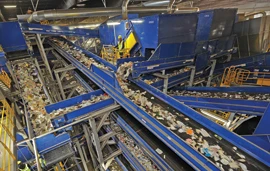
Our collection world now includes an assortment of concepts: multisort recyclables, commonly referred to as source-separated recyclables, single-stream recyclables, greenwastes, wet wastes, dry wastes, and garbage-or, basically, everything in one can. Likewise, moving through that same list typically calls for more complicated and expensive MRF equipment. Each system also has its true believers. But the truth about which is the best and where we are ultimately headed may be as elusive as finding a golden needle amid the plastic beverage containers.
There are environmental costs for frequent transportation and waste type pickups along with extra labor involved, issues involved with enthusiasm and education regarding programs on the customer side, and loss of revenue from wastes that aren’t captured, no matter how much they should be. Here we’ll explore the questions of whether there are there clear-cut indicators as to where we’re headed, or even if there are enough good reasons for each of the above approaches to continue. In the end, the answer may not be exactly what we expected.
Does the Big Picture Point to the Future?
Waste generation rates are something that is going to be scrutinized as time goes by. Steve Viny, chief executive officer of Envision Waste Services LLC, was asked to speak at the senior executive session of SWANA in 2013 on the decline in waste generation rates, the so-called “disappearing ton.”
Instead of lecturing, Viny broke the audience down into five groups of 10 or 12 people and asked them several questions. He presented them with a graph of waste generation from 1935 until 2008. It is a steady incline every single year.
But in 2007 it drops abruptly. Viny asked those in attendance to fill in the next 10 years, asking them to tell him where the waste generation rates would be going and why. Seventy senior executives from all around the country all came back with the answer that waste generation rates would continue to decline before leveling off completely.
“There are a lot of things that go into why waste generation rates are going to decline,” explains Viny. “But a lot of them are coming right out of the recycling bin. We get more electronic media replacing the old print and paper media in this area than we ever had before, and this is just the beginning.
“Many forms of media now have far more electronic versions than simply paper, as in the past. Ten years ago that wasn’t even an option. The Plain Dealer recently went to three days of print with the rest of the days of the week being online. … That’s a half step to saying, “˜we’re going to 100% online. But we’re going to let you hang on to a print copy for a little while.'”
Viny brings up the point that newspapers from USA Today to The Wall Street Journal are all available online as are virtually every trade publication. The United States Post Office has lost millions in business and revenues because people no longer send letters, they send e-mails and texts. All these factors indicate that the amount of paper in the rubbish bins is going down, or that there may not even be any in these bins because it’s all in the recycling bin.
Banks are also going to electronic statements and will even ask you specifically if you would like an e-mailed receipt instead of a paper one. “When I first started in recycling, there were 25 aluminum cans to the pound; now it’s 32,” Viny says. “Ways have been found to make thinner, smarter packaging and getting strength from better engineering when it comes to can wall thickness.
“HTPE drink bottles are now far thinner than years ago. Packaging has gotten much better and lighter, and the same is true for virtually every commodity needing packaging. The bottom line is that you must go and look at the cost of collection for waste materials. In the midst of all of these packaging changes, the cost of fringe benefits for employees has outpaced inflation. The cost of a hospital stay has increased much higher than the CPI (consumer price index) every single year, the cost of fuel has risen faster than the rate of inflation, as have vehicles and labor to operate the machinery or do the work.”
The bottom line is that everything costs more, but there is less total weight to pick up because containers are being made lighter and lighter as time goes by. In sum, you have a dollar chasing a dime at the moment, according to Viny.
MRFs started out with five or six bin trucks coming to a house. Newspaper would be separated and put in one bin, aluminum cans would be in another bin, steel in another, and glass in another. A MRF was nothing more than a pre-engineered building with a baler for baling these separate commodities. The next generation included the placing of like commodities together. Magnets were used to separate steel, and other methods were used to separate glass or aluminum. Paper would be separated on a belt.
After the two-bin system, the next iteration was the one-bin system, which was basically the advent of the star screen, allowing rigid objects to be separated from such nonrigid items as fiber, paper, or cardboard. Eventually, the single-stream MRF came about, followed by the single-stream MRF with near infrared, which is used to separate paper and plastics.
In the area of eddy-current separation technology, MRFs have gotten wider and slightly better now, according to Viny, but they haven’t changed much. “Infrared equipment has also already become wider and less expensive,” says Viny. “But the reality is that the mechanical advances for single stream are just not going to make a lot of difference anymore, because systems are so advanced now.
“The limiting factor is the amount of material, the cost to get it to the MRF, and the ability of people to separate out large percentages of materials that need to go to the MRF. You could have all the recycling materials in the world, but if your setout rate is only 50% then that’s all you’ve got. The other half of the material goes to the landfill. Americans typically have a poor set-out rate when compared to Europeans, and that’s just not going to change.”
Viny feels the cost of getting materials to a single-stream MRF have never been higher and it’s going to get higher yet. Paper is the single largest commodity, and it’s diminishing. Aluminum is the “gold” in the recycling system, but people are only drinking so much soda. “If you end up with 32 cans to the pound instead of 25, you’re still going to have the same number of cans; they’re just going to weigh less.”
The point is that the economics for single-stream recycling will deteriorate, according to Viny. If we were to graph the business cycle of single-stream recycling right now, we are at the peak of the parabola, and the economics are going to start to diminish. Single stream may eventually simply get taken over by mixed-waste processing. Technology now to separate out recyclables from raw trash has never been better, and there are a lot of things that will continue to make that better.
“We’ve been doing this for 20 years,” says Viny. “In the 20 years we’ve been operating mixed-waste processing plants, we’ve never had a load of recyclables rejected. [We] get the highest index price for our materials, and anyone that says the quality of materials is better from a single-stream MRF than from a dirty MRF, they obviously don’t have any experience, because that is 100% false.”
It is strictly the cost of the collection, which makes such a difference. If a house is visited repeatedly for such additional items as recyclables, yardwaste, foodwaste, or trash, the most expensive part of the waste infrastructure-transportation-is being quadrupled. If it could be done all in one shot, a real difference in cost can be made. The cost of a landfill is a fixed cost, for the most part.
As rubbish volumes decline, landfills have no choice but to raise their prices. As that happens, mixed-waste processing becomes more attractive. “You have a whole bunch of factors, and it’s setting up for a perfect storm. Anaerobic digesters are allowing organic wastes to be used to obtain gases for fuel, and grease is being turned into biodiesel fuel. Obscure sectors are now getting some legs.
“With mixed-waste processing, more and more material is extracted for value, meaning even less is going to the landfill. All of these factors add up eventually. There is targeted revenue that has to be met, and if you are unable to get the volume, you must raise the price at the landfill.
“If collections were all done with one haul, the savings would be vast. You don’t have to be a genius to realize there is an economic driver. It’s only a matter of time before this is the norm. Look at the city of Houston. They presently have an RFQ [request for qualifications] out in order to set up a single-haul system.”
Closing the Loop
A number of MRFs around the country are now recovering such organics as foodwaste, which in turn can be used in anaerobic digestion to create biogas. That fuel, in turn, is able to fuel the fleet that picks up the waste materials. Among these are Newby Island MRF in San Jose, CA-which already has such a system in place-and Montgomery, AL, which is working toward that goal.
Peter Raschio, of Bulk Handling Systems, wonders if people may want to seriously consider the benefits to society offered by having all the garbage in one can. Operators may recover 90% of available recyclables (there is always a tradeoff, you could collect them all with enough equipment). In multisort and single-stream systems, operators may recover 99% of recyclables. However, if participation in the area is low, there is a tradeoff. Single-stream recycling therefore works better in areas with high participation rates, such as San Francisco, and not as well in areas with lower participation rates.
Keeping Everything in Perspective
Hans Ouellet, vice president and sales engineer with CP Manufacturing, worked for Machinex for 20 years and also worked in gold mining operations. He works now providing engineered solutions in the MRF setting.
“Some people have a little different perspective. Say, if they are an operator, they are looking at their individual system and might not understand all of the other options out there,” explains Ouellet. “They are only having a look at the one option right before them. But there is a wide variety of options out there. It might help to use the analogy of the car industry. With that industry, things are ever changing and moving forward step by step. Likewise, in the area of waste-handling issues, I don’t see that there is a magical solution to problems.
Operators might want to try something out in the waste-handling world and make sure it is valid for, say, five years. At that point, one might want to add options and make changes as the operation moves toward 10 years, according to Ouellet. Then the company might want to upgrade the equipment.
“I know that many newspapers are going to online editions, cutting out the need for dealing with or recycling newsprint,” he says. “But new magazines in print form are also continually appearing, and materials ordered online now require packaging for delivery. All that material must be discarded too.”
Ouellet sees the situation more as a shift than a major change. Waste from online ordering may feature different types of materials to be thrown out, but volume may still be the same. His operation can process wet, dry, single-stream, mixed-stream, demolition waste, or flat waste. The company can custom-design a system where something needs to be sorted, separated, or extracted in order to make money from that item by selling that on the market.
“We are trying to make things as convenient as possible. From all the organics, including even paper, ethanol can be created, which can be mixed with fuel.”
Ouellet points out a recent project called INEOS, which is creating ethanol from cellulose. The plant, located in Vero Beach, FL, only consumes 6.8 million gallons of gasoline each year. Vero Beach doesn’t have an incinerator to generate power.
In July 2013, INEOS announced that it would be producing the nation’s first commercial volumes of cellulosic ethanol from its Vero Beach operation. Made from woodwaste, this clean-burning, environmentally friendly fuel is proof positive that the RFS is working. INEOS contends that the operation will diminish dependence on foreign oil, diversifying the fuel supply as well as reducing carbon emissions.
Keeping Dry and Wet Separate
For the most part, the US has adopted single-stream recycling, unlike Europe, which mainly uses the source-separated recycling system. “What a lot of areas with a very developed single-stream program are discovering is that the participation level is limited to as low as 30%, so there is still quite a bit of recyclables still in the garbage,” explains Brian Stellate, director of business development with Van Dyk Recycling Solutions.
“A place may have a multimillion dollar single-stream plant but also consider needing an MSW or garbage plant to increase their recyclables. MRF costs, in turn, may go up because you’ll need a clean one and a dirty one.”
The model involving wet waste (including greenwatse) and dry waste is big in California, according to Schellati. This lends itself to anaerobic digesting and composting of the wet organics. The dry waste, in turn, is somewhat similar to what a single recyclables would look like.
“That’s a pretty good model, actually. I see some potential with that. With everything together in one bin, collection costs are lowest, and some places in Ohio and Houston, TX, are considering this. Some of these are places that haven’t gone to single stream yet and are looking for an alternative.
“They know that sorting technology for MRFs has increased over the last 10 years, and the thinking is that it’s possible to do sorting of recyclables when everything is just combined together. Some single-stream MRFs are very different and lower performing than others. We typically have only 5% to 8% residue from our single-stream plants, whereas other plants might have 15% to 30% residue.”
A lot depends on what is getting put into a plant in a certain area, according to Schellati. If an area has a very poor education of the single-stream process, then what ends up happening is they put garbage or other waste into the single-stream, increasing the residue that’s not recoverable at the single-stream plant.
“When you roll the single-stream program out into the community, it’s positive, but you’re still not going to get everyone to fully understand it. Putting all the potential recyclables into that bin, no place that has seen that works perfectly. There may always be a need for something else. Whether that’s a dirty MRF, I am not sure, but getting the recycle rates higher seems to be what’s needed. “I think in the future, success will come with a combination of programs like single-stream recycling in some areas and green/wet waste and dry waste recycling in others. In areas where single-stream has a good foundation, I don’t think they’re going to pull away from that. Typically, a dirty MRF can be doing two things: producing recyclables or producing some type of fuel or feedstock for a waste-to-energy conversion technology.”
Dirty MRFs have come a long way over the years, according to Schellati. But the wet-waste-dry-waste-separated option is most appealing to Schellati, even though there are still two pickups, especially since the benefit of not having recyclables contaminated is present. All of the potential recyclables are in one bucket, all on the dry side.
“There are a lot of waste conversion projects trying to get technologies like anaerobic digestion and gasification to a commercial scale. If any of those really takes off, that will have a big impact. Things are moving in the direction of MSW/garbage processing. That’s the vast majority of the projects we are working on. But they are just developing slowly due to many factors, so it’s just not happening yet on a vast scale.”
Latest from Waste Today
- Worn Again Technologies unveils Accelerator plant to advance polycotton recycling
- Nashville Waste Services launches new digital route system
- ACUA landfill expansion project unanimously approved
- Clean Energy announces multiple RNG deals with fleets nationwide
- Interchange 360 to operate alternative collection program under Washington’s RRA
- Waste Pro files brief supporting pause of FMCSA CDL eligibility rule
- New Way Trucks expands US network with Joe Johnson Equipment
- Tire Industry Project publishes end-of-life tire management guide