Increasingly, many solid waste agencies are faced with the “triple whammy” of declining waste quantities, increasing labor, fuel, and equipment expenses, along with lack of a political and public appetite for increasing tipping or user fees. What is any sane solid waste or public works director do in this case? The answer in a nutshell is to undertake a cost of service or rate analysis to gauge the short-term financial situation of his or her agency as well as determining the long-term financial consequences of things like landfill expansions, purchases of new and potentially different collection equipment, and such changes in recycling programs as single-stream and organics collection. One could argue that most agencies should develop a modeling tool to help assess their financial health on an annual basis, typically as part of a budget making process. This is no different than a patient going to an internist for an annual physical. A recent case study of a cost of service analysis points out the potential benefits.
Cost of Service Study
Charlotte County, which is located in southwestern Florida, was one of the first communities in the state to implement a non-ad valorem, special assessment to fund solid waste management operations. Over the past 30 years, this program has expanded well beyond solid waste disposal by inclusion of solid waste collection and recycling services within the overall customer special assessment. Not unlike other communities statewide, Charlotte has been faced in recent years with responding to issues of reduced waste tonnages to its landfill and greatly reduced operational budgets.
In light of these issues, an extensive capital improvements plan, and a possible change in franchise collection operations within the next five years, county managers wanted a fresh look at the department’s cost of service to help analyze long-term financial health. A final report was submitted to Charlotte County in July 2013 as part of the overall county budget process. SCS Engineers was engaged by the county to provide technical and consulting assistance in analyzing the county’s solid waste financial health and to develop analytical tools to conduct a cost of service study.
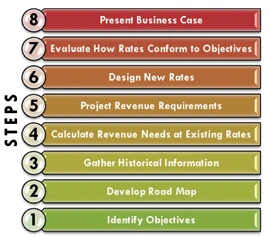
Briefly, the overall objective of a cost of service and rate study design study is to determine the solid waste fees and assessments required to adequately recover the costs of providing those services to the customers. Based on its solid waste industry experience, SCS worked with county through a series of eight critical tasks (Figure 1) that provided a foundation for the conduct of the study.
Cost of Solid Waste Service Planning Steps
Using both historical and current department budget information from its six cost centers (Figure 2), a pro forma financial model was developed, which enabled development of projections of revenue needs of solid waste collection, recycling, and disposal for the upcoming planning period (FY 2014-2018) as well as to model different possible rate structures.
Each year, the county’s solid waste division prepares an annual budget of revenues and expenses for the next fiscal year (September 30) adopted by the board of county commissioners at least two months prior to the end of the fiscal year. The system has a five-year capital improvement plan, which identifies equipment replacement needs and cost estimates. This plan helps ensure funding needs are identified, and that there will be sufficient funds available to accomplish the division goals.
The division has developed a routine replacement program for critical operating equipment-compactors, dozers, earthmovers, and excavators-through the capital improvements plan. This helps ensure relativity new and reliable equipment is available and also helps keep downtime and repair costs to a minimum.
Approximately 84,000 residential units within unincorporated Charlotte County are currently assessed $148.04 annually as a non-ad valorem fee for solid waste services. This includes $109.80 for the franchise curbside collection services; $32.80 goes to the department to operate the landfill, provide recycling, diversion, and household hazardous waste programs, the Keep Charlotte Beautiful program, the Illegal Dumping Task Force Program, and to operate two mini-transfer and recycling facilities. The remaining portion, $5.44, represents administrative costs associated with tax collection and mailing notices.
The division funds from its operating revenue the annual scheduled closure cost amount, based on engineering cost estimates. These estimates are updated annually based on landfill life estimates performed by an engineering consultant and the county’s finance department, which are then submitted as certifications to the state pursuant to landfill financial responsibility requirements. These certifications represent the financial liabilities for closing and long-term care of the landfill. Pursuant to state regulations, the county submits an annual cost estimate for landfill closure and 30-year, post-closure care expenses. These costs are adjusted annually by SCS to account for inflation and are represented on the division’s annual budget for the landfill as an annual expenditure accrual. Reserves also include future capital improvement funds, equipment replacement funds, and operating contingency fund with a total of approximately $10 million dollars.
Revenue Requirement by Cost Center
In accordance with Florida state law, the solid waste assessment rate developed in this study would be assessed as a non-ad valorem special assessment for solid waste within the Charlotte Sanitation Unit. Therefore, the customer classes included in this rate analysis include the unincorporated county and three adjacent barrier islands.
Rate Study Methodology
The following methodology was used by SCS and the county to conduct the cost of service analysis.
Collect historical actual expenses and revenues for the county system-The first task was to gather available historical actual revenue and cost data and include these into a financial database.
Development of the test year-The second task was the development of an annual revenue requirement for a “test year.” The revenue requirement represents the total revenue for the system to recover during a year to fund all system costs. SCS worked with county staff to select a period that reflected a typical year for the system. Actual expenses for FY 11/12 and 12/13 were used as the basis of the test year for the Study. SCS then worked with county staff to make these costs more representative of anticipated conditions during the upcoming five-year financial planning horizon. The resulting test year was used as the basis for forecasting expenses for the five-year forecast (FY 13/14 to FY 17/18).
Development of a revenue requirement projection-After developing the revenue requirement for the test year, SCS worked with county staff to project changes in anticipated costs due to inflation, labor increases, facility and vehicle maintenance, planning costs, etc. This resulted in a five-year revenue requirement forecast for the entire system, including collection, recycling, and disposal of solid waste.
Revenue offsets-SCS worked with county staff to develop estimates of the sales of recyclables delivered to two customer convenience centers.
Allocation of solid waste system costs-SCS then worked with county staff to assign costs to the various cost centers, as noted in the paragraphs above.
Determination of the delivered landfill tonnage-SCS worked with the county to identify the appropriate allocation of the solid waste tonnage delivered to the landfill from the different customer classes (i.e., sanitation district, commercial customers, public utilities, etc.).
Determination of the number of assessment units-SCS worked with county staff to develop reasonable estimates of future number of parcels in the sanitation district over the next five-year period.
Calculation of the system tipping fee-SCS then distributed the costs of each customer class across the proper billing units to estimate the cost of service for each customer class.
Rate Recommendations
Three different options were developed for consideration by the board of county commissioners.
Option 1, the no change option-This option assumes that the estimated deficits in anticipated revenues would be met by using existing available funds in the Department’s reserves.
Option 2, the full recovery option-This option assumes a full recovery of estimated landfill revenue needs.
Option 3, the CPI adjustment option-This option assumes that an annual estimated 2% CPI adjustment would be made in the landfill tipping fee for a partial recovery of the estimated landfill revenue needs.
In discussions with the county, it was believed that the department’s adequate fund reserves at this time could be utilized over the next three years to cover any potential shortfalls in landfill tipping fee revenues and solid waste collection assessments. The current contract with the county’s franchise hauler includes a provision for stable collection and recycling rates during this time period. The pro forma model will be used by the county to estimate potential escalation costs when the county enters into contract renegotiation in three years.
Figure 3 and Figure 4 graphically illustrate a comparison of the proposed assessment and tipping fee rates with those of neighboring communities.
Latest from Waste Today
- Vecoplan to present modular solutions at IFAT 2026
- Terex Ecotec appoints Bradley Equipment as Texas distributor
- My Green Michigan expands depackaging capacity
- Washington selects Circular Action Alliance as PRO
- Ten-8 Industrial opens new central Florida service center
- Triumvirate Environmental acquires Environmental Waste Minimization
- Official NYC Bin availability expands ahead of deadline
- US Food Waste Pact’s 2025 Impact Report shows decrease in food waste