It’s a well-known fact that trash trucks operate in one of the dirtiest, most severe environments. Because of this, keeping up-to-date on routine and preventative maintenance is even more important than in other industries. One day of unscheduled downtime is worth $780–$1,000, estimates Michael Thompson, inside service manager, Autocar LLC—and that doesn’t even include parts and labor; he’s calculating just lost productivity.
It starts with the simplest of things: cleanliness. “Refuse trucks get all kinds of stuff on them,” says Thompson. It’s important to keep them clean, which both helps to avoid corrosion and makes it easier to see issues. Some fleets run the trucks through the wash bay weekly, he says.
Autocar tries to keep it simple, offering manuals online so they don’t get lost, torn, or dirty. They also created levels of preventive maintenance. The first comes at 150 hours and is known as “APM.” It covers brakes, the air intake piping, and connection, transmission mounts, and powertrain mounts (to check for cracks).
BPM is up next at 300 hours. It includes the fuel filter, air filter, receiver dryer and A/C system (a pressure test for refrigerant loss), fan belt, and fan clutch (checking for loose bearings).
At 1,200 hours, the CPM adds checking wheel bearings, wheel alignment, and steer axle springs. “You want to look at U-bolt torque and adjust the steering stops if needed,” says Thompson.
The DPM is performed annually or at 2,400 hours. It covers the power steering filter and power steering fluid, which should be drained and replaced to increase life.
It’s important to follow the manufacturer’s recommendations for PMs, Thompson notes. “There’s no way to extend them.” Failure to perform PMs on time can cause downtime due to catastrophic failure. To encourage service managers to stick to the recommended routine, Autocar uses a modular system, which Thompson says makes it easier to access the filter. Recyclable filters help reduce operating costs.
PMs for after-treatment are different. “We used [a diesel particulate filter] in 2010,” recalls Thompson. The DPF is a device designed to remove diesel particulate matter or soot from the exhaust gas of a diesel engine. Later, diesel exhaust fluid systems had filters that needed to be replaced. “There’s DEF with SCR and DPF in a single device to save weight.” The selective catalytic reduction is an advanced active emissions control technology system that injects a urea-based diesel exhaust fluid through a special catalytic converter into the exhaust stream of a diesel engine to reduce NOx emissions.
Tech Talk
CNG engines require different maintenance than diesel engines. “You must understand the requirements,” cautions Thompson. They have spark plugs and ignition coils, which should be serviced at 18 months or 15,000 hours. “You should test the ignition coil and replace the plugs.” You also must use a different engine oil for natural gas.
To keep track of varying maintenance requirements on a mixed fleet, Autocar’s maintenance software helps fleet managers to be more efficient. “It provides accurate documentation and is easy to share information with customers,” says Thompson. Maintenance records used to be tracked on paper, but Autocar is digitally tracking them now. Onboard diagnostic features “see” faults without additional software. “It’s easy to obtain information.”
Technology on solid waste trucks is here today, says Al Michaud, national sales manager, Loadmaster—and it’s evolving quickly. “Thanks to digital CAN Bus technology adopted from the automotive industry, we can now monitor rolling stock while en route.”
Engine control management systems are reporting data that can be transmitted remotely, using telematics systems. Fault codes can report an impending failure before it happens, and even identify the appropriate replacement part, which it can be arranged to have shipped even before the truck is off the road. “Add to that the ability to remotely track compactor body diagnostics, and we have built a system that can be used to preemptively manage fleet maintenance,” continues Michaud.
Loadmaster also utilizes the advances in technology in its designs. Their Eclipse product, a premier Automated Side Loader, incorporates the Parker IQAN System that allows the bodies to not only communicate with safety features of the body but also to monitor the performance of the body functions, detect abnormalities, and notify the operator. “Loadmaster was very particular in the use of technology,” says Michaud. “We wanted to provide easy troubleshooting and maintenance issue detection, but also keep the system simple.”
A chain adjustment on a New Way Sidewinder automated side loader arm is a minor adjustment. A quick arm adjustment every month will provide many years of trouble-free service, but what if the truck could tell you when to make it? “That’s where we are today with digital technology,” says Don Ross, vice president of sales and marketing for The McLaughlin Family Companies, the parent company of New Way Trucks and KPAC compactors.
But digital technology in a fleet department can be daunting and can sometimes create other issues, depending on the technical skills of the staff. Ross says New Way customers prefer a “less is more” approach. “These folks prefer a simpler approach to collection vehicles. This is the reason we continue to manufacture our basic air system-based Sidewinders and Mammoth front loaders.” He says they provide their customers with what they want and what works best in their environment.
Must-Do
No matter how technical the systems become or how well they track usage, it still pays to be cognizant of some items that need attention but may be overlooked. Fastener torque is often forgotten, Thompson notes. “In a severe environment, bolts and nuts, such as those on the suspension powertrain mounts, can come loose. If you fail to maintain proper torque, it can have a catastrophic failure.” However, he points out, you can’t see torque until a bolt comes loose. Therefore, he says it’s a PM directive to check torque.
Engine oil, transmission oil, and gear lube all require changing at specific intervals. An oil life monitor features an indicator, but, Thompson says, you have to track engine oil by mileage.
As the first refuse manufacturer to install Cummins engines, Autocar has been able to extend the service life on engine oil from 500 to 1,000 hours thanks to more efficient circulation. “We’re taking orders,” says Thompson. The X12 has many advantages, he indicates, such as additional payload and more efficiency, which can save $11,000 in fuel costs over its lifetime and reduce the amount of DEF used.
Since all moving components need greasing, it’s important to monitor chassis lubrication. It’s also critical to check engine mounts for debris and oil leaks because they can deteriorate the material.
The list of “must-do” items to keep fleets running starts with basic blocking and tackling skills, according to Ross. “When making collection vehicle purchases, start with consistent vehicle specifications to reach a level of standardization.” By choosing a standard chassis and body, technician training requirements will be streamlined, existing suppliers of goods and services can be leveraged, and operators will work in familiar surroundings, which leads to higher productivity.
Next, Ross continues, strong operator pre- and post-trip inspection procedures should be second nature. “Vehicle feedback is critical for safe and productive collection operations and provides a critical platform for operations and fleet maintenance to interact and communicate. One department cannot operate without the other. Strong communication channels will [reduce] equipment downtime and enhance service to the customer.”
Bodywork
Loadmaster, a leading manufacturer of refuse bodies, located in the Upper Peninsula of Michigan where winter weather conditions are extreme, is the sister company to Great American Disposal, which serves refuse and recycling hauling needs. Many of their routes are rural, which means that unexpected downtime due to insufficient maintenance is very costly. It’s why Michaud says they design refuse and recycling bodies with the cost of improper maintenance in mind.
“Some of the body features we provide as part of our standard equipped body which allow for reduced maintenance are easy-change wear shoes or premium nylatron NSM shoes, which have a longer life than typical GSM shoes used in the industry,” explains Michaud.
Other standard features include undercoating for rust protection and rock/chip and road salt protection in the susceptible areas on the sides of the body in the form of a bed liner-type product. An option available is “Boots on the Ground” greasing capability that allows the service person to grease all required areas while standing on the ground. It’s a safety feature because it eliminates the need for service personnel to climb ladders or climb onto the truck to reach grease points. “Safety as well as ease of maintenance both played important roles in our inception of this feature,” confirms Michaud.
Their theory is that the easier it is to perform routine maintenance, the more likely it will be accomplished. Therefore, ease of maintenance is a driving force in how Loadmaster designs equipment.
Operator Know-How
Operator training to spot potential issues and malfunctions can prevent catastrophic failure. Beyond basic operator training, a new driver should be aware how his vehicle will regenerate for emissions compliance, how to know his or her fuel capacity in a compressed natural gas unit, and how to spot a potential hydraulic oil leak either during a pre-trip inspection or on a route, Ross advises. “For example, although no oil may be seen leaking, a protective hose covering might show signs of wetness, indicating the hose underneath has failed.”
Knowing how to shut off a truck quickly on the route could be the difference between an expensive pump replacement—including vehicle downtime—and a simple hose repair. Ross suggests, “Make sure drivers know how to spot the leak, how to stop pumping oil, and how to quickly respond with a spill kit to prevent something small from turning into a larger environmental issue.”
Going Up
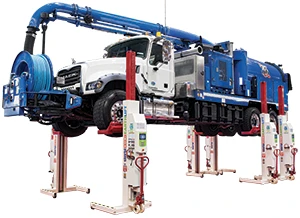
Most shops have a checklist for regular PMs: engine and oil filters, cooling system, drive shafts, belts and hoses, CV joints, steering suspension, tires, wheel and rims, etc. “Shop equipment can help,” says Peter Bowers, technical sales support manager, Stertil-Koni. That equipment includes transmission jacks, wheel dollies for wheels and tires (which can weigh 1,000 pounds), and lifts.
In order to perform many maintenance tasks, mechanics must access the trucks from below. Lifts make their job easier and safer. The most common type is the mobile lifting columns, Bowers says. “There are challenges with a fixed system in the floor,” he says. But because the mobile columns do not require excavation to install, they come with a low infrastructure cost. In addition, one person can place all the columns and lift a vehicle. The ANSI-approved mobile lift is third-party certified by the Automotive Lift Institute.
Other options include a platform-style fixed lift that is mounted to concrete. The multi-post Skylift is new. This heavy-duty platform lift features a vertical rise that doesn’t use floor space, with mechanics “nested” underneath, Bowers explains. Available in tandem configuration up to 100 feet in length, the Skylift provides access from all sides, is easy to install, and requires little maintenance. Its modular design permits flush-mount or surface-mount installation.
Traditional piston inground-style lifts are still popular. Stertil-Koni’s Diamondlift is a telescopic piston lift with a shallow, low profile in the floor for low ground clearance. Two options are available: the cassette and the frame, which is ideal for use in existing concrete pits or retrofit situations. Both can be configured with two, three, or four pistons.
Stertil-Koni’s Ecolift is a full-rise, axle-engaging inground scissor lift for very shallow pits in the floor—typically less than 3 feet deep, Bowers says. It can be selected in a two-scissor or three-scissor configuration.
Technicians need a comfortable work environment. Maintenance can be completed more quickly and safely with a lift, but, cautions Paul Feldman, marketing director, Stertil-Koni, it’s important to take note of the maximum weight each lift is capable of. “Know the maximum you can go to; know the configuration.”
Lifts come with hydraulic technology and built-in safety mechanisms including wireless operation that eliminates driving or tripping over cables or cords. Nevertheless, Bowers says, lifts should undergo annual inspections and regular maintenance. “They are easy to diagnose and repair,” he says, adding that they are cycle-tested.
Even equipment as seemingly basic as a lift is going digital. Stertil-Koni is now incorporating a full-color touchscreen control console into the Diamondlift. The ebright Smart Control System provides information about how the lift is being used in real time. It also provides warnings and service alerts and monitors the lift’s motor run timer. “It’s an easy and intuitive way to track usage of the machine,” elaborates Feldman.
On the horizon, Feldman says, are interlock controls that permit only certain users and trained service technicians access to the machine. Tracking machinery will become increasingly important, as will battery-driven and regenerative technology. “We’re putting a lot of weight over people’s heads,” points out Bowers.
The next generation of high-pressure, low-volume hydraulics will use less fluid and release less fluid into the environment. Lifts will be made with recyclable components and will be capable of more lifting cycles per battery charge.
Routing
Sometimes it’s just better to avoid having to do maintenance. Reducing route miles and optimizing routes can reduce wear and tear on trash trucks, which, in turn, can cut down on the amount of maintenance they require.
Trucks have to drive residential, commercial, rolloff, and recycling routes every day, every street. Optimizing routes can result in a reduction of miles and time by as much as 8–10%, according to Doug Hill, director of marketing, RouteSmart Technologies, Inc. That results in an increase in productivity, improved safety, and lower maintenance requirements. When a route is optimized, there’s no need to rush through a route, no hard acceleration, no safety issues.
For medium- to high-density routes where they have to drive every street, the system figures the days of the week and breaks it into routes that comprise a “doable” workload for one truck. “That way, there’s no overloading, no under-use,” says Hill.
There’s no “easy button” to push, Hill continues. “Routes must be optimized, reviewed, refined, and constantly maintained.” GIS tools can make it simpler to refine routes. “RouteSmart provides route optimization solutions that are proven to reduce mileage. It’s not just a matter of avoiding right turns. The way RouteSmart builds routes reduces the need for unnecessary turns. These two factors reduce wear and tear on vehicles and increase intervals between very expensive service.”
It’s a sequence that avoids U-turns, backing, and reversing. The navigation system chooses same-side service where possible. The Curotto Can only reaches the right side, for example. “It’s a safety issue as well,” points out Hill. “Workers shouldn’t have to cross the street.”
Routes differ based on whether they are residential or commercial (with an estimated 500 versus 75–100 stops and potentially stringent requirements on hours), the type of loader (front, side, or rear), and its capacity or if it’s automated, which could increase the total amount it can pick up by 50%.
“You input all the parameters,” explains Hill—“The type of vehicle, the terrain, traffic, capacity, type of route—residential or commercial…” The navigation system then uses historical data to create the optimal route. Raw data provides the speed classes for all roads. Residential is typically low speed, Hill says. “RouteSmart Navigator is robust for residential, with thousands of stops.” It provides an idea of usual traffic patterns, which is particularly useful in high-density areas that cannot be avoided. It also updates data for construction on a quarterly basis.
Rolloffs usually have a lower density route, but the navigation system will still benefit the operator, incorporating information about the type of service: pick up, drop off, exchange, dump, and return. “It can be different every day,” acknowledges Hill. The web-based solution provides simple and clear information.” Printed maps and reports are most common, Hill says, because it’s difficult to work a route that is constantly being spoken to them.
“You don’t have to start from scratch,” indicates Hill. “You can input the data, existing routes, and customers into an existing route.” One California company is constantly tweaking their routes, he says. Peoria Disposal, which holds several central Illinois contracts, recently optimized routes for 50,000 homes when it picked up a new contract for another town, he says.
Latest from Waste Today
- Vermeer announces plan to build new facility in Des Moines metro area
- Buffalo Biodiesel shares updates on Part 360 application to DEC, Tonawanda facility progress
- Capstar Disposal expands roll off dumpster rental services
- Supreme Court strikes down IEEPA tariffs
- Casella details facility closures, expansion efforts
- Zero harm: Building a SIF prevention program for waste and recycling operations
- Casella posts a loss in Q4 2025
- McNeilus names Haaker Equipment first Dealer Partner of the Year