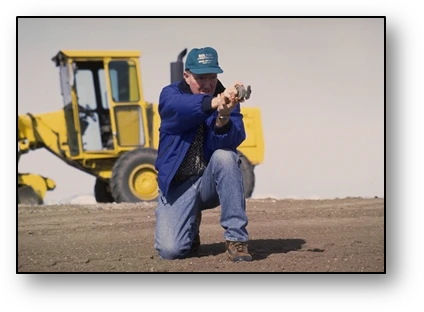
I used to be a good map reader. When traveling to a distant project, I would look at a map, watch for street signs, and find my way. Now the voice on my phone guides me wherever I want to go. Heaven help me if my battery ever dies halfway there!
Technology is a good thing, but sometimes I think we rely on it too much. Remember when we used to sit around on the weekend and talk? We didn’t text, Tweet, chat, email, Facebook, or message. We just talked.
Don’t get me wrong. I love technology, with all its apps, and buttons, and automated processes. But I’m concerned we have lost something important along the way. Take, for example, the ability to make grade at a landfill.
More than four decades ago, when I worked as a heavy equipment operator, I was fortunate to work for many different contractors operating a wide range of heavy equipment. From pioneering roads in the hills to the very precise grading and paving that had to tie into building pads and concrete curb-and-gutter, from mass excavation to underground utility projects. These types of projects that fall under the heading of heavy construction, all have one thing in common—surveying.
And all those activities translate, in one way or another, into the same type of work we do at landfills every day. The only difference is: Landfills are construction projects that never end.
When it comes to surveying, we’ve probably all heard about – and some of you may be using –incredibly high-tech systems., total stations, electronic distance measurement devices, and backpack GPS units. Dual-plane laser levels for precise grading on the top deck, and for non-plane surfaces, GPS units on dozers, compactors, and motor graders. Heck, we even use drones that can map a landfill, going from takeoff to landing in less than an hour.
But if any of these systems go down, or if the power supply fails, do your operators know how to make grade? For many of you, the answer will be, “yes,” others may struggle, and a few might as well shut the landfill gate.
In this issue, we will begin by talking about slope. After all, we can't build a good slope at a landfill until we know how to define slopes in the first place.
Slopes
In the landfill business, there are two ways we define slope: as a ratio or a percent. Geologists and foresters may measure in degrees, but for us landfill folks, it is ratio or percent. The decision to use one or the other comes down to how steep the slope is. By tradition, 10% is the common dividing line. Anything steeper is measured as a ratio, such as 10:1, 5:1, 3:1, or 2:1. Flatter slopes are typically measured as a percent, such as 10%, 8%, or 2%. Here’s how they both work.
Ratio Method
The ratio method is a simple comparison of the horizontal distance divided by the vertical distance. From your high school days, you may recall the terms run (horizontal) and rise (vertical). In this scenario, the run divided by the rise is the slope ratio. Here's the equation:
Horizontal ÷ Vertical 6 feet(h) ÷ 2 feet(v) 3:1 slope
To help you visualize how a slope is measured in terms of ratio, imagine we are using a carpenter’s level to establish a horizontal line reaching out from the slope. And we use a ruler (grade rod) to measure the vertical distance from this horizontal line to some point lower on the slope. We then divide the horizontal distance by the vertical distance. That’s it: the slope expressed as a ratio.
Using the photo at right, the slope would be 4 ÷ 2 which equals 2. So, the slope is 2:1.
In the years that I worked as a field engineer, I did a lot of slope staking. My normal tools were a 10-foot wooden grade rod to which I taped a small torpedo level. This was used to establish a level and measurable horizontal line. And a folding carpenter’s ruler that I used to measure the vertical distance.
I sometimes utilized a hand level and a grade rod, but this took a bit more practice to yield accurate results.
When we talk in terms of ratio, the larger the number, the flatter the slope. So, a 4:1 is flatter than a 3:1, which is flatter than a 2:1, and so on. The ability to make "good" slope is a critical skill for landfill operators, especially on those outside slopes where a miss can mean slope instability or a costly loss of airspace.
Percent Method
The percent method for measuring slope uses the same horizontal (run) and the vertical (rise) factors as the ratio method, but the percent method flips the equation to rise over run. That is the vertical distance divided by the horizontal distance. The resulting answer is then multiplied by 100 to convert it to percent. Here is an example:
Measured over a horizontal distance of 50 feet, the elevation increases by 2 feet, resulting in a slope of 4%. Here is the equation:
Vertical ÷ Horizontal x 100% 2 feet(v) ÷ 50 feet(h) x 100% 4% slope
Different tools are required to measure these longer, flatter slopes. A grade rod and ruler won’t get it.
Instead, we use a measuring wheel, tape measure, or laser range finder to measure the horizontal distance. And we use a hand level and grade rod to measure the vertical distance.
Hand levels are simply a small handheld telescope with a carpenter's bubble level built-in. Some hand levels have a magnification of 2x, 3x, or more, while others have no magnification. When you look through a hand level and center the bubble, then whatever you are looking at is dead level with your eye. That is why hand levels are sometimes referred to as eye levels—a descriptive but incorrect term.
When I’m using a hand level, I often make little sketches on a notepad or the back of a wooden lath. This lets me visualize what I'm measuring and helps keep the math straight. The key to using a hand level is to remember that whatever you are sighting is always level with your eye.
Regardless of the tools or the method used to calculate slopes, this is a skill that is crucial for landfill equipment operators and managers. It may take a bit more work to figure out the “old school” method, but it’s great to have that under your belt as a backup if the technology isn’t working.
Latest from Waste Today
- Worn Again Technologies unveils Accelerator plant to advance polycotton recycling
- Nashville Waste Services launches new digital route system
- ACUA landfill expansion project unanimously approved
- Clean Energy announces multiple RNG deals with fleets nationwide
- Interchange 360 to operate alternative collection program under Washington’s RRA
- Waste Pro files brief supporting pause of FMCSA CDL eligibility rule
- New Way Trucks expands US network with Joe Johnson Equipment
- Tire Industry Project publishes end-of-life tire management guide