In the previous issue, we talked about how all landfill slopes are measured by one of two methods, either as a ratio (e.g., 3:1 slope) or as a percent (i.e., 5% slope). So, whether you’re talking about the landfill liner, a tipping pad, the access road, the outside slope of the landfill, or the flowline of a pipe or ditch, the slope will always be represented as a ratio or percent.
It's one thing to talk about slope or read it on a set of drawings, but it's quite another when you must measure it in the field, where you must measure a specific slope. When it comes to the real-world application of slope, you must know how to describe a specific slope and know how to measure it accurately in the field utilizing a hand level or other surveying instrument.
Let’s start with hand levels, as they are one of the most basic tools, and the one surveying tool every equipment operator should have—and know how to use effectively.
Hand Level
When you look through a hand level, it’s like looking through a low magnification telescope, some even have no magnification. But off to the side, you can also see a bubble level, like the bubble on a carpenter’s level.
The bubble is floating in a vial that has three lines, a centerline and two stadia lines. We'll talk more about stadia lines in a few minutes.
When the bubble is centered (on the centerline), whatever lines up with the centerline is dead level with the hand level and your eye.
Checking Grade – Percent Method
Let’s say you want to measure the slope of an existing haul road. Be safe! Don’t do this if there is traffic on the haul road! Start by choosing a specific point on the haul road. Maybe it’s a white rock, a piece of litter, or an orange mark you painted on the ground. In any event, it’s something you can see from a distance.
You then walk down the road (i.e., downhill), periodically stopping to look at the “target” through your hand level. When you have reached a point where you are seeing the bubble is centered and approximately on the target, it’s time to stop and “check the grade.”
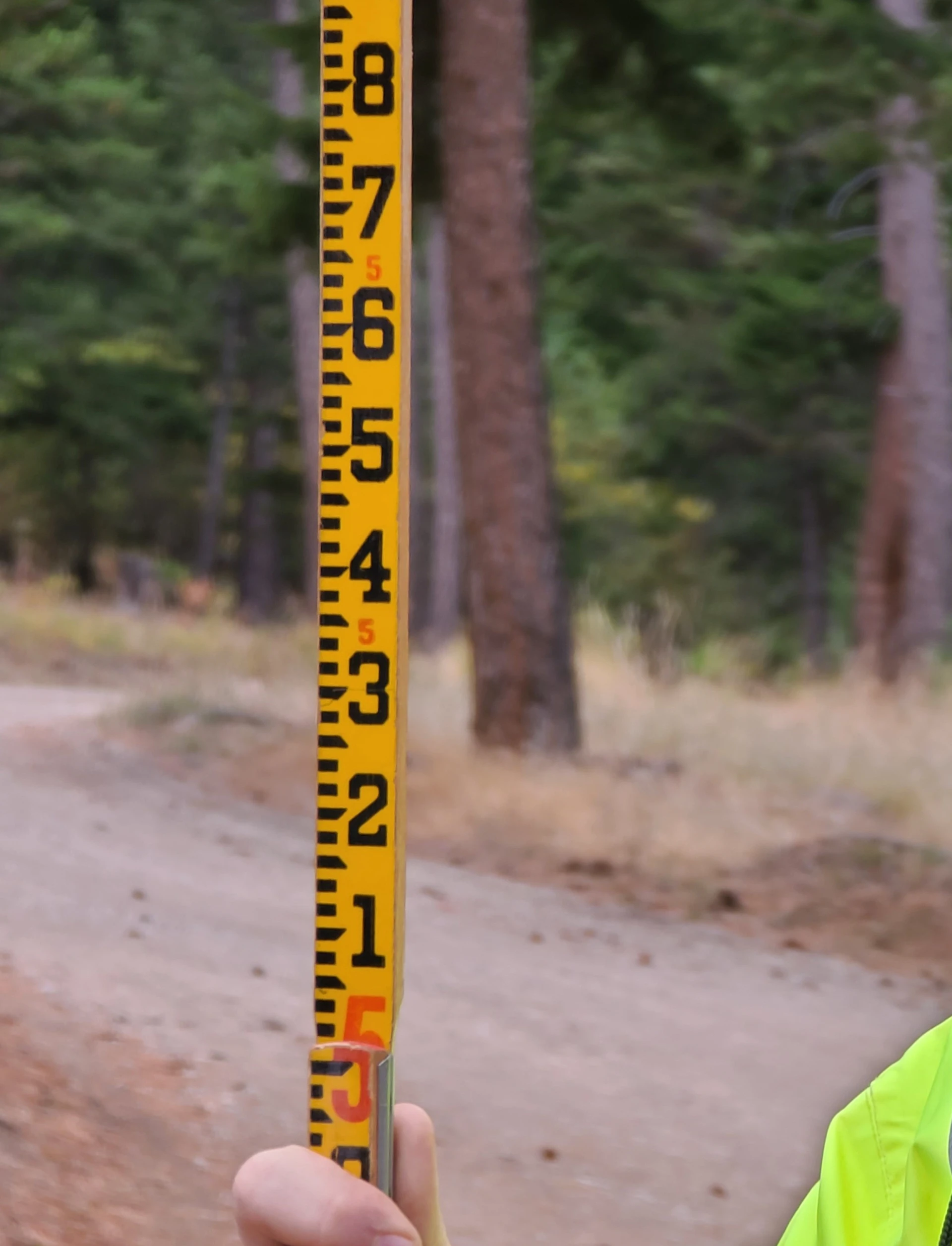
Using a grade rod as a measuring device—and as a means of steadying your hand level, you look back toward the mark. It works well to hold the hand level with one finger, like Winston Churchill with a cigar, then hold grab the grade rod with the rest of your hand. This locks the hand level to the rod and helps you get a more accurate shot.
Start by looking through the hand level and tilting it slightly fore or aft, until the bubble is leveled with the centerline. Then, while keeping the bubble as level as possible, slide your hand up or down the grade rod, until the centerline is on your target. If you can’t get high enough or low enough to see the target when the bubble is level, you may need to move slightly uphill or downhill to find a spot where you can comfortably see the target on level.
Note where the hand level is on the grade rod, to determine its height above the ground. Let’s say it’s at the 5.4-foot mark.
Then, using a tape measure, measuring wheel, or laser range-finder, measure the distance to the target “mark.” With practice, you can even pace the distance and be within 3%-5%.
At this point, you now have the vertical “rise” distance and the horizontal “run” distance. Let’s say, for example, that those are 5.4 feet and 112 feet, respectively. You can calculate the slope as a percent, using the equation from the previous article.
Slope = 5.4 feet / 112 feet x 100% = 4.8%
In this example, the actual slope was measured at 4.8%.
This same process can be used to check slope at any location.
Height and Slope – Ratio Method
Using a similar approach, you can also measure the height of a stockpile, the vertical distance between benches, etc. Here's the process, using only a grade rod and a hand level:
Starting at the bottom, sight through the hand level (while simultaneously holding the grade rod) and pick a point on the slope. Again, a clump of grass, a stick, a rock, or some other point on the slope is your target. Look level and record the height on the rod. Then walk up the slope, place the rod on the "target" and repeat the process. In this manner, you can stair-step your way up the slope until you reach the top. The sum of the rod heights is the overall height.
If you were measuring the horizontal distances at each “target,” you could sum those too, and then calculated the average slope. As an example, here’s a simple schematic and a table of those measurements.
The height of the stockpile is 51 feet, and the average slope is 2.5:1, based on the following equation:
Slope = 51.0 feet / 20.2 feet = 2.5:1
Certainly, you can do a lot of surveying if you have just a hand level, a grade rod, and some way of measuring horizontal distance. The secret is to think in terms of vertical “shots” and horizontal measurements.
But instead of a measuring wheel, tape measure, etc., you can measure horizontal distance using the stadia lines on your hand level.
Stadia Lines
[insert Stadia Lines photo]
The stadia lines seen in a hand level are used as a pair, with one upper line and one lower line. When you look through a hand level, you’ll the bubble level on one side, and whatever you’re looking at on the other. You’ll also see 3 lines on the bubble.
The centerline is the level line. When the bubble is centered on this line, whatever you see in the background, is at the same elevation with your eye (and your hand level). In this case, you are sighting a grade rod that someone is holding, and you are "shooting" at 5.4 feet.
You’ll also notice that the upper stadia line is at 5.6 feet, while the lower stadia line is at 5.2 feet. That is a difference of 0.4 feet. And because stadia lines are set at a ratio of 100, the grade rod is 40 feet from the hand level, based on 0.4 feet x 100 = 40 feet.
This is handy information and if you are attentive, you’ll find simple ways to measure distance using only the stadia lines in your hand level. Remember, the distance to an object is 100x the span of the stadia lines.
Using the stadia lines, you could estimate the distance to a person. For example, if the stadia lines span the entire height of a 6-foot man, he is 600 feet away. If it spans half his height, he is 300 feet away. If two times his height, he is 1,200 feet away. You could do the same thing if you knew the height of a pickup, the height of a scraper tire, the height of a garbage truck. Or turn your hand level sideways and measure the length of a truck, the distance between fence posts, and so on. With a little creativity, you could come up with a pretty good estimate of distance…to just about anything, simply using the 100:1 ratio designed into the stadia lines.
Hand levels are a great tool, one that I'd consider mandatory for a competent equipment operator where making grade is part of his/her job description.
Get a hand level and learn to use it effectively. You’ll wonder how you ever survived without one.
Latest from Waste Today
- Vermeer announces plan to build new facility in Des Moines metro area
- Buffalo Biodiesel shares updates on Part 360 application to DEC, Tonawanda facility progress
- Capstar Disposal expands roll off dumpster rental services
- Supreme Court strikes down IEEPA tariffs
- Casella details facility closures, expansion efforts
- Zero harm: Building a SIF prevention program for waste and recycling operations
- Casella posts a loss in Q4 2025
- McNeilus names Haaker Equipment first Dealer Partner of the Year