The Woodsy Owl battery recovery campaign has seen significant early success in three test markets since late August, with key metrics suggesting strong public interest. The campaign has seen over 352,118 social media impressions and more than 2,400 social interactions, capped by a strong 3.71 percent engagement rate, with 2 percent considered standard in similar scenarios. This success was bolstered by three live TV appearances: two in our nation’s capital and one in Chicago.
The campaign continued with two live drop-off events. In November, Woodsy Owl visited American University for a battery take-back event in northeast Washington, D.C., near the National Cathedral. Additionally, a battery take-back event took place Oct. 30 at the Washington State Capitol Campus. The engagement from state agencies and local residents was strong, with more than 8,000 visits to the event webpage in just two weeks. We are encouraged by the interaction on both social media and the website.
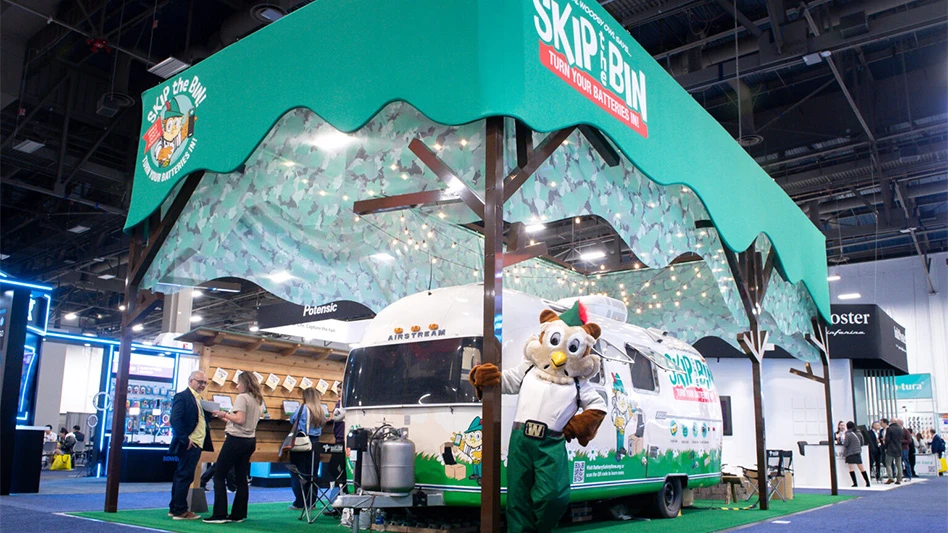
Woodsy also is scheduled top make his national debut at CES 2026 in Las Vegas in early January. The launch will include a dedicated booth featuring a dressed-up Airstream camper for an interactive experience identifying where batteries exist in our everyday lives. CES also has two media days scheduled for Jan. 4–5, 2026, that will help create interest in the national campaign. We continue to work with multiple partners, of which CES will include several, to amplify the campaign’s message.
Market headwinds
Switching gears, traditional recycling markets remain challenged in 2025, with old corrugated containers (OCC) and plastics showing particular weakness. OCC is struggling due to the oversupply of containerboard production—the primary consumer of recovered OCC. The surge in e-commerce during the COVID-19 pandemic led to containerboard makers overbuilding capacity. Even though e-commerce stabilized at a higher level, the supply of recycled containerboard continues to outweigh demand. OCC prices are undermined further by low-cost virgin containerboard production coming online in South America and Asia.
Plastics, particularly recycled polyethylene terephthalate (rPET), face similar headwinds. Low oil and natural gas prices are keeping virgin plastic prices low, which appears to be leading packaging companies to walk back their sustainability commitments regarding the use of recycled content. This domestic pressure is compounded by Chinese rPET imports that are flooding the U.S. market. Furthermore, speculation that China could be flaking the virgin PET it produces and exporting it as rPET is undermining the viability of global rPET markets.
Traditional recycling markets remain challenged in 2025, with old corrugated containers and plastics showing particular weakness.
Commodity pressure
Recycling processing successfully moved to a more fee-based business model from a commodity-based model. Despite this clear progress to improve the industry’s structure, the downward commodity pressure is overshadowing solid fundamentals of traditional collection and disposal.
Moderate U.S. gross domestic product growth of between 2.5-3 percent is insufficient to reverse the downward pressure on recycled commodity values.
The market would require an overheated economy to drive widespread demand recovery. Absent that, structural interventions, such as addressing excess containerboard production capacity and implementing import controls on rPET, are needed.
Latest from Waste Today
- My Green Michigan expands depackaging capacity
- Washington selects Circular Action Alliance as PRO
- Ten-8 Industrial opens new central Florida service center
- Triumvirate Environmental acquires Environmental Waste Minimization
- Official NYC Bin availability expands ahead of deadline
- US Food Waste Pact’s 2025 Impact Report shows decrease in food waste
- Coastal Waste & Recycling expands recycling operations with Machinex
- Reconomy acquires German-based GfAW