Over five decades at the helm of Casella Waste Systems Inc. in Rutland, Vermont, Chairman and CEO John W. Casella can count plenty of lessons learned. Overcommunication is key, for one, and successfully growing a business through mergers and acquisitions (M&A) requires relentless work to maintain a single, overarching company culture. He’s also developed a keen understanding of balance sheets, debt and leverage and the knowledge that the waste management business is not conducive to being highly leveraged.
He describes running the company as a “journey with no destination.”
“Because we bring so many new people into the organization from an M&A perspective, from a growth perspective, we just have to keep working at it every day,” he says. “As long as you’re acting within the core values, you can’t really make a mistake.”
What has kept Casella near the top of the heap over five decades in the industry is its resilience. John says the company has faced major hurdles at times, such as an unsuccessful 2015 attempt by a shareholder to oust him from the board after stock prices plummeted, an ordeal detailed in a 2019 story in Forbes magazine.
The company’s shares have surged since then, and the Casella leadership team marked the company’s 50th anniversary June 17 by ringing the Opening Bell at the Nasdaq MarketSite in Times Square.
What kept him going through those struggles, John says, was “grit, pure grit.
“What doesn’t kill you makes you better, right?”
Company history

John’s younger brother, Doug Casella, started the business as Casella Refuse Removal in 1975 in Rutland, collecting waste from customers in the area with a pickup truck. Thanks to reliable service, the enterprise soon grew. A year later, John joined his brother to help run the business.
“In the ’70s, pretty much everyone in the solid waste business, those families had built really terrific businesses,” John says. “But kids in those days were going off to be doctors, lawyers, and a lot of businesses didn’t have succession planning in place. They didn’t have children coming up that were going to take over the business.”
That dynamic created an ideal opportunity for Casella to rapidly grow through acquisition. In acquiring family-owned businesses throughout Vermont and New England, Casella grew to about $90 million in revenue by 1997, when Goldman Sachs, DLJ and Oppenheimer took the company public.
From the beginning, when the company built the first recycling facility in Vermont in 1977, Casella has incorporated resource solutions and recycling into its solid waste management strategy. It views waste management as an integrated set of services involving collection, recycling, transfer and disposal.
“It’s something we approach up front with our customers,” says Ned Coletta, the company’s president. “We find a lot of ways to drive value for our customers but also for ourselves, and [it’s] something that we’re really proud of and it’s a big differentiator in the marketplace.”
Coletta, a longtime Casella employee, was promoted first to chief financial officer in 2012 and then to president in 2023.
In the years that followed Casella’s initial public offering, the company continued to grow throughout New England through acquisitions, supplementing traditional waste management services with its expertise in resource renewal and sustainability.
In 2000, the company realized it needed additional disposal capacity and set out to develop new landfill projects.
“We were successful on five out of six development projects and put 100 million tons of disposal capacity in place,” John says.
Today, the company handles about 4 million tons of waste annually at its nine landfills, recycles about 1 million tons at 14 material recovery facilities (MRFs) in six states, runs about 2,200 collection vehicles on residential and commercial routes and employs more than 5,300 people.
Service offerings
Casella operates a vast infrastructure of nearly 180 facilities across 10 states, primarily in New England and the Mid-Atlantic region. It’s a full-service environmental company offering collection, recycling, organics processing, resource solutions, disposal and landfill services.
About 60 percent of Casella’s revenue comes from collection, 35 percent of which is residential and 40 percent commercial, with the remaining 25 percent split between temporary construction roll-off and industrial compactor work. The rest of the revenue makeup is 22 percent recycling and 17 percent is disposal.
“Strategically, what we really want to do is drive the business up and down the Eastern Seaboard,” John says of the company’s future expansion plans. “We don’t necessarily, at this point in time, have a desire to go across the country, but certainly we see our growth contiguously down the seaboard.”
One service many might not be as familiar with is Casella’s resource solutions business, which operates in 40 U.S. states, helping to manage waste and recycling services to meet manufacturers’ and other industrial customers’ sustainability goals.
“From our vantage point, a lot of times we’ll approach things from a circularity standpoint and really help customers find ways to drive more into recycling or into reuse,” Coletta says of Casella’s diverse offerings. “I think it’s a big differentiating factor for us, especially with the larger customers like universities or institutions or industrial customers. It’s an area of our business that’s one of the fastest growth [opportunities].”
People first
What truly sets Casella apart, Coletta says, is its people, and the company treats its employees as its No. 1 priority. As the organization has grown, it has worked tirelessly to stay true to its core values of treating its people well.
“Clearly, our focus is our people first,” John says. “If your people are happy, they’ll make your customers happy. If your people and customers are happy, then your shareholders are going to be happy. And it’s in no other order than that.
“It’s not that we get it right every day. In the last year, we’ve added 1,000 people to the company. And so, consequently, it’s never-ending work to keep working at the culture and keep making sure that people understand how we want to treat each other. And we are of service to each other first before we can take care of the customers, and it’s paid real dividends for us.”
In 2024, Casella was named to Time’s annual list of “America’s Best Mid-Size Companies” in large part for its employee satisfaction record, according to standardized work-related key performance indicators based on survey data from a large sample of employees from U.S. companies. In 2024, Casella was the only company in the waste, recycling and resource management services industry to be recognized among the list of 500.

The company actively seeks out people who are eager to buy into the Casella culture and want to be a part of what the company is doing and take it to the next level.
“We have built a great market position for us in the Northeast,” John says. “As we step into new markets, we’re finding that our culture is very much a winning culture where we have a lot of great people joining our team, and they love our focus on people and people development and helping our employees grow.”
Coming out of the COVID-19 pandemic, John adds, the company realized it didn’t have enough training programs in place to support its employees. In the years since, Casella has beefed up its training programs, purchasing a 90-acre college campus in Rutland that it converted into a center offering safety, leadership and finance training and more.

If your people are happy, they’ll make your customers happy. If your people and customers are happy, then your shareholders are going to be happy. And it’s in no other order than that.” – John W. Casella, Chairman and CEO, Casella Waste Systems Inc.
Five years ago, Casella built its own commercial driver’s license (CDL) school to attract high school graduates into the trade. The company pays to put students through the school, covering tuition and room and board, and asks for a two-year commitment to Casella upon graduation.
A similar maintenance school was put in place two years ago.
“About 40 percent of the kids in high school are not going on to college, and we want to attract as many of them as we possibly can to our industry,” John says.
Regional considerations
Working in the Northeast, Casella Waste Systems has experience facing issues unique to the region, including a growing disposal capacity shortage and relatively sluggish economic growth compared with other fast-growing regions.
“Those are some of the things that are inherent in the footprint that we’re in,” John says. “We’re in an area that doesn’t have a lot of economic and a lot of GDP [gross domestic product] growth, but it’s also a little bit more stable in a downturn. … When you do have a recession, we’re not hit as hard.”
Additionally, the company has long had to deal with unpredictable winter weather and plenty of snow and ice.
“[The winter weather conditions are] something that we manage well now,” John says. “It took us a number of years to perfect it, but nonetheless.”
Across the Northeast, Casella’s asset base includes many unique facilities, from landfills to transfer stations to recycling facilities, that could never be replicated in other areas, Coletta says.
Technology improvements

As Casella looks to the future, improving digital interaction with its customers is a top concern. Coletta is leading an effort to better integrate digitized options for customers, including self-service apps, online tools and e-commerce solutions. The company is running pilots of a Casella app, which Coletta hopes to roll out to customers in the next six months.
The company is also updating its legacy hauling, transfer and landfill sites to the latest version of operations software from Chattanooga, Tennessee-based Soft Pak Software Solutions, a waste management software company.
“We’ve had a really good relationship with the Soft-Pak team for a lot of years,” Coletta says. “And we’re just focusing on the integrations between that Soft-Pak solution, our customer payment solutions [and] our online solution.
“We’re just giving customers what they demand today—more connectivity through apps, through online, more ability to self-service—while at the same time always having someone to be able to pick up the phone.”
Over the past few years, Casella Waste Systems has worked with Machinex, headquartered in Plessisville, Quebec, on retrofit projects in its MRFs, making an investment of just under $40 million in robotics and artificial intelligence-enabled solutions.
A $20 million retrofit in its Boston-area facility and an $18 million upgrade in its Willimantic, Connecticut, MRF added state-of-the-art optical sorters and robots.
The Casella team continues to evaluate how it can use technology to be more effective and to drive costs down as the company continues to grow, John says.
One of the major technology programs Casella has invested in over the last few years is implementing onboard computing and camera systems from Routeware Inc., Portland, Oregon, into a large percentage of its trucks.
“It allows us to optimize routes but also have digital engagement for our drivers on stops and safety and weights,” Coletta says.
Community focus
Casella Waste Systems is not a company that has grown exponentially in just one geographic location but rather has grown through acquisitions in all kinds of communities across the region—and that approach has required a thoughtful touch when it comes to community engagement.
“One of the things we’ve done historically is to be very much involved in the communities that we serve,” John says.
The company empowers its division managers to become active members of the communities they serve, whether that’s supporting schools and sports teams or participating in activities. Over time, Casella has taken a more formal approach to community engagement, making bigger contributions and developing relationships with organizations that are trying to make a difference in the communities it serves like Goodwill Industries, John says.
Looking to the next 50 years, John says he feels optimistic about the company’s long-term trajectory.
“We’re excited,” he says. “We’ve got the team in place for the future. We’ve got a great platform that we’ve built over the last 50 years. Ned and the finance team have done a great job on the balance sheet. We’ve got a balance sheet that will support that growth on a go-forward basis. It’s an exciting time at Casella, it really is.”
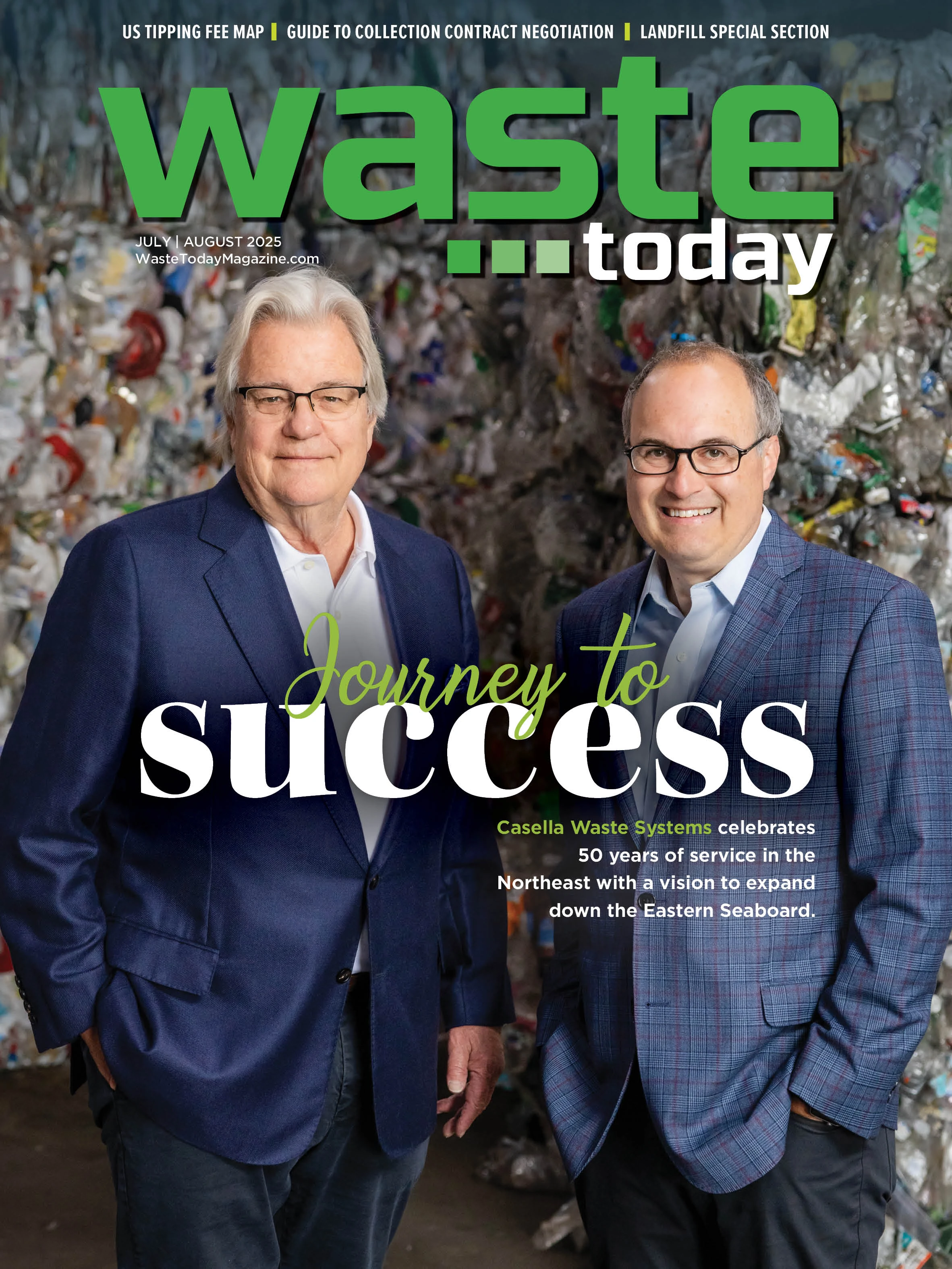
Explore the July/August 2025 Issue
Check out more from this issue and find your next story to read.
Latest from Waste Today
- Fleetio launches AI capability to accelerate fleet maintenance approvals
- Recycle Ann Arbor extends drop-off station operating hours
- Sybilion seeks to help manufacturers confidently address volatility
- Ecowaste Solutions partners with city of Trinity, Texas
- Bristal Hauling acquires G&R Garbage Disposal
- Baltimore trash collection expected to slow as WTE facility closes for maintenance
- Landfill Insights | Connecting the dots: Policy to practice
- FCC Environmental Services awarded collection contract in Florida