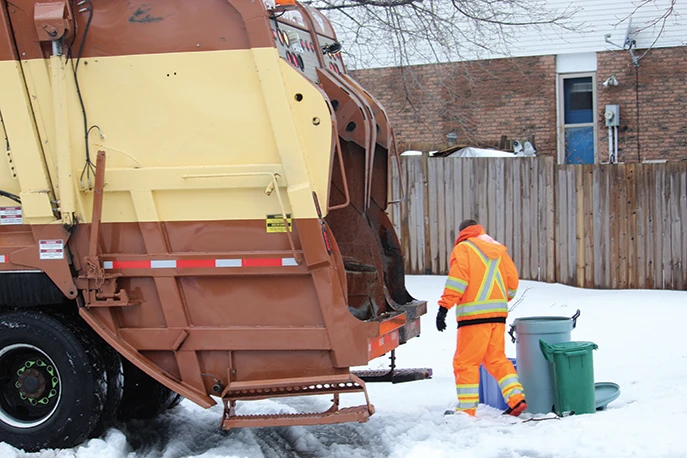
There are several hazards when backing a vehicle—not just avoiding what is immediately behind the truck or moving into the pathway of the truck, but there may be inadequate clearance on the sides or top of the vehicle, and the truck’s blind spots hide objects whose presence can make it unsafe to back up.
National General Insurance has the following guidelines for backing up:
- Educate drivers on backing accidents
- Plan routes that limit the amount of backing
- Use ground guides to assist in backing
- If no guide is available, walk around the entire vehicle
- Adjust mirrors and ensure backup lights function properly
- Roll down windows and turn off the radio
- Don’t back up unless absolutely necessary
According to the National Safety Council, one out of every four accidents occurs while the vehicle is operating in reverse. “Backing” and “back-over” accidents cause an estimated 500 deaths and 15,000 injuries each year. And, according to Kim Kinzalow, president at Rearview Systems, the average backing accident on a truck costs more than $12,000. Plus, a truck in the shop isn’t making money.
To combat work accidents, work injuries, property damage, lawsuits, and the stigma that the safety record of the waste industry stinks, the waste industry has seen for the past decade record adoption of backup detection and rearview cameras.
“The waste has been one of the first industries to adopt these technologies on a large scale,” says Joseph Schechter, executive vice president, Rear View Safety Inc.
“The waste industry is one of the most dangerous vocations out there,” says Tom Loutzenheiser, VP of business development, Preco Electronics. “In no other industry are big trucks expected to safely ply around tiny neighborhoods each week despite the weather. I’m proud of all the steps that the waste industry is taking to improve safety.”
“The waste industry is working really hard to reduce accidents and get out of the stigma of the waste industry being a really dangerous place to work,” says Todd Teal, director of operations, Global Sensor Systems Inc.
Both rearview cameras and backup detection systems are part of a larger trend of including advanced driver-assistance systems (ADAS) into vehicles; ADAS are systems that help the driver in the driving process in order to improve vehicle and road safety.
There are various options for backing safety technologies, and the number of new technologies, options, and companies is ever increasing. So, what should someone consider when purchasing a backing safety technology?
The Digital Eye
“While 2017 was the year of the [electronic logging device], fleets and insurance companies are stating that 2018 will be the year of video—something we’ve already seen evidenced by our own significant growth,” says Steve Mitgang, CEO of SmartDrive Systems, in a statement.
“Cameras are being deployed across the board on the vocational category—that is waste, recycling, utilities, construction, and municipal—operations that have medium- to heavy-sized (class 5–8) trucks,” says Tom Loutzenheiser. “Customers are seeing the benefits of reversing cameras.”
“Backup cameras are now the norm with the majority of refuse trucks and we see almost unanimous adoption with all our major fleet customers,” says Mark R. Regan, executive vice president, 3rd Eye Inc.
3rd Eye provides up to eight cameras. “Camera placement is flexible for the most part, but keep in mind the overall rationale for cameras is to increase safety through improved visibility,” says Regan. “Our in-cab camera module represents the first two cameras, as it has both a forward facing camera and a driver facing camera. The next six cameras are designed to provide 360 degrees of visibility around the vehicle. Depending on the type of truck, several of the camera placements will allow the driver to see the hopper (and its contents), the arm view, body side views, and tailgate views.”
The tailgate camera captures vehicles that may come into contact with the truck on a public street. This footage would be used to determine fault. The tailgate camera is also used by the driver to ensure no one is behind the vehicle when the truck is moving in reverse.
“These cameras provide increased visibility to both the driver and to the fleet’s owners,” says Regan. “As an example, a hopper camera provides the driver with immediate validation of what is being collected at curbside—or in the case of a front loader, what commercial refuse is being collected. Driver-facing cameras are designed to assist fleet safety directors with opportunities to coach unsafe driver behavior or to validate driver behavior regarding post-accident investigations.”
“As soon as you have pedestrians, or work in tight spots, and especially on anything that has wheels, you need a camera for every blind spot,” says Marc Lefebvre, president, RMT Equipment. RMT Equipment has been an Orlaco Authorized vision solutions Preferred Partner for the US and Canada for 10 years.
“With Orlaco, you can have up to four views on one monitor and choose from seven different types of views from very, very narrow to very, very wide; this allows you to customize your camera system to the type of truck and to the application,” says Lefebvre. “They also have the most powerful infrared night vision camera on the market; it captures images up to 100 feet, whereas other cameras can only capture images up to 30 feet.”
An infrared camera detects infrared energy, converts it into an electronic signal, and then produces a thermal image on the cab monitor.
Lefebvre says that RMT sells a lot of systems that go onto semi dumpers and garbage trucks. “They’re highly popular on those types of trucks because they frequently back up in tight areas. Customers regularly report backing accidents have decreased 80 to 90% since including Orlaco cameras in their fleets.”
Orlaco first began engineering cameras for the heavy equipment industry; then, their products evolved to meet the needs of more industries. “Orlaco is at the high end of vision solutions for vehicles in the recycling industry,” says Lefebvre. “The premise of their products is robustness; they’re pretty much indestructible. Their products can sustain extreme vibration, cold, heat, and humidity; they go through long hours of testing under many and extreme conditions in order to meet and exceed ISO certification standards. No competitor has as many certifications as Orlaco.”
Orlaco has designed a new really wide-angle camera—the HMOS DigiCoax camera. “It’s designed for flat nose trucks,” says Lefebvre. “Drivers of flat-nosed trucks don’t see much on the front right of the truck. This camera, fastened to the front right of the truck, shows the front and full right side of the truck—about a 280-degree view—and displays the image in high definition on the monitor; the video is the same quality as a video played on an iPad.” The unit also features video recording capabilities in either single view or quad view.
For backing up, Orlaco’s RadarEye rearview camera and radar detection systems include a camera that can see better at night than the human eye and can view up to 118 degrees. Their cameras are 100% watertight and heated to prevent condensation or frost.
Intec Video Systems also uses heat to keep their cameras free from condensation and frost; they boast that their cameras can operate in temperatures approaching -90°F. The company also boasts the widest field of view (FOV) in the industry of any rearview camera at 160 degrees.
“The waste industry is loading up on cameras,” says Jason Palmer, chief operating officer, SmartDrive Systems.
SmartDrive Systems Inc. takes another approach to video. They are less interested in the real-time images displayed on the in-cab monitor and more interested in capturing data to generate reports that can be used to coach the driver and change driver behavior, thereby leading to safer operation. “We primarily focus on safety as a service, which is part of what makes us different,” says Palmer.
The company’s SmartDrive video-based safety program and SmartDrive SmartIQ transportation intelligence suite provide waste and recycling fleets with an effective way to improve driver performance and fleet efficiency.
This coaching program hits at one of the biggest shortfalls of rearview cameras in preventing accidents—it relies on driver behavior. It doesn’t matter if your truck is fitted with dozens of cameras, footage from drones, and a 27-inch monitor with ultra high-definition if the driver doesn’t use regularly check monitors.
“It doesn’t matter which technology you use if the driver doesn’t use it to its full potential,” says Palmer.
“Cameras aren’t an active solution; they don’t warn the driver,” says Loutzenheiser. “Even when they’re deployed, it doesn’t necessarily decrease backing accidents.”
“Drivers tend to continue to rely on their mirrors even after their truck has been outfitted with a rearview camera,” says Schechter.
Cameras are excellent for providing the driver the visual information needed to operate the machine in a safer manner, but it requires the operator to look at the monitor for the system to work. When backing up, a driver has to look at the truck’s monitor, instrument panel, and several mirrors, as well as any potential objects or people not in the path of the backing area but who could move there. This amounts to a lot of competition for the driver’s eyes.
A backup detection system, on the other hand, has the potential to give an audible alert, which doesn’t rely on the operator looking at a certain spot, which means the time between when the moving object crossed into the truck’s path to the time the driver applies the brakes can be decreased.
Two Orlaco cameras with monitor. Orlaco has been designed for the heavy equipment industry, and is therefore very durable.
Going Full Circle
Backup detection systems include several technologies, including radar, sonar, lidar, three-dimensional cameras, and infrared. The first technologies to come onto the market were sonar and infrared. “I think, at the time, the early cheap sonar systems put a bad taste in people’s mouths; it just produced too many false hits,” said Teal. Global Sensor Systems uses infrared in their backup detection technology. “When testing technologies, 40 years ago, we discovered infrared light gave us the best real-world reliability,” says Teal. After sonar came radar, and most people have some knowledge about that technology; it’s the most popular technology for back up detection. “Lidar and 3D cameras are the newest kids on the block,” says Teal. Lidar stands for light detection and ranging. “Both technologies bounce light off objects to measure distances between the object and the truck and track their location.”
“The waste industry is one the first adopters of this technology; they have been investing into it for 12–13 years,” says Schechter. “Similar to backup detection is blind spot lane change technology; it gets installed the same way, and it can detect up to 60 feet along the side of the truck for safer lane changing.”
Backup detection technology is seeing greater adoption across the board in vocational trucking,” says Loutzenheiser. “It has been popular in waste for quite a while, and its adoption is really accelerating due to how dangerous working in or around waste trucks can be.”
Preco Electronics uses radar for its backup detection systems. “We had looked at ultrasonic and light-based products, but found radar to be the most reliable and consistent; it works in all weather conditions and even when it gets dirty,” says Loutzenheiser. “One of the things that set Preco apart is that we have been doing safety systems for 70 years.” (The beep, beep, beep sound that trucks make when they reverse—Preco Electronics invented that.) “For the waste truck, for example, our job is to make it safe as it plies around the neighborhood, including equipping it with active collision avoidance and blind spot safety solutions. Waste trucks are huge—class 8 trucks—they have significant blind spots on the side and rear of the vehicle.”
Loutzenheiser says that Preco Electronics’ customers report a decrease in backing accidents of 80% after installing one of the company’s backup detection systems.
Perry Mitrano, the head of the solid waste department for the City of Bunnell, FL, reports how, while subbing for one of his drivers, he came within inches of killing someone when backing up a truck in a parking lot. His truck was outfitted with the Preco Electronics PreView Radar System which is what alerted him to the elderly man who had stopped behind his truck near the rear wheel to pick up his keys.
Mitrano is a good driver; in 2012 he out-performed 450 other drivers to take first place in the Mack Truck Driving Skills contest at the annual WasteExpo conference. Therefore, it takes more than being a good driver to be a safe driver.
“Backup cameras are wonderful. We use them on our truck and they help us avoid a lot of incidents,” says Mitrano. “But there is a zone between the bottom of the cameras and the ICC bar [of the truck] that I call the ‘bubble.’ It’s a blind spot where any objects that are lower than the bar don’t show up on your monitor. That’s where this gentleman was when the Preco system picked him up and started going off.”
“Highway trucks for the waste and recycling industry put radar on the back and the side of their trucks,” says Lefebvre. “The system offers a visual signal via five indicators that change in color from green to yellow to red. And, if the radar is activated, the monitor will automatically display the image seen by the camera.”
“Many years ago, industries were embracing sensors. Then, they started embracing cameras. Now, they are going back to sensors. It seems to have gone full circle,” says Teal.
Global Sensor Systems goes one step further by applying the brakes; this is level one automation. “A system with automatic braking takes the driver error (or driver reaction time) out of the equation,” says Teal. “If a truck is moving at 3 to 5 miles per hour—which is the recommended reversing speed— the truck would have traveled more than 6 feet by the time a driver sees an object and reacts to it. Our system would have caught it and stopped the vehicle within the 6 feet.”
“Radar is good, but it’s not enough. Cameras are good, but they’re not enough. The 99% solution to backing accident avoidance is a system that combines both technologies,” says Lefebvre.
Both technologies are usually purchased as an aftermarket solution and not integrated into the machine direct from the vehicle original equipment manufacturer. This means rear-facing sensors and cameras have to be wired through the entire truck, which can be a real nuisance depending on the truck’s configuration. Wireless options are available, but a wireless signal has its own problems; some objects, such as the presence of aluminum, can interfere with the transmission, leading to the system not detecting objects.
Telematics—The Next Step
Sensors and cameras capture data that is useful not only to the driver in the cab at the moment but also to fleet managers when the information is fed through a telematics program.
“Historically, people just wanted cameras,” says Schechter. “Now, they want the full deal. They want to protect their drivers, protect against false claims, and provide greater backup safety.”
“We see more and more fleets adopting the real-time monitoring of camera data and the addition of collision avoidance radar,” said Regan. “3rd Eye’s Enhance VBA allows for the real-time transmission of chassis and body sensor data, as well as video and radar information feeds. This is particularly important when fleet owners need to validate proof of service to a customer or during a post-accident investigation.”
Enhance VBA stands for Enhance Vehicle Behavioral Analytics and represents the complete suite of digital tools that 3rd Eye offers. “Think of Enhance VBA as a digital menu that fleet owners can choose from,” says Regan. “3rd Eye’s complete suite involves video capture from up to eight cameras, collision avoidance radar, data feeds from both the chassis and body, and GPS tracking—all transmitted in real time through 3rd Eye’s Hurricane Gateway to any number of backroom fleet routing software applications.”
This information is collected into reports, which fleet managers and owners can use to make smarter business and fleet decisions, as well as coach drivers. “Our systems are designed to provide fleet owners with the ability to spot good behavior and provide coachable moments for drivers operating their vehicles in unsafe manners,” says Regan. Speeding, taking sharp corners, not coming to a full stop, and texting while driving are obvious unsafe driver behaviors. “Those are easy to spot and to address. But 3rd Eye systems are also able to monitor eye movement and the cab environment to ensure that drivers are not fatigued or distracted.”
“One-third of drivers have admitted to falling asleep behind the wheel,” says Schechter. “Technology prevents catastrophe.”
Latest from Waste Today
- Worn Again Technologies unveils Accelerator plant to advance polycotton recycling
- Nashville Waste Services launches new digital route system
- ACUA landfill expansion project unanimously approved
- Clean Energy announces multiple RNG deals with fleets nationwide
- Interchange 360 to operate alternative collection program under Washington’s RRA
- Waste Pro files brief supporting pause of FMCSA CDL eligibility rule
- New Way Trucks expands US network with Joe Johnson Equipment
- Tire Industry Project publishes end-of-life tire management guide