Growing up on a family farm sparked an early interest in environmental engineering for Christopher Toevs, a facility engineer for the Chester County Solid Waste Authority (CCSWA) in Narvon, Pennsylvania. During childhood, he tended a flock of sheep using rotational grazing, relying on Google Earth and a geographic information system (GIS) to make the operation more efficient.
This glimpse into land planning was “very enlightening,” Toevs says, and helped establish an understanding of sustainability and how natural elements—animals, soil and water—were connected.
“I think that mindset is what naturally led me into environmental engineering.”
While Toevs admits he had no prior interest in the solid waste industry, he says he grew to respect it largely because of its dynamism and integration. “Solid waste affects every part of the community, and it’s costly, evolving with different regulations [and] different technologies,” Toevs explains.
What truly hooked him on the industry was its continuous innovation, a large component of Toevs’ current role. Using drone surveying technology and artificial intelligence tools to monitor landfill conditions and other data, he always is seeking ways to better serve CCSWA.
In the following interview with Waste Today, Toevs shares what he’s learned in his first solid waste role and how to balance daily operations with long-term vision.
"Landfills are often overlooked, and I think that it [is important to remind] the general public that these are highly engineered and strictly regulated facilities.”
Waste Today (WT): Tell us about your role at CCSWA and what made you interested in a career in the solid waste industry.
Christopher Toevs (CT): As the only licensed professional engineer at Chester County, I’m responsible for landfill [design], permitting efforts, leading construction projects and having an influence on long-term planning for the waste authority.
We serve over 400,000 residents in our service area, and the chance to be a part of something bigger really spoke to me.
Another aspect [of] Chester County is that we have a big focus on long-term green space planning. We’re currently collaborating with two different recreational groups. One is a local disc golf club, where we’re developing a nine-hole disc golf course at the facility here, and we’re also developing a remote-control airplane that people can come and fly … at our scenic overlooks.
Pushing those partnerships to create better green space … is really unique … and it’s something that I definitely enjoy about working at Chester County—creating something that is of value for the environment, but also something the community can enjoy.
WT: What are some challenges that come with your field?
CT: One of the biggest things is public perception. Landfills are often overlooked, and I think that it [is important to remind] the general public that these are highly engineered and strictly regulated facilities.
… One of the more unique challenges we’re dealing with today is related to lithium-ion batteries. This is a growing concern that affects collection [and] landfill operators. We are all dealing with this increase in fires at our facilities, and a lot of it is attributed to these lithium-ion batteries making their way into the waste stream.
… And then I think the third one is [balancing] daily operations with long-term vision. Definitely, in this field, having to do the day-to-day work can be very engulfing, but reminding yourself that there’s a long-term vision that needs to guide your decisions today can help with future challenges you haven’t faced yet.
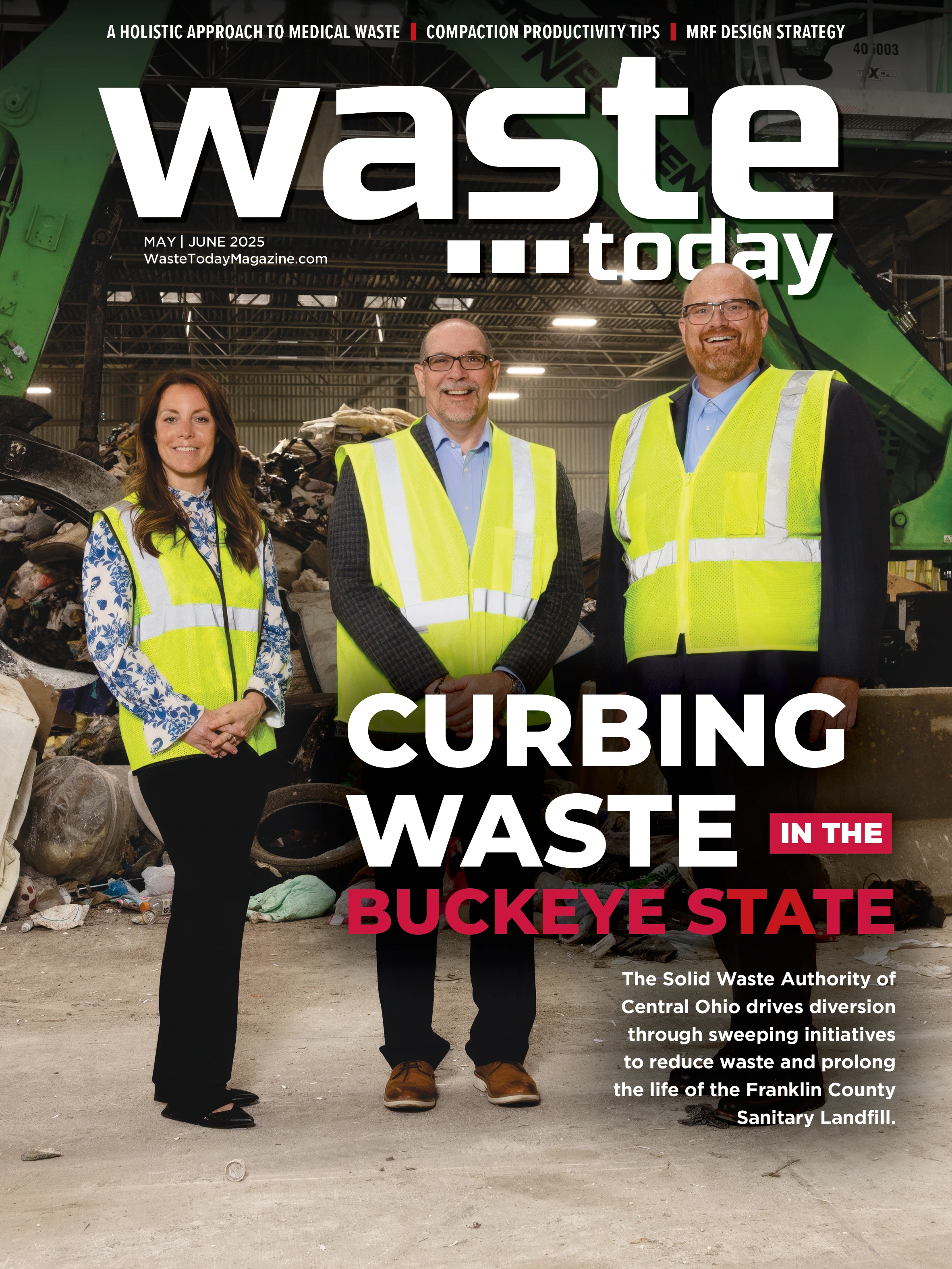
Explore the May/June 2025 Issue
Check out more from this issue and find your next story to read.
Latest from Waste Today
- Fleetio launches AI capability to accelerate fleet maintenance approvals
- Recycle Ann Arbor extends drop-off station operating hours
- Sybilion seeks to help manufacturers confidently address volatility
- Ecowaste Solutions partners with city of Trinity, Texas
- Bristal Hauling acquires G&R Garbage Disposal
- Baltimore trash collection expected to slow as WTE facility closes for maintenance
- Landfill Insights | Connecting the dots: Policy to practice
- FCC Environmental Services awarded collection contract in Florida