Every landfill will eventually come face to face with it: the Big C—Closure. And when that day comes, there will be some wishing.
You’ll wish you had set aside more money for closure. You’ll wish you had more years to set aside more money for closure. Unfortunately, once you’re to the point of wishing for what you should have done, it’s a little too late. The time to act on those wishes is now.
Let’s talk about that first wish, that you’d set aside more money for closure and post-closure. Your need for a closure and post-closure fund shouldn’t come as a surprise to you. That requirement was officially part of Subtitle D in the early 1990s and after some delays, became law in 1997, when Subtitle D set forth requirements for all landfills to provide funding (financial assurance) for closure / post-closure. At about that same time, your state adopted similar rules regarding financial assurance. You’ve had nearly 3 decades to get ready for this.
When subtitle D took effect in 1991, it required that your landfill develop a closure plan and post-closure maintenance plan. Among other things, that plan required that you prepare a cost estimate for closure of whatever would be the largest exposed footprint. It also required at least 30-years of post-closure care, along with money to cover any known corrective action activities.
We now know that the original 30-year post-closure maintenance requirement has evolved into what will be perpetual care. This means that the post-closure care fund must be set up like an annuity, where the principle of the fund can generate enough investment income (i.e., interest) to pay for post-closure care indefinitely.
For most landfills, those financial assurance requirements amount to millions, or often tens of millions of dollars.
When you originally developed your closure/post-closure cost estimate, it was based on an assumption regarding the remaining life of your landfill, and how much money you’d need to set aside for each ton you received, in order to build that closure/post-closure fund. And ideally, you’ve been setting that money aside each year, and are well on your way toward having it fully funded by the time your landfill closes.
Theoretically, that’s how it should work. Unfortunately, financial assurance is the proverbial can that gets kicked down the road. Sometimes it gets kicked because of competition. You may not have enough money in the budget at your current market-driven tipping fee rate to build that closure/post-closure fund, so you don’t pay into the fund.
Or perhaps you have been diligent about building that fund, but then somebody looked over the fence, saw that money just sitting in the bank, and decided they had a better and more immediate use for it. In other words, somebody else comes along and kicks your can down the road. Maybe it was diverted for capital costs at the landfill, or maybe it was pulled into the general fund. This is a common scenario when money gets tight, something we frequently observed during and immediately after the 2008 recession.
Regardless of the cause, the can is down the road.
Here’s the bottom line. If your closure/post-closure fund is not on track to be fully funded by the time your landfill closes, some adjustment is required. From a financial standpoint, the bean-counters in your organization can probably do the math. If you have 10 years of remaining life at your landfill, you’ll need to set aside 1/10th of that amount each year. Of course, there may be some financial magic done on those numbers to account for interest rates, investment returns, inflation, and the time value of money, but from a financial perspective, it is essentially an equation. And to your financial folks, it is a simple equation, because they may have no idea what's in that black box of operational factors that drives your landfill toward its eventual closure date.
But if you lift the lid and look inside that box, you’ll see that the operations folks at the landfill—those who push, pack, and cover the trash—play a major role in how much remaining life the landfill has.
Let’s start by looking at that estimate from which you determined your landfill’s remaining life. Chances are you hired an engineer to compare this year’s topography with last year’s topography and calculate how much airspace was consumed. Then they extracted tonnage data from your scale records. By dividing tons received by volume filled, they determined your landfill’s annual airspace consumption rate.
As an example, perhaps you consumed 300,000 cubic yards of airspace last year. That same engineer could then compare this year’s topography with your final (trash) grades to determine your landfill’s total remaining capacity. Let’s further assume that your engineer calculated that your landfill has 3,000,000 cubic yards of remaining capacity. A simple math calculation (3,000,000 cubic yards of capacity, divided by 300,000 cubic yards per year, equals 10 years) indicates 10 years of remaining capacity.
Again, this is a simple equation, but what’s missing are those factors that lie within that black box that we call, “operations.” Those 300,000 cubic yards of airspace consumed last year may be an accurate amount, but it’s not necessarily a given. Your airspace consumption rate is based on the amount of waste you receive at your landfill, where you place it, how you place it, and how you cover it. Let’s take a look at each of those four factors.
How Much Waste You Receive
The amount of waste you receive at your landfill is important. At most landfills, that’s what generates revenue for the system. You could reduce tonnage to extend landfill life, at the cost of reduced revenue. Or you could increase tonnage and revenue, which would reduce landfill life.
There is another option, and that is to receive tonnage to maintain revenue, but direct that waste someplace other than into the landfill so it doesn’t consume airspace. To do that, start by looking at your inbound waste stream – something we refer to as waste stream characterization. The goal is to look for waste materials we can receive at the landfill, for which we can charge a tipping fee, but use for some other ABL purpose. ABL, that’s Anything But Landfill.
Here are some beneficial re-use options, which don’t directly consume landfill airspace.
Do you receive contaminated soil that could be land-farmed or stockpiled for later use as daily, intermediate or final cover?
Do you receive organic waste materials that could be run through a chipper or grinder for use as mulch, erosion control, or compost? Some of these options could even generate a second layer of revenue. Wouldn’t it be great to charge for this material coming in, charge for it going out, and never consume airspace in the process?
A similar approach could be used for any aggregate that comes into the landfill. Asphalt, concrete, brick, tile, and other similar materials may be crushed or even used directly for road base. Any excess of this material could be sold to local contractors.
If your landfill receives a significant amount of inert waste, it may be possible to permit a separate (unlined) area for that material. Many states allow inert materials to be landfilled in a C&D or inert waste cell. This option could allow you to receive the waste, charge the tipping fee, but not consume your landfill’s primary (Subtitle D) lined airspace. This could occur within the landfill’s buffer zone, an adjacent property, or anywhere other than within the lined landfill footprint.
It’s important to remember that just because waste comes across the scale and generates revenue, doesn’t automatically mean it must go into the landfill and consume airspace. Every cubic yard of airspace you save extends the life of your landfill.
Where You Place the Waste
The second factor is where the waste is placed within the landfill. Landfills generally experience significant settlement, depending on the age of the trash, the depth of fill, type of waste, overall moisture content, and amount of surcharge (loading) placed on top of the landfill.
By strategically sequencing how you fill the landfill, you may be able to bring certain areas up to near-final grade but stop a lift or so short—then move to another area. This would allow time for the natural (gravity and decomposition) process of settlement to occur. Settlement can be enhanced by placing stockpiles of soil, rubble, organic material, or anything else that can put a load on the waste.
After a landfill closes, settlement is usually a negative thing, because it can disrupt access roads, stormwater drainage systems, create ponding, or cause erosion. But during the operational phase of the landfill, settlement is your friend. Find ways to take advantage of settlement and increase landfill life.
You should also evaluate the landfill's topography and look for areas that were not properly or completely filled, or that have settled over time. Perimeter side slopes are often a hidden gold mine of fillable airspace.
You might also ask your engineer to re-evaluate the perimeter slopes. We regularly see side slopes that were designed and constructed at a slope of 3:1, 4:1, or even 5:1. These are quite flat when you consider that waste can often be stable at 2:1. Along that same line, ask your design engineer to re-evaluate the slope stability analysis to determine how steep you could go with those outside slopes, while still maintaining landfill stability. You’ll often find that engineers have rounded off the slope stability results to the next highest whole number. For example, if the slope stability analysis was calculated to be safe at 2.55:1, it would be typical for the engineer to have rounded up to a flatter slope of say 3:1, just to keep the math simple. That simplification alone could be costing you years of landfill life.
How You Place It
The third factor is how waste is placed. This is getting down to the mechanics of how waste is pushed and compacted. This concept of compaction is covered in detail in previous articles. If you’d like to conduct further self-study, see the training resources on our website here: blueridgeservices.com/services/training/webinars.
To achieve optimum compaction in your landfill, the waste must be properly segregated and spread into thin layers. We talk about layers of loose waste that are spread 2 feet thick or less. The type of waste and the type and size of the compactor are also important factors, but in any case, spreading the waste thinner is always better.
Of course, the machine should be appropriately sized to match the inbound waste type and tonnage.
For machine sizing, I’ll use Caterpillar machines as a reference, while acknowledging that there are many excellent compactor manufacturers, all of which produce great machines.
The appropriate compactor size will be based on your inbound rate of tonnage. In general, an 816-size compactor will produce optimum results when handling 30–40 tons per hour. An 826-size compactor optimizes at around 60–75 tons per hour, and an 836 works best handling 90–125 tons per hour. These are general guidelines based on production tests we’ve conducted at numerous landfills over many years, but as you might imagine, there are many variables.
Compactor operator technique, machine speed, and wheels and teeth are all important.
The operator’s technique is an important factor. Operators that work horizontally—rather than up/down the slope—will almost always achieve better compaction. This boils down to a matter of speed. Compactors working horizontally will usually have a higher average velocity, maybe 3 miles per hour, compared to 1.5miles per hour, when working on a slope. Long runs rather than a short back-and-forth pattern will do the same thing, because the compactor spends more time moving, as opposed to time spent slowing, stopping, changing direction, and then accelerating back up to speed. All of this serves to put more teeth into the trash over the same period.
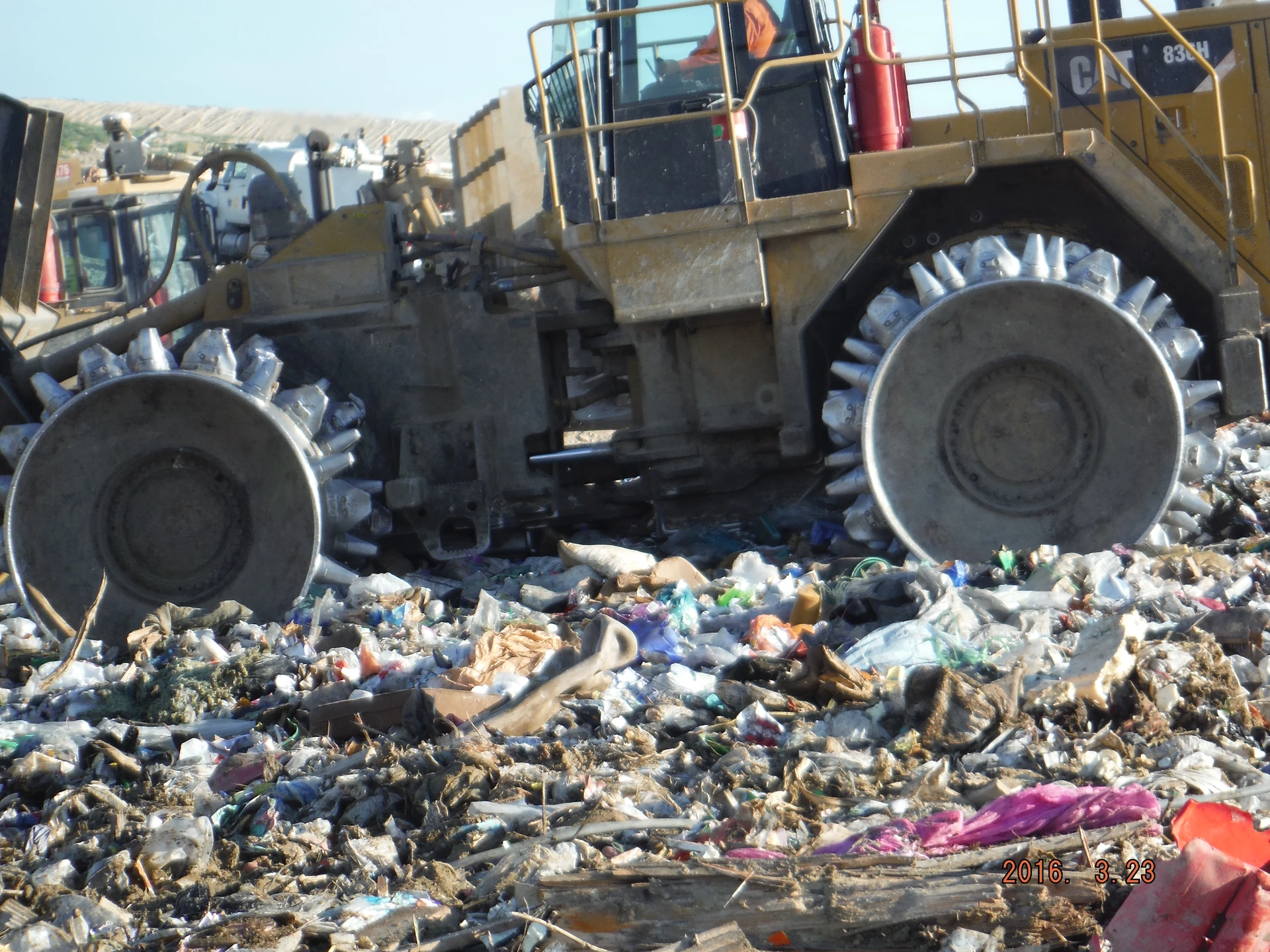
It’s the teeth that do the compacting, so more tooth penetrations always result in greater compaction. Also, when it comes to teeth, a good general rule is to go for more teeth and bigger teeth—think sharks and grizzly bears.
All other things considered, the most important factor when it comes to compacting trash is the moisture content of the waste.
Wet waste simply compacts better than dry waste. During the rainy season, the waste will naturally be wetter. Additionally, you can blend loads of wet waste with dry loads—especially those that contain lots of paper, cardboard, or other cellulose-based material that become softer when wet. Some landfills spray or inject leachate into the waste mass to add moisture to the process.
How You Cover It
The fourth factor is how you cover the waste. Subtitle D and state regulations require that waste be covered with a minimum of 6 inches of soil at the end of every operating day. Unfortunately, virtually every landfill that uses soil for covers, uses more than 6 inches. Excessive use of cover soil is the single biggest factor associated with wasted airspace at modern landfills. Think about it—it costs money to excavate, transport, and place cover soil, and then it takes up valuable airspace that could otherwise have generated revenue.
Landfills can reduce soil use by first finishing the trash to a smooth, uniform surface and then carefully placing the soil with a small, maneuverable dozer. A D5 or D6 with a 6-way blade is ideal.
An even better option is to not use soil at all—at least to the extent possible—but use some type of alternative daily cover.
If we had to prioritize our focus on the most important step a landfill could take toward reducing airspace consumption, it would be to reduce the amount of soil used for daily and intermediate cover, period.
We often see improvements in the range of 15–40% in airspace consumption rates by focusing on these four key operational drivers.
With those operational criteria in mind, think about your landfill’s closure date. The date that was based on the available remaining volume, divided by your landfill’s annual airspace consumption rate.
As a point of comparison, let’s look at the example landfill that had 3,000,000 cubic yards of remaining capacity and was consuming 300,000 cubic yards per year. What happens if that annual airspace consumption rate is reduced to 200,000 yd3 per year? The landfill’s remaining life extends from 10 years to 15 years! Remember that second wish, that we had more time to build that closure fund? Well, here it is.
Not only would this provide more years to accumulate the needed funding, but it would also provide additional time to plan and permit whatever comes next—a landfill expansion, new landfill, or transfer station.
At the end of its life, despite all your operational efforts at longevity, your landfill will be closed and capped. Yet you can still help reduce those overall closure costs by customizing your final cover design. It may be exciting to have a complex final cover design that includes low permeability soil, synthetic materials, a gas vent layer, a coarse-grained capillary break, a geosynthetic clay liner (GCL), or other jazzy geotechnical materials, but those complex final caps are expensive to build and maintain. As an alternative, you might consider a monolithic (single layer) system. These are sometimes referred to as evapotranspiration (ET) cover. Consisting of a single layer of soil, such caps are often constructed using the landfill staff, at a fraction of the cost of hiring a contractor.
Finally, when it comes to post-closure maintenance, you’ll save money in the long run by making sure the access roads, stormwater control systems, and other improvements are built right the first time. And if some maintenance is required down the road, address the root problem rather than just putting a band-aid on the symptom. That may cost more than the initial band-aid fix, but not in the long run.
I know it's been weird talking about closure costs without getting into the actual cost of building the cap or laying out the plastic. But as you've seen, many other factors impact closure and post-closure, that have nothing to do with the direct costs of closure. You’ve also seen that there are many aspects of landfill operation that have a major indirect impact on closure.
Landfill closure and post-closure costs will at some point be your reality. Start working now to help minimize the shock and cost of those activities. You’ll be glad you did.
Latest from Waste Today
- Worn Again Technologies unveils Accelerator plant to advance polycotton recycling
- Nashville Waste Services launches new digital route system
- ACUA landfill expansion project unanimously approved
- Clean Energy announces multiple RNG deals with fleets nationwide
- Interchange 360 to operate alternative collection program under Washington’s RRA
- Waste Pro files brief supporting pause of FMCSA CDL eligibility rule
- New Way Trucks expands US network with Joe Johnson Equipment
- Tire Industry Project publishes end-of-life tire management guide