Location: Deerfield, NJ
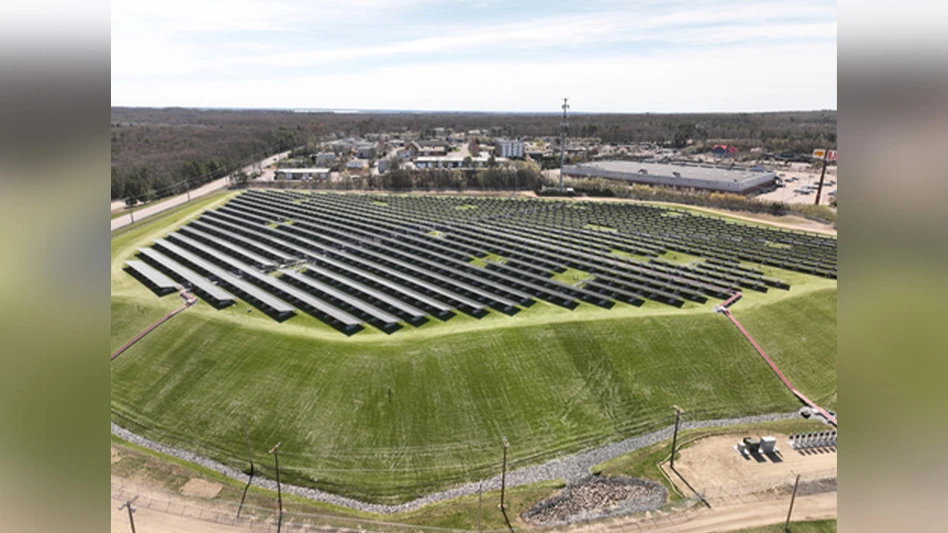
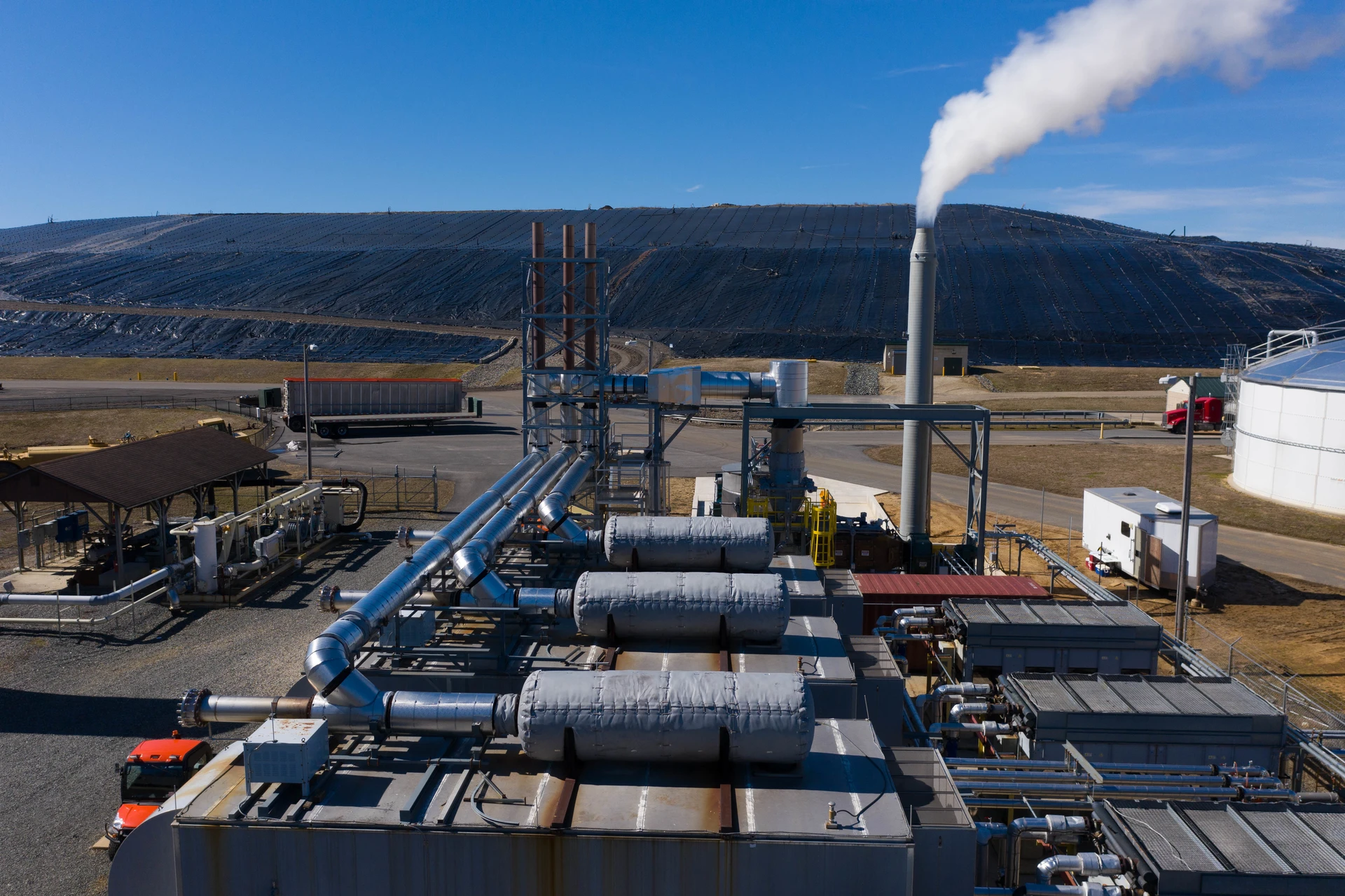
Cumberland County Improvement Authority Solid Waste Complex
- 275 acres permitted
- Over 6 million tons of waste in place
- Receives approximately 750 tons per day of solid waste
Key Takeaways
- RO Concentrate Treatment – direct contact evaporation is one of the best ways to treat challenging Reverse Osmosis (RO) concentrate
- Cogeneration for Evaporation – beneficial use of engine exhaust for evaporation improves engine efficiency and cost-effectively evaporates leachate
- Environmental Sustainability – through on-site evaporation, The Authority is taking significant steps toward achieving their sustainability goals
- Energy Efficiency – beneficial use of engine jacket heat preheats water and improves treatment effectiveness
- Economic Benefits – RO Concentrate treatment reduces overall leachate treatment costs
Case Study Overview
In 2018, Operators of the Cumberland County Improvement Authority (“The Authority”), in partnership with their landfill gas-to-energy plant operator Energy Power Partners, saw an opportunity to reduce operating expenses for the county Solid Waste Complex while meeting key sustainability goals for the Authority. By installing the Heartland Water Technology CoVAP leachate evaporation system (see Figure 1), The Authority has saved concentrated leachate transport and disposal costs while increasing energy efficiency and reducing the environmental impact of the Solid Waste Complex.
The Authority
The Authority’s mission is the development, financing, and integration of projects, strategies, and initiatives integral to the sustainability of the economic and environmental future of Cumberland County, NJ. In line with this mission, the Authority has led several projects at the county’s Solid Waste Complex in Deerfield, NJ. One such project has improved both economic and environmental sustainability for the county by installing an on-site landfill leachate treatment plant.
Reverse Osmosis (RO) Concentrate
The Solid Waste Complex, like all landfills, generates landfill leachate. Leachate is wastewater that accumulates when rain falls onto a landfill. The Authority is the only solid waste complex in the State of New Jersey with a direct discharge permit for treated leachate. A treatment facility utilizing a combination of ultra-filtration and reverse osmosis (RO) systems, shown in figure 2, removes contaminates and generates clean water. The contaminates, however, are separated into a smaller waste stream, called RO Concentrate, which is generally three to four times the strength of raw leachate, and which requires further treatment for disposal.
Changes in regulation and a requirement to have multiple disposal options forced the Authority to haul significant amounts of the concentrated liquid over 40 miles to the Delaware County Regional Water Quality Authority (DELCORA) in Chester, PA. With 25 truck trips per week, transport and disposal costs rose to over $1M per year. Additionally, the Authority recognized important environmental impacts and risks associated with so many trucks on the road hauling concentrated leachate.
Energy Power Partners
The Authority first partnered with Energy Power Partners (EPP) to install a renewable landfill gas to energy plant which began operations in November of 2008. EPP is a private market fund manager that specializes in developing renewable energy projects. EPP owns and operates the landfill gas-to-energy plant, located at the Solid Waste Complex. The plant uses three Caterpillar 3520 engines to generate 4.8 MW of renewable electricity.
In early 2018, EPP saw an opportunity to help the Authority address its leachate disposal challenges and increase the overall efficiency of the landfill gas-to-energy plant at the same time by beneficially using engine waste heat to evaporate concentrated leachate using the CoVAP configuration of Heartland’s LM-HT Concentrator. Figure 3 shows the energy distribution of a typical reciprocating engine which is generally only 36% efficient. Sources of heat loss include exhaust, friction, and jacket water.
CoVAP Configuration
CoVAP stands for Cogeneration for Industrial Evaporation. The Heartland Concentrator was designed and patented for using waste heat from engines or turbines beneficially to evaporate wastewater. This is a classic Cogeneration solution.
The Authority’s CoVAP configuration utilizes ~900°F engine exhaust from three Caterpillar 3520 engines. As shown in Figure 4, the exhaust is ducted together and transferred to the Heartland Concentrator which evaporates the concentrated leachate. The concentrator operates under slight negative pressure and pulls the heat across wastewater using a direct contact approach. Additionally, heat from jacket loss is reused to pre-heat feed water and increase the efficiency of the process.
For the Solid Waste Complex, The CoVAP solution has several important benefits. By beneficially using the engine exhaust, EPP was able to increase the overall efficiency of the plant. Additionally, by beneficially reusing the exhaust and jacket water, thermal energy costs, which are often the most significant cost associated with evaporation, were removed. In the same project, the Authority both saved cost and reduced the carbon footprint of the landfill.
Results
EPP began operation of the Heartland Concentrator in January of 2021. The project has been considered successful both economically and environmentally.
Chart 1 shows the water treatment performance of the leachate treatment system between June 1 and August 31, 2021. Total solids concentration increased from 5,000 mg/l in the raw leachate to over 300,000 mg/l in the Heartland residual. This residual concentration corresponded with an over 97% total system volume reduction. The remaining highly concentrated residual waste slurry is suitable for landfill disposal which further reduces the requirements for offsite disposal.
Table 1 shows the improvement in energy efficiency associated with the capture and beneficial reuse of the engine exhaust. By increasing energy efficiency to over 75%, the Authority has reduced its carbon footprint and taken steps toward achieving its sustainability goals.
Conclusion
Onsite leachate treatment reduces costs and removes trucks from the road. Every eliminated trip reduces the environmental risk of hauling leachate around the state of New Jersey and further shrinks the carbon footprint of the solid waste complex by eliminating truck emissions.
Before installing the concentrator, the solid waste complex was hauling 25 trucks per week of RO Concentrate to wastewater treatment plants for disposal. Due to its partnership with EPP and Heartland, the Authority has reduced its annual disposal costs by 20–25% while increasing the efficiency of the energy plant.
Said President/CEO of The Authority Gerard Velazquez, III, “The ability to implement these programs while creating environmentally friendly and sustainable systems is integral to the ongoing operations of The Authority and its partners.”
Latest from Waste Today
- Vermeer announces plan to build new facility in Des Moines metro area
- Buffalo Biodiesel shares updates on Part 360 application to DEC, Tonawanda facility progress
- Capstar Disposal expands roll off dumpster rental services
- Supreme Court strikes down IEEPA tariffs
- Casella details facility closures, expansion efforts
- Zero harm: Building a SIF prevention program for waste and recycling operations
- Casella posts a loss in Q4 2025
- McNeilus names Haaker Equipment first Dealer Partner of the Year