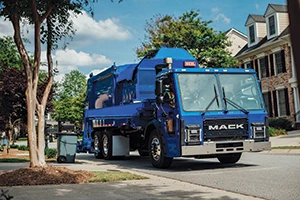
Refuse is one of the most difficult applications, most severe duty cycles,” says Ed Steyn, vice president of engineering with Autocar. He lists factors that combine to make it so: curbing, extended idling, stop-and-start driving, full throttle/full brake, the force on front- and side-loaders, and landfill issues.
Continuous operation, alternating loads, changing weather, and dirt and grime contribute to the test. “It’s dirty; it’s dusty. It’s refuse soup,” says Steyn.
While those conditions are hard on the trucks, they are also detrimental to the efficiency and life of the lubricants that keep the trucks operating.
Location, Location, Location
As a chassis builder, Autocar works with OE suppliers to ensure that the “vehicle works together as a system,” adds Steyn. “It’s very important to work with engine and transmission suppliers to make sure the customer has uptime. We must comply with engine OE requirements and specs; Cummins must approve use of the engine.”
To ensure uptime, Autocar carefully locates components and has a program to integrate bodies and chassis. “Packaging of components is challenging,” acknowledges Steyn. “We recognize that the vehicle is not just a cab and chassis—which we produce. The body builder adds components. It’s all part of a system; we must integrate the body and the chassis.”
Placement is important, he continues. “It helps cleanliness. If we locate components in the chassis out of harms’ way, they don’t get as dirty. For example, placing a washout tank above or below the DEF tank is not a good idea; it gets dirty more quickly.”
Because Autocar works with a lot of body builders and styles, their chassis are individually designed and pre-engineered on the product line. “They are engineered to order, knowing what body will go on,” explains Adam Burck, vice president brand manager. “Parts are pre-engineered to fit together. None of the hydraulic systems needs to be moved to fit the body: no modifications need to be made.”
Placement is also important for fill and check points. Most check points are under the cab, but tilting the cab every day to examine is tedious, Steyn says. “We use fill points and check points on the outside, in one location, close together, within arms’ reach. They are curbside for safety.”
It comes down to the issue of convenience, Curtis Dorwart believes. The Mack Trucks vocational marketing manager says that if the service check points are easy to see and access, there is a higher probability that the system or component will be inspected and maintained at regular intervals.
“Cleanliness is another consideration,” continues Dorwart. “If a fill port or other service item is buried under other components, there is a good possibility that fluid contamination will occur just in the process of topping off a fluid, something we really don’t want to happen. For these reasons, check points for normal service items like oil fill and dipsticks, coolant, power steering reservoirs, and air filter restriction monitors are typically positioned in such a way that a quick visual inspection can be easily done with minimal intervention.”
Cleanliness Counts
While Steyn recommends following the guidelines of suppliers when it comes to lubrication and maintenance, he emphasizes good practices: regular cleaning and routine maintenance intervals. “It is extremely important to do PMs,” he says.
In addition to multiple tables and pages in the manual about when to check lubrication, he says alerts are built into the machine system to aid in reminding the operator. “But you still must routinely check,” adds Steyn.
It’s essential to follow the recommended maintenance intervals for both the truck and the body, agrees Jim Zito, Peterbilt Motors Company national manager of vocational sales. “You need to understand the equipment you have and be proactive to take care of it,” he says. “It is much less expensive to maintain equipment than to repair it.”
Keeping the truck and body clean is essential. Zito suggests running every unit through a wash at the end of each day.
“It helps prevent debris and contaminants from affecting a component or system and it makes it easier to spot any possible leaks.”
If there is a leak, he says it should be taken care of immediately. Not only does it prevent any issues with the unit being pulled out of service, but it can help prevent larger problems if the fluid levels become too low for safe and normal operation.
“For fluids, filters, and other parts, we recommend using OEM-approved replacements,” says Zito. “You don’t want to compromise expensive systems to save a few dollars on commodity items.”
Nor do you want to compromise the systems by using dirty oil. “Sucking in dirt creates wear,” notes Mark Barnes, with Des-Case Corp.
Equipment lasts three to four times longer if maintained at acceptable levels of cleanliness. The problem is that new oils in bulk delivery are not clean, he observes. “Twenty years ago, a British research study looked at a group of construction equipment and the cleanliness of hydraulic oil. The dirtiest contained 42% particles—metal—while the cleanest had only 7%.”
He says fluids are typically 8–16 times dirtier than they should be. Adapter kits for barrels of oil help reduce dirt by sealing them against contamination.
The typical desiccant breather cannot be sealed. “It must be able to breathe,” explains Barnes. “It’s a tradeoff. The challenge is it’s open to the environment at all times, so it gets saturated with moisture and must be replaced.”
The newly developed EX breather, launched nine months ago, provides the best of both worlds, he says. When it’s “breathing,” it completely seals while exchanging air.
When the hydraulic cylinders extend, oil flows out of the tank into the arm, creating low pressure in the tank and causing the valve to open. Once the pressure equalizes, it closes again. In addition to lasting two to three times longer than standard breathers, Des-Case’s EX breather doesn’t put oil in the air, making it ideal for working in environmentally sensitive areas.
Latest from Waste Today
- Vecoplan to present modular solutions at IFAT 2026
- Terex Ecotec appoints Bradley Equipment as Texas distributor
- My Green Michigan expands depackaging capacity
- Washington selects Circular Action Alliance as PRO
- Ten-8 Industrial opens new central Florida service center
- Triumvirate Environmental acquires Environmental Waste Minimization
- Official NYC Bin availability expands ahead of deadline
- US Food Waste Pact’s 2025 Impact Report shows decrease in food waste