Waste collection does not stay constant. Like any other industry, it changes and grows with each new innovation in machinery or technique. Other industries consciously adopt the formal process of “continuous improvement” to advance their capabilities and improve the quality of their products and services. Waste collection is no different. The methods of continuous improvement include ongoing efforts to improve methods, techniques, products, services, or processes. These improvements can be incremental or can occur suddenly in great leaps of innovation.
Continuous improvement for waste management is not just desirable; it is also necessary since the nature of the waste stream continues to change over time. Recycling efforts have played a major role in these changes, beginning with the reduction of organic wastes (food wastes, yard wastes, leaves, etc.) by removing them from the community waste stream and sending them to separate composting operations instead of landfills. This required changes and accommodations to residential collection procedures. Collection and shipment to single-stream material recovery facilities (a.k.a., “dirty MRFs”) require different equipment and collection methods. Bulk collections from commercial and multi-family residential units require yet another method of pickup and delivery. These different applications notwithstanding, each type of waste collection and hauling operation can benefit from the process of continuous improvement. These include increased truck sizes, more efficient routing, and improved pickup and loading methods.
Improvements in Waste Collection Load Capacity—Changes in Truck Classifications
A recent development is the expanded use of Class 7 (which includes fuel trucks, heavy-duty garbage trucks, dump trucks, and beverage delivery) collection trucks instead of traditional Class 6 trucks (which includes dump trucks, garbage trucks, and concrete trucks). Class 6 is a medium truck with a 19,500-to 26,000-pound capacity (average 23,000 pounds). Class 6 waste management trucks tend to have both lower gross vehicle weight and tare weight and come equipped with three axles. Class 7, the next size up, has a capacity from 26,000 to 33,000 pounds (average 29,500 pounds) and requires a Class-B commercial driver’s license (CDL). The heavier-duty Class 7 has both greater GVW and tare weight and is serviced by four axles. Aside from the volume and weight efficiencies inherent in the larger vehicle, their use requires modifications in collection and transport procedures, especially in residential areas. Still, the incremental increase in the use of larger and more efficient trucks with a higher payload-to-cost ratio represents a significant continuous improvement.
The Class 7’s average increase in tare weight of 6,500 pounds represents a 28% payload increase. The average American produces 4.4 pounds of waste per day (US EPA data), with a family of four producing 6,351 pounds of waste each year. This represents a weekly pickup of 122 pounds. An average Class 6 garbage truck can collect waste from 188 residential customers. The Class 7 can accommodate an additional 54 customers per hauling route, or 242 customers. If properly taken advantage of, this tare weight increase can result in the need for proportionally fewer trucks, and lower associated fleet operating costs. The key to efficient truck usage lies with proper routing of the trucks.
Improvements in Waste Collection Methods—Truck Routing
Even as basic a waste hauling operation as truck routing can benefit from continuous improvement. The benefits from more efficient truck utilization become obvious after examining the fuel consumption and operating costs incurred by a typical waste collection truck. These vehicles can travel up to 30,000 miles each year with a fuel efficiency rating of only 3 miles per gallon of diesel. The resultant annual fuel consumption of 10,000 gallons of diesel at a nationwide average cost of $2.34 per gallon (“On-Highway Diesel Fuel Prices,” Energy Information Administration, 2016 cost data) represents a cost of almost $25,000 each year.
A waste collection fleet serving a large metropolitan area could typically utilize 50 waste collection trucks with each servicing approximately 2,000 residential customers, or 100,000 total customers. Total fuel costs for this fleet would be $1,259,000. For such an operation, workers’ fringe benefits and workers’ compensation could approach $10,000,000 annually. Capital costs for truck purchase and replacement would average around $1,600,000 per year, with maintenance expenses being another $1.5 million annually. Total capital costs, expense, and overhead would amount to almost $15,000,000. This represents an annual operating cost of $150 per pickup stop or $300,000 per truck (based on data from “The True Cost of Garbage Collection in Pittsburgh: Can the City Compete with Private Contractors?” Allegheny Institute Report #08-02 July 2008).
So, incremental improvements in routing that minimize the amount of time required for each pick up would yield significant cost savings over time. Using the above example, even an incremental 10% decrease in average time per pickup would yield significant cost savings. First off, assuming improved routing, the truck fleet could be reduced to 45 trucks, each servicing 2,200 customers. Improved routing would reduce truck movement (and measured truck miles) by 10%, trimming annual fuel costs by $126,000. Maintenance and capital replacement costs would also fall proportionally by $150,000 and $160,000 respectively. A proportional decrease in labor costs probably won’t be achieved, since management and support staff would not experience the same staffing cuts as the drivers. Yet a smaller 5% reduction in labor costs would yield savings of at least $500,000 per year. Under this hypothetical example, total annual costs from a 10% improvement in truck routing would result in annual savings of $936,000.
The goal of improved truck routing is to eliminate any wasted movement and inefficient allocation of trucking assets. This allows for improved per-hour waste collection rates and an increased number of households served each shift. However, there are limits to how efficient a truck’s hauling route can be. With experience and the use of routing software, a fleet operator can achieve maximum routing efficiency. This upper limit is determined by multiple local factors such as population density, road net availability, use of transfer stations and material recovery facilities, location of landfills, weather and seasons, the efficiency of landfill disposal operations and resultant truck queuing at the landfill entrance gate, waste compaction densities achieved by the collection trucks’ internal hydraulic compaction system, and type of pickup (residential, commercial, or roll-off). A perfect, 100% efficient truck hauling route is not physically possible. So, what kind of incremental improvement can be made to further overall operational efficiency? These can be found in the individual trucks, their crews, and their methods of waste pickup and loading.
Improvements in Waste Collection Techniques—Waste Pickup and Loading
There are six types of waste collection trucks: three basic and three designed for specialized functions. The basic types are defined by the location of their loading mechanisms: front loaders, rear loaders, and side loaders. The specialized truck types rely on vacuum extraction loading or long reach automated grappling arms, or are utilized exclusively for the pickup of recyclable materials. Each is designed to service a particular market (residential, industrial or commercial, and direct recycling).
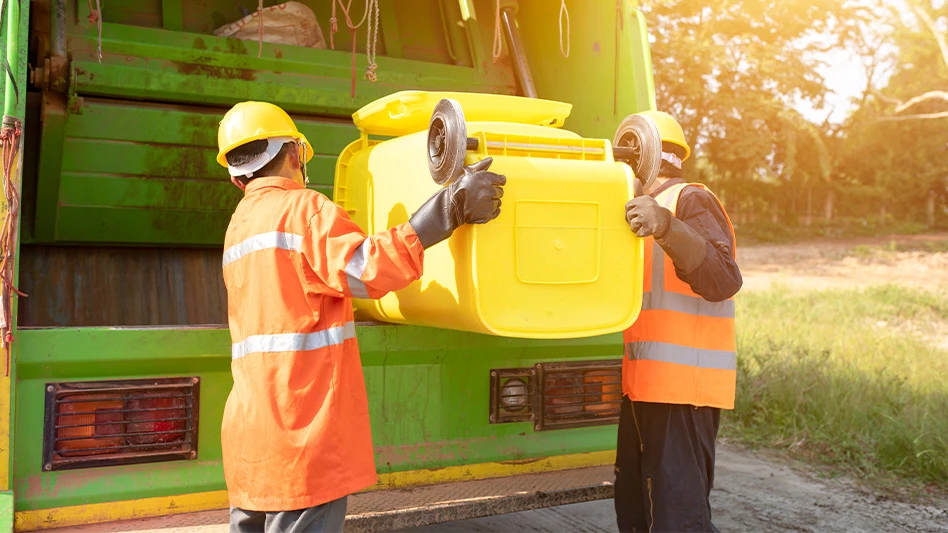
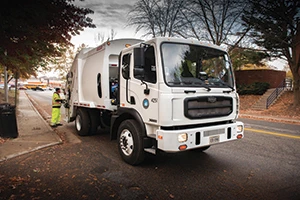
Standard trucks vary depending on the size of the waste container being loaded, which in turn depends on the source of the waste being generated. Front loaders are designed to lift and load the contents of dumpsters containing waste from industrial operations, demolition debris, commercial businesses, or multi-residential housing units. It utilizes a forklift (powered by hydraulic lift cylinder or rotary actuator) whose arms are inserted into metal loops on the exterior sides of the dumpster, which then lift and dump its contents into a hopper in the rear of the truck. Rear loaders are typically utilized for individual residential curb pickup of waste cans and containers. These are typically loaded manually by the truck’s crewmen. Hydraulic blades inside the hopper take the deposited waste and sweep it forward, compacting it to a high density. Manual crew loading can be augmented by automated loading systems combined with specially designed waste cans called toters, which are larger than normal cans. These are designed to physically line up with a special groove slot in the truck with an automated loader and be lifted into place for dumping. Automated side loaders operate in the mid-range between large dumpsters handled by front end loaders and individual waste cans that are manually loaded. These mechanisms pick up medium sized dumpsters and mobile garbage bins. Some models utilize grabber arms that can reach up to 9 feet and are operated by the driver within the cab, which reduces or eliminates the need for a loading crew accompanying the truck.
In general, size and shape matter as much or more than weight. For example, a standard 95-gallon waste cart typically weighs 350 pounds when fully loaded. Available hydraulic systems can lift twice that weight. It is the dimensions of the cart, bin, can, or dumpster that determine if it mates up with the grappler or forklift arms. Design of the waste containers also has to be modified in order to fully utilize automated loading systems.
Specialized trucks are designed for unique functions. Recycling trucks are designed to manage both multi-stream (separated by the homeowner or public service into separate waste categories) or by single-stream (commingled recyclables that require separation and sorting at the MRF) waste flows. Recyclable trucks have hoppers divided into four chambers to receive four different types of recyclables (typically newsprint, cardboard, metals, and glass). Recyclables are loaded loosely without compaction to avoid difficulties separating the material when it arrives at the MRF. As such, recyclable trucks tend to be less efficient overall and require greater labor involvement, costs that are mitigated by resale of the recycled materials on the commodities markets. Vacuum extraction trucks utilize flexible pneumatic tubes positioned by cranes and booms to apply negative pressure to suck up liquid and semi-liquid waste from tank containers. Grapple trucks utilized clamshell buckets or orange peel grapplers connected to the end of extended booms to reach down and grab large, odd-shaped waste objects typically found at industrial facilities and construction sites. These types of waste trucks usually require less labor—often just a driver and a spotter or positioner.
Improvements in Waste Collection Services—Changes in the Waste Stream
What is picked up by waste trucks is as important how it is picked up. And the biggest changes to the types of waste being collected have resulted from community commitments to recycling and composting programs. According to the EPA (2012 data), the residential waste stream on average consists of the following categories by weight:
“… newspaper/mechanical papers recovery was about 70% (5.9 million tons), and about 58% of yard trimmings were recovered. Organic materials continue to be the largest component of MSW. Paper and paperboard account for 28% and yard trimmings and food waste account for another 28%. Plastics comprise about 13%; metals make up 9%; and rubber, leather, and textiles account for 8%. Wood follows at around 6% and glass at 5%. Other miscellaneous wastes make up approximately 3% of the MSW generated in 2011.”
Recycling and composting can greatly reduce the amounts of one or multiple waste categories, depending on market conditions and the emphasis placed on the recycling program. Just sending food waste and yard waste to composting operations (or relying on local composting efforts) can cut the waste stream by more than one-fourth. Removal of other potentially valuable recyclables (ferrous and non-ferrous metals, plastic, glass, newsprint, cardboard, etc.) typically occurs at a single-stream “dirty” MRF. These materials would have to be hauled by waste trucks to the MRF and would not affect initial pickup or hauling operations. That would require source separation by homeowners and the hauling of these materials to multi-stream “clean” MRFs.
In any case, source separation of waste materials would result in a significant drop in the mass of waste being picked up at each location. A separately dedicated fleet of recycling trucks would pick up the recyclable material, but the cost of these vehicles would be accounted for in the overall recycling business plan. The primary waste-hauling truck fleet would require fewer trucks and less labor, causing a daisy chain of cost savings similar to the one described above.
The Concept of Continuous Improvement—Applying It to Waste Collection
Continuous improvement is a management concept that seeks to continuously improve operations, services, and products while reducing costs and increasing efficiency. It focuses on reducing the amount of time required to perform tasks and provide services, reducing waste materials and wasted time and effort, and improving responses to changing conditions and customer needs. It is formally defined by the Institute of Quality Assurance as:
“Gradual, never ending change focused on increasing the effectiveness and/or efficiency of an organization to fulfill its policy and objectives. It is not limited to quality initiatives. Improvement in business strategy, business results, customer, employee and supplier relationships can be subject to continual improvement. Put simply, it means ‘getting better all the time.’” (IQA Fact Sheet #7)
Its basic philosophy assumes that any business, production, or service related activity—even something as commonplace as trash pickup and hauling—can be improved. Furthermore, it believes that this improvement best comes from the workers on the line performing these tasks, not senior management. It is a bottom-up operation, not a top-down direction. This makes employee involvement the foundation of the whole improvement process. More than half the battle is installing this philosophy in a waste hauler’s work force.
Major Suppliers
Autocar celebrated its 120th anniversary in October and still builds waste collection trucks custom-engineered for each customer’s specific jobs and situation. In doing so, they integrate the truck chassis and body controls, fuel systems, and other components, resulting in many advantages to the truck owner. Autocar’s customers have documented significant improvements in uptime as well as reduced maintenance and operating costs resulting from this unique approach to integration. Their Autocar Solutions service command center provides free support from actual truck technicians, not operators, to handle technical questions and help get trucks back into service as fast as possible. They provide industry-leading after-sales service with real-time assistance, training classes, and access to technical documentation. A steady stream of advances has made their ACX Xpeditor one of the most versatile refuse trucks on the market. It comes with a wide range of powertrain choices and the ability to meet strict exhaust emission level requirements. In May, Autocar was the first truck OEM worldwide to offer FuelSense 2.0, which can reduce fuel consumption up to 6%. Autocar also offers the Class 7 ACMD Xpert truck to handle medium-sized loads while still providing a three-man cab and factory-installed dual-driving options. The new ACMD 6×4 can handle loads up to 22 yards and fit in narrow urban streets and alleys.
Labrie’s innovative designs can be found in their side loader trucks. Their Automizer right-hand side loader features a strong, light-weight body with a reliable loading arm that can reach farther (12 feet, lifting up to 1,000 pounds fully extended) than any other automated side loader. This arm is easy to operate with an electric over hydraulic joystick control, and the zero-grab low swing-out allows for collection in narrow spaces. It is a solution for customers who want a strong, lightweight ASL that can dump inside low-ceiling transfer stations, or that just feels more comfortable to operate on soft landfill terrain.
New Way Trucks produces a wide variety of refuse and recycling collection bodies including front loaders, rear loaders, satellite bodies, and automated side loaders, but its Mammoth front loader is in a class by itself. Their new 15,550-pound Mammoth front loader includes a range of features designed for high productivity in refuse and recyclables collection. It comes with one-piece body side construction and a curved shell and floor with the highest steel specs in the industry, for superior strength and streamlined appearance.
The Mammoth’s standard features include 10,000-pound lift arms, a four-split bearing block with bronze bushings, and an easy-adjust deceleration valve, giving the operator precise control of the arm’s return to the truck body. It is also equipped with two safety cameras: one to observe the hopper and one for backing up. The Mammoth is available in all standard sizes: 34-yard, 37-yard, 40-yard (fewer options available), and 43-yard. A lighter-weight West Coast unit is also available with all the same features of their regular unit.
In addition to the size advantages provided by the Mammoth, New Way also provides equipment for specialized applications, as shown by their auger-driven ROTO PAC automated side loader for organics or MSW collection. Not only does it achieve the goal of maximizing collection efficiency, but the ROTO PAC also takes advantage of ongoing changes to the waste stream and addresses the challenge of collecting segregated organics, including food waste.
The ROTO PAC is specifically designed to handle the high liquid content of food waste from curbside residential and commercial cart-based programs and does it efficiently and productively. Customers focused on waste diversion will appreciate the benefits; organics and food waste represent a significant portion of the waste stream, and a unit specifically designed for organics with the added benefit of being able to also collect MSW can maximize diversion without compromising on equipment.
The New Way ROTO PAC side loader is a major step in achieving this goal. With multiple pickup days becoming common (organic waste on one day and residential MSW later in the week), waste haulers can either have separate specialized trucks or one truck that can do both jobs. The dual-purpose ROTO PAC is designed to provide this operational flexibility. Instead of a standard sweep and compacting hydraulic blade, it has a self-cleaning auger that not only more efficiently compacts organic materials, such as grass clipping and food waste, but will automatically reverse in the event of a jam. The 23,000 pounds of auger torque allows for quick compaction and self-cleaning, eliminating downtime to clean out behind the packer RAM. The automated arm has a 12-foot reach and can manage up to 500 pounds at maximum extension. Its high capacity 27-cubic-yard body, and the highest legal payload in the industry at 25,000 pounds, further increases its efficiency. The auger design reduces maintenance expenses because costly packing cylinders are eliminated and a sealed hopper and body design allows for a leak-free route with its 40-inch-high sealed hopper for containment of liquids. Drivers love operating the ROTO PAC too. The unit has an ergonomic design like New Way’s famous Sidewinder side loader, and the auger is simple to operate through the same joystick that controls the lift arm.
Latest from Waste Today
- Vermeer announces plan to build new facility in Des Moines metro area
- Buffalo Biodiesel shares updates on Part 360 application to DEC, Tonawanda facility progress
- Capstar Disposal expands roll off dumpster rental services
- Supreme Court strikes down IEEPA tariffs
- Casella details facility closures, expansion efforts
- Zero harm: Building a SIF prevention program for waste and recycling operations
- Casella posts a loss in Q4 2025
- McNeilus names Haaker Equipment first Dealer Partner of the Year