In many ways, material recovery facilities (MRFs) are harsher work environments than landfill working faces. During both operations, the protection of human health and the environment are primary concerns. While not exposed to the elements, the management of waste in a confined building has its own hazards. Enclosed facilities that do so are referred to as either MRFs, or transfer stations. Since the processing of waste at a MRF is more extensive and time consuming than at a transfer station (among other polar opposite operational characteristics), MRF operations are more prone to the hazards of dust and debris as well as the discomfort of odors. In fact, MRFs face similar operational hazards as those found in factories and construction sites but with additional dangers.
As such, MRFs require specific safety features to protect human health and the environment. Liquid spills are usually managed by the facility’s containment structures such as foundation walls, sloped floors, raised curbing, inlets and grates, drainage pipes, sanitary sewer pipelines, and collection tanks. Since waste is highly combustible, and can give of dangerous emission if set ablaze, fire is a serious concern. Fire protection is provided by systems of chemical and water sprays operated by the facility’s hydraulic system. Odor and dust control, on the other hand, have more to do with operations and material processing instead of the building’s structure. To minimize dust formation and odor emissions additional control systems are needed.
MRF Operational Characteristics
A MRF is basically a reverse factory. Factories take raw materials, shape them and process them into durable goods and other material products along with their associated packaging for shipping. At a MRF, finish and discarded goods and products are disassembled into their component waste materials.
There are two types of MRFs: a multiple stream “clean” MRF, and a single stream “dirty” MRF. Materials arrive at a clean MRF essentially already disassembled and separated by their waste sources. The result is a multiple number of waste streams of individual waste types arriving at the clean MRF so they can be properly stockpiled and prepared for shipping back to recycling markets for resale.
This makes it simple to sort, collate, and organize recycled materials. Therefore, a clean MRF can rely mostly on human labor and simple equipment instead of complicated processing machinery. As there is relatively little mechanical processing at a clean MRF, these facilities are less prone to odor emissions and dust generation.
A dirty MRF, however, lives up to its name. It receives only one massive stream of commingled waste from multiple sources that is further mixed together during collection and transport. These waste types include:
- Organic waste, any waste material derived directly from plant and animal sources (food waste, vegetation removed during clearing and grubbing operations, cotton and woolen fibers, etc.)
- Paper, a wide-ranging category that makes up the largest single type of commercial and residential waste, such as office paper, newsprint, magazine stock, corrugated cardboard, etc.
- Commercial plastics, found mostly in waste containers such as milk jugs and shampoo bottle with literally dozens of configurations, variations, and types, such as HDPE, PVC, PET, etc.
- Ferrous and nonferrous metals, which are the easiest waste types to remove from the waste stream via electromagnetism
- Glass of all colors (clear, amber, brown), cullet, and ceramics
- Fabrics from clothing, including rubber, leather, and textiles.
- Miscellaneous other waste, including large objects such as
major appliances
Each type of waste has different material characteristics in terms of size, density, moisture content, combustibility, propensity to biological degradation, and ferro-magnetism. Individual sheets of office paper and newsprint are relatively small and of low density, while corrugated cardboard boxes are also of small density but of much large size. Plastic is low density, variable in size, low moisture content, and very flammable (being made from petroleum). Organics and paper can be composted or removed by high-pressure water streams and end to anaerobic digesters as feedstock for methane fuel production. The methods for extracting and separating out different types of waste materials are almost as varied as the materials themselves, and include the following:
Metallic objects of all sizes can be removed by Magnetic Separators and Eddy Current Separators. Magnetic Separators remove ferrous metals by means of magnetic attraction. Eddy Current Separators extract non-ferrous metals via induced currents generated by rapidly rotating magnets.
Organics (paper of all types, cardboard, wood debris, food waste, etc.) can be removed by the brute force method of hydro-pulping. Water jets operating at high pressure and high-velocity blast into the wastestream. The force of the water blasts shreds, dissolves, and pulps organic materials, making it easier for them to be carried away by the water stream piped to an aerobic digester to produce methane fuel.
Human workers performing manual removal of waste types remain an integral part of any MRF operation. Manual laborers are especially useful in the removal of large, heavy objects such as appliance and machinery when they first arrive at the MRF, as well as irregularly shaped objects that the MRF’s separation machinery may have difficulty handling.
Disc Screeners separate out large, lightweight objects, such as cardboard boxes. They do so by passing waste over a floor equipped with rotating discs of various sizes and shapes (depending on the material being processed) whose movement creates a wave like motion that carries large/light objects to the top for easy removal.
Rotating Trommels remove the opposite kind of objects than disc screeners. They remove small, heavy objects like fines, soil grit, shards, and other organic and inorganic residue. These are rotating drums with holes perforating their walls. As the drums rotate, these small and heavy objects fall out to be disposed of, leaving a polished waste stream coming out of the drum’s exit for easier recycling and processing.
Air Classifiers are structures resembling chimney stacks. They are equipped with blowers that pull small, light waste objects such as paper and newsprint up out of the main waste stream. Many are also equipped with a second stage cyclone separator that can further separate paper types by size and density. A refinement of the air classifier is the air knife. This utilizes “blades” of air that create sheets of high-pressure air flow arranged in parallel. Each air blade has a different velocity and pressure, which allows for the further separation of different grades of paper, magazine stock, and newsprint.
Multi-colored waste objects (plastics and glass of all types) can be removed by color separators. These utilize LSP meters that read the wavelength of the light reflect off of the glass or plastic object. The reading then instructs a series of high-pressure air blows to push the object at the right time into the appropriate storage bin. Infrared sensors (similar in operation to LSP meters) are used read the density of plastic objects and thereby determine the type of plastic it is made from. Again, this information is sent to a series of blowers that push the object into the correct receptacle.
In broad strokes, the purpose of a dirty MRF is to take a single mass of incoming waste, separate out its individual components by type, stockpile and store these segregated materials, bundle and package them for shipping, then load them and transport them for sale in scrap markets and recycling facilities. They do this by means of an often complicated series of equipment operating sequentially on a waste stream that gets smaller as it progresses on moving belts through a series of removal stations.
And at each step along the way, the facility is presented with a unique set of challenges in regards to managing dust and odor. Dust can irritate lungs and create choking hazards, irritate eyes, and reduce visibility, diminish worker safety, and foul up machinery and moving parts. Meters and sensors are also affected, such as optical sorters used to remove plastic and glass waste. Though the enclosed nature of the facility can prevent significant amounts of dust from escaping and impacting surrounding areas, this can result in high concentration of dust inside the building itself.
Similarly, given the organic and putrescible nature of much of the incoming waste stream, odor is a serious concern. This is not just a discomfort, there are serious health and safety issues associated with waste odor emissions. Decomposing waste can give off both carbon dioxide and methane deepening on its stage of decomposition and moisture content. Both gases are extremely dangerous in confined locations as they can accumulate to high degrees of concentration. Other potentially toxic gases, such volatile organic compounds (VOCs) and semi-volatile organic compounds (SVOCs) may be present in the wastestream in amounts that could represent a chronic health hazard to facility workers. Lastly, oxygen oddly enough can also be considered a gaseous threat given the combustible nature of most of the wastestream. Certainly, the smoke from even a small waste fire is an obvious health and safety threat.
So at each stage of the waste recycling process there is a danger from dust formation and odor emission. MRFs need to be equipped with systems designed specifically to manage and remove, if not eliminate, dust and odor. The configuration and operation of each system depends on the facility’s floorplan, machinery layout, and processing methods.
Dust is a generic term for tiny solid particles, typically less than 500 microns in diameter. In addition to sin and eye irritation and reduced sight, dust can have serious health consequences if inhaled. For occupational health purposes, airborne solids are categorized by size as either respirable or inhalable. The larger particles (average size of about 10 microns) in the inhalable dust classification are typically trapped in the nose, throat, or upper respiratory tract. Particles smaller than 10 microns are small enough to penetrate deep into the lungs.
Odor can be classified as either transient (sometimes apparent) or steady state (all the time). Most of the odors humans find offensive are the result of nitrogen- or sulfur-bearing compounds. When materials containing these compounds decompose, the nitrogen and sulfur atoms develop volatile molecules that give off odor.
MRFs (as well as transfer stations) have a tipping floor where incoming waste is initially delivered. The tipping floor is sized to properly manage the incoming amount of waste, plus up to an additional two days’ worth of surge capacity. The floor is equipped with containment walls to ensure proper stockpiling if necessary and improve the efficiency of the loading operation. The rest of the facility—which can have more than one operational floor depending on anticipated workload and available real estate space—is occupied by the processing equipment. A highway of moving heavy-duty industrial grade belts connects this equipment. These belts are loaded with waste and then proceed to carry the waste to and through each removal station. Hooks and blades slice open and remove trash bags, spilling their contents onto the belt. Typically, those waste components that are relatively easy to remove (like metals) are extracted first with the most difficult to remove materials being all that remains of the residual wastestream at the end of the removal process.
Removal is just the beginning. The extracted materials are dumped into awaiting bins and other receptacles for initial collection. The bins are wheeled in and out of position as the get filled and are subsequently emptied into their individual storage areas. Bundling, compaction and loading of the waste into transport truck waiting in nearby bays then follows. Outside the facility there can be several acres of additional area devoted to truck scales, approach roads, buffer zones, standby rolling stock, employee parking, visual shielding, and fencing.
Sources of Odor and Dust, and Their Control Methods
Good dust control begins with good process management. Good operating practice is the first step in effective odor and dust minimization. This effort begins on the outside of the facility with access roads and parking lots properly paved and our serviced by water trucks to wet the surface and hold down dust from vehicle traffic. In conjunction with the wetting effort, these surfaces should also be regularly swept by a street sweeper. And being in an enclosed structure, the dust generated by tipping and processing operations at least will not be blown away by the wind and become air borne contaminants.
Odor impacts can also be minimized by effective management procedures. These can include the immediate handling of odor loads and only processing these loads inside of a confined building. Tarping of the loads is also necessary, both during long-term hauling, and as the truck waits in the queue to dump its load on the tipping floor. Proper housekeeping practices, such as the cleaning up and removal of residual waste from the tipping floor and approach roads at the end of each workday, prevent the accumulation of aging, putrescible waste.
What are the sources of the odor that can plague a MRF operation? According to Laura Haupert, director of research and development for OMI Industries:
From an odor perspective, just as we see in any solid waste application, there are a wide-range of odor sources within any MRF. Many odors coming from waste is caused by the biological decomposition of that waste. Waste tends to be more odorous when it has a higher amount of organics in it. These odors often come from decomposing food waste in many of the recycled materials, which have become sour or moldy. In addition, many of these materials have been left in a hot or damp environment for an extended period of time, which can further compound any odor problems. In addition, when it comes to recycled materials there are many kinds of odor sources including moldy cardboard materials, and food waste, which decompose and offer a variety odors. As food scraps, along with other issues with citizens not properly sorting their recycling, make these odors an ongoing challenge for MRF facility managers. The odorous gases from hydrogen sulfide, mercaptans and dimethyl sulfide are the most common sources of odors in the solid waste arena. These compounds give off those commonly known odors that smell of rotten eggs, garlic, skunk, and rotten cabbage. These compounds are detected by the human nose at levels in the parts per billion resulting in foul odors at low concentrations.
Odor management begins with the application of neutralizing chemicals and covering scents to those areas and loads that evidence significant odor generation. These neutralizing sprays are typically mixed with the water misting systems. Chemical odor neutralizers change the chemical nature of odor generating compounds to make them less noxious. Primary treatment methods include adsorption to sticky surfaces, absorption in filter media, chemical oxidation and biological oxidation. Neutralizers are specially formulated oils that are dispersed through nozzle sprays or fans dispersal units. They are chemically attracted to odor droplets and form a thin film around each droplet. Masking agents create a new odor strong enough to crowd out the malodorous compound with a more pleasant scent. Biocides can also be applied to organic waste, but given the relatively short detention time during processing they usually don’t have enough time to kill off the bacterial source of the odor.
Odor is also managed by roof exhaust systems equipped with blowers that are designed to evacuate odors from the building. These systems may not be applicable in high-density urban areas where the vented odors could result in an offsite nuisance to the facility’s neighbors. In that case, instead of simple venting, the exhaust may require filters to trap the chemical odors as they exit. In all cases, air emission controls will be used as need to prevent pollution of the environment. In summary, the best solutions are the ones that can handle a broad range of odor problems, and are also safe for employees and the community at large. There are solutions that use natural ingredients to eliminate and neutralize MRF odors without the need for harsh chemicals or masking fragrances. Masking agents are often unsafe and only “mask” the overall odor problem resulting in a fragrance smell on top of the smelly odors at the MRF. Solutions that use natural ingredients as the active ingredients to eliminate the odors can be dispersed through oscillating fan systems, vaporization, atomization nozzles, and even sprayed on waste and recyclables being transferred by trucks.
Dust (as well as odor control) begins at the entrance gate. In particular, actions that involve shredding, crushing, or screening tend to release significant amounts of dust, which can be generated by paper, plastics, metals, or other materials. Truckloads arriving at the MRF are also visually screened to determine their potential for odor generation or dust production. As a preemptive measure, water sprays (heavier than the misting described below) are used to wet down the truckloads of water as they arrive at the site. Isolation of the tipping floor can also be useful. Separation of this tipping area from the rest of the facility will reduce dust issues. By confining the bulk of the dust generation in one area the potential for dust migration throughout the rest of the facility is greatly minimized.
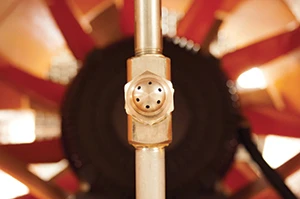
Inside the MRF building, dust is suppressed primarily by means of misting systems. These misting systems are located in critical areas where most dust generation can be expected to occur (shredding, baling, screening operations, tipping floor, bag ripping operations, cardboard screeners, removal stations for certain types of dry wastes, etc.). The equipment used in these operations are a perfect example of up front good management practices that minimize dust generation. For example, a low-speed, high torque rotary shredder will reduce particle and dust generation. In keeping with the practice of segregating dust-generating operations, this equipment is often located in separate buildings. Water for these misting and spray operations usually come from both stormwater runoff storage ponds and tanks, or from the local municipality’s potable water supply system.
Blower systems are also used to apply negative pressure and remove dust particles floating in the air. The blowers are connected to a series of ducts that terminate above dust prone operating stations. The negative pressure pulls the surrounding air into the ducts fixed to the ceilings of the work areas, thus reducing local dust concentrations. These particles are blown to bag houses where they are filtered out of the air stream and trapped for later disposal. These bag houses also trap floating debris such as paper and dry organic waste.
And as a smoke and dust prevention system, as well as safety measure, automatic sprinklers are deployed throughout a MRF as a fire suppression system. All such systems will be able to deploy pressurized water from sprinklers that are automatically triggered by the heat of a fire.
Lastly, individual workers will wear appropriate level personnel protective equipment (PPE). These include particulate dust masks, filter masks, respirators, and eye protection. Other engineered safety systems such as emergency warning systems, emergency shut offs, passive air monitoring, rapid exit egress points, etc. are also utilized in case the main dust and odor control system fail.
None of these procedures practices, equipment and protections will operate effectively without an overall Fugitive Dust Control Plan. Such a plan is typically required at most industrial, mining and construction operations, which does not minimize their necessity or importance. These plans provide a compliance summary and identify fugitive dust sources; appropriate, cost-effective control measures; and estimate of the amount of dust emissions projected annually. It will provide both projections and records of water usage and operating costs. It should also describe how the durst control system complies with mandated Best Management Practices (BMPs) and other applicable regulatory standards.
Major Suppliers
Benzaco Scientific, Inc. researches, designs, manufactures, and applies state-of-the-art chemical and equipment technology for odor control. Using their in-depth understanding of specific naturally occurring compounds to negate foul odors, Benzaco has developed proprietary chemical formulas for their ODOR-ARMOR product line. This product has been used with wide success eli
Latest from Waste Today
- Worn Again Technologies unveils Accelerator plant to advance polycotton recycling
- Nashville Waste Services launches new digital route system
- ACUA landfill expansion project unanimously approved
- Clean Energy announces multiple RNG deals with fleets nationwide
- Interchange 360 to operate alternative collection program under Washington’s RRA
- Waste Pro files brief supporting pause of FMCSA CDL eligibility rule
- New Way Trucks expands US network with Joe Johnson Equipment
- Tire Industry Project publishes end-of-life tire management guide