COR Disposal & Recycling on an upward trajectory in Portland, Oregon

Family-owned COR Disposal & Recycling is recalibrating after undergoing a rapid expansion of its disposal and recycling services in Portland, Oregon.
Editor's Note: This article originally appeared in the September 2024 print edition of Waste Today under the headline “Upward trajectory.”

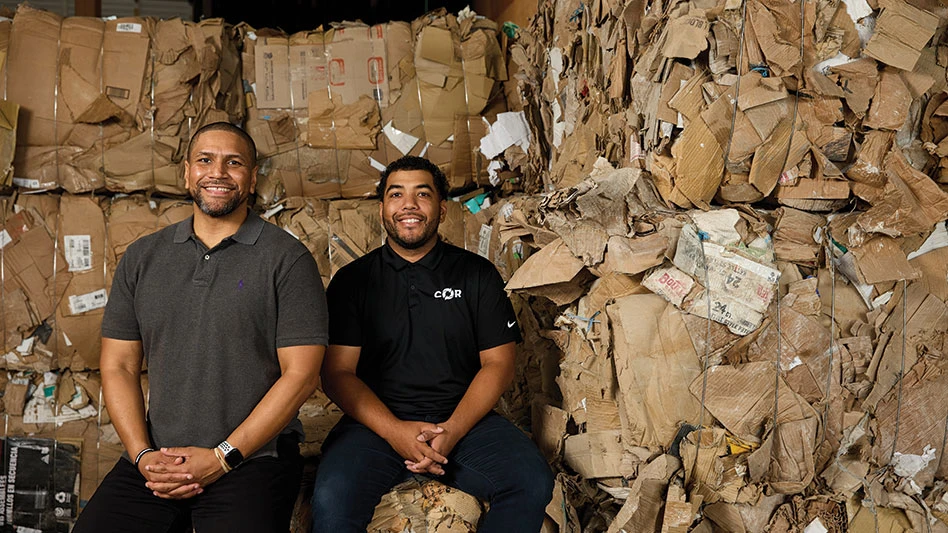
COR Disposal & Recycling CEO Alando Simpson (left) and Chief Operating Officer AJ Simpson
Photo by Craig Mitchelldyer Photography

For COR Disposal & Recycling, a Portland, Oregon-based waste company, growth happened slowly—one step at a time and often through hands-on labor—and then all at once. Since 2019, CEO Alando Simpson says the company’s revenue has grown by more than 1,000 percent.

During a decade of work for the city of Portland’s maintenance bureau collecting and transporting street debris, Alando’s father, Al Simpson, recognized a lack of diversity in the waste and recycling industry. To correct that, he took out a second mortgage on his home to start his own industrial hauling company, beginning with a single roll-off truck and a dumpster.

Al named the company COR Disposal & Recycling after Portland’s “City of Roses” nickname. From the start, he had a mission to grow the business while providing people of color advancement opportunities.

“He did it on his own,” Alando says of his father. “His office was his truck. He’s one of those bootstrappers.”

Over the next decade, COR earned a reputation in the Portland area for providing reliable roll-off box service on construction sites. In 2005, with an ambition to evolve the company into material recovery, Al acquired a 2-acre site to develop a recycling facility to support the company’s continued growth.

Alando officially joined the team around that time, with the primary objective of helping build the recycling facility. He worked to find creative ways to finance the new building and navigate the permitting process. COR began operations at that facility in 2014.

COR could process about 6,000 tons of construction and demolition (C&D) material per year at the site, Alando says, and quickly outgrew the space. Alando’s brother, AJ Simpson, who has a background in accounting and finance, joined COR full time to open a combination material recovery facility (MRF) and transfer station.

AJ says his first task was to build the road leading into the property his father had acquired for the new building. After a crash course with a local contractor, AJ and Alando set out to build the road themselves.

Photo courtesy of COR Disposal & Recycling

“We laid the pipe, set the storm drains and we graded it all,” says AJ, whose next project was cleaning out the 1950s-era building his father purchased to house the company’s MRF.

COR moved into the 100,000-square-foot building on a 12-acre site on Portland’s east side in 2019. In its new facility, COR processes about 130,000 tons yearly. “Since then, it’s been rapid growth,” AJ says.

COR has leveraged its position as the only Black-owned Certified B-Corp waste and recycling company in the U.S. and as the only privately owned transfer station in Portland.

“When we opened our new facility, it was like a Field of Dreams type of thing where we’re very well-located in the east side of Portland. Most major haulers are also parking their trucks near here, so it’s very convenient for them,” AJ says. “Very quickly we needed to learn how to handle volumes we’d never seen.”

In the MRF, COR’s full-scale processing line can process more than 200 tons daily. The company added a new processing line in the past year to sort dry materials, such as C&D debris, and uses two larger excavators to feed the processing lines. COR processes and bales cardboard on-site and also operates a wood grinder to produce hog fuel, a sustainable and renewable source of energy for paper mills.

The company’s fleet comprises more than 20 trucks, including roll-offs, front-loaders and rear-loaders, AJ says. In November, COR rolled out the first electric waste collection truck in Oregon.

AJ now serves as COR’s chief operating officer, and Al is technically retired—though most days he still can be spotted in the facility.

“He’s always holding us accountable and just kind of keeping us on our toes,” Alando says. “He could have never imagined that we were going to be this large.

“Now, I think that our rapid growth is stabilized to a certain extent, and we can actually tighten everything up. We can manage the operation more efficiently.”

Photo courtesy of COR Disposal & Recycling

Growing commercial collection

The company’s next big growth opportunities are securing larger commercial accounts, building collection volumes within the city of Portland and developing partnerships with larger venues.

COR has not been able to expand into residential service, Alando says, because of solid waste regulations in Portland. The city uses a franchise system to provide and oversee residential waste collection service, a public-private hybrid service model that has streamlined residential collections through eight assigned companies.

Still, that hasn’t stopped the company from rapid expansion. Instead, COR has focused on building relationships and synergy with public agencies, public officials, businesses and community-based organization partners to foster growth.

“I think we’ve done a pretty good job of building trust and relationships with them over the past 10 years, and they see the value and benefit of working with forward-thinking, locally owned businesses, businesses of color, businesses that are good stewards of the environment and social equity,” Alando says.

In 2022, COR won the bid on a five-year contract for East Portland public trash can collection and purchased a front-load truck for the job. This year, the company is handling collection for four different sections of the city.

Recent contracts COR has been awarded include Moda Center, the city’s basketball stadium; Providence Park, the city’s soccer stadium; the Oregon Zoo; Providence Hospitals, the Oregon Convention Center and the Portland5 performance venues.

AJ says the company does about 80 percent industrial and 20 percent commercial business; but, with new contracts on the horizon, that ratio should shift to 70-30 in the near future, with COR’s goal being to capture increasingly more commercial business.

A family focus

COR has about 85 employees, 80 percent of whom are women or people of color.

“We are a family-owned business. I think people who work here also feel like they’re part of the family,” Alando says. “We have a lot of people who’ve been here for 15 to 20 years—some dating back to when my dad started the company. People who come tend to stay.”

The company focuses on workforce development and improving the economic trajectories of its employees, including frequently promoting from within and offering an in-house training program with a career pathway for licensed drivers who want to get a commercial driver’s license.

“Most people … we hire, we build them internally,” Alando says. “People move around positions in the company all the time because an opportunity pops up.”

When Al first started in the industry, he faced a certain amount of discrimination as a newcomer navigating the industry, according to his sons.

“Our dad tells stories about being the only person of color in the industry for years. People used to laugh at him and ridicule him and not take him seriously,” Alando says. “When we have big milestones, it’s really begun to sink in just how far we’ve come. I couldn’t have imagined being him and staying motivated when people treat you like that just because [they] can. You were doing it for something greater than yourself, and I think that those types of people, those types of leaders, those types of martyrs who sacrificed for the next generation—those are the real-life heroes.”

Alando and AJ say they always have felt very comfortable in all rooms and places, having conversations with people from all walks of life. I’m sure some people assume that we’ve gotten to where we are because we’re Black, but they don’t recognize the years of hard work our family has put in and what we had to go through to get here,” AJ says. “Working at a facility at this level? It’s not just by chance and by luck that we’ve built the company to what it is, and people keep coming and actually enjoy the service.”

The brothers pride themselves on the reputation for efficiency and speed they’ve developed with the city and Metro, the Portland agency responsible for overseeing the city’s solid waste system.

“I think we’ve become a fan favorite in the city of Portland,” AJ says. “At first, we were just a small company, and they wanted to help a small, local company. But what they learned was that we actually service customers much better than any of the other companies. If you need to talk to somebody, you can pick up the phone and call us and we answer.”

Al’s guiding principles of right and wrong have been woven into the DNA of the company, Alando explains. He commends his brother on his ability to always hone back in on those values, questioning whether the company needs to grow that fast or needs to work with this type of person or hire that type of person.

Photo courtesy of COR Disposal & Recycling

Looking to the future

One big project on the horizon for COR over the next year is building its site for an innovative organics facility. Plans for a 50,000-square-foot building located near the existing transfer station and MRF are in development. The city of Portland has instituted a commercial food scraps policy, which has created a new market for segregating commercial food scraps away from other potentially recyclable items. Alando and AJ are working to come up with new, innovative ways to find higher and better uses for food scraps and organic material, “whether that’s finding upstream ways to minimize [waste], first and foremost; secondly, feeding humans; and, then, looking at renewable energy production,” Alando says.

With Oregon enacting an extended producer responsibility law that places recycling responsibilities on manufacturers, the brothers see the potential to continue to expand COR’s services.

“I think there’s going to be a big opportunity for us to play in that space given the fact that we’re already kind of embarking on this path of innovation and circular economy,” Alando says. “How do we continue to grow and evolve that model so that the largest producers of waste streams, which are manufacturers and human beings, essentially, are accountable for the role that they play in the ecosystem of waste?”

The final phase of opportunity, in Alando’s mind, is becoming a manufacturer of renewable products and renewable energy. He’s envisioning a COR Campus, an innovation hub that would colocate multiple climate tech companies on-site.

“We’re talking about modern infrastructure, buildings [and] utility systems using renewable energy, alternative energy, closed-loop systems, [creating] green jobs in the manufacturing sector for underserved and marginalized communities of color. Thinking like that is really showing how the triple bottom line of sustainability should work socially, environmentally and economically,” Alando says. “Figuring how to crack that code is going to be our next focus, and we have a plethora of partners that are helping us with that.”

The author is managing editor of Waste Today and can be reached at smann@gie.net.

Read Next

Brace for impact

September 2024
Explore the September 2024 Issue

Check out more from this issue and find your next story to read.