Collection vehicle bodies and chassis have experienced significant changes over the past decade, which have paved the way to meet contemporary needs and challenges.
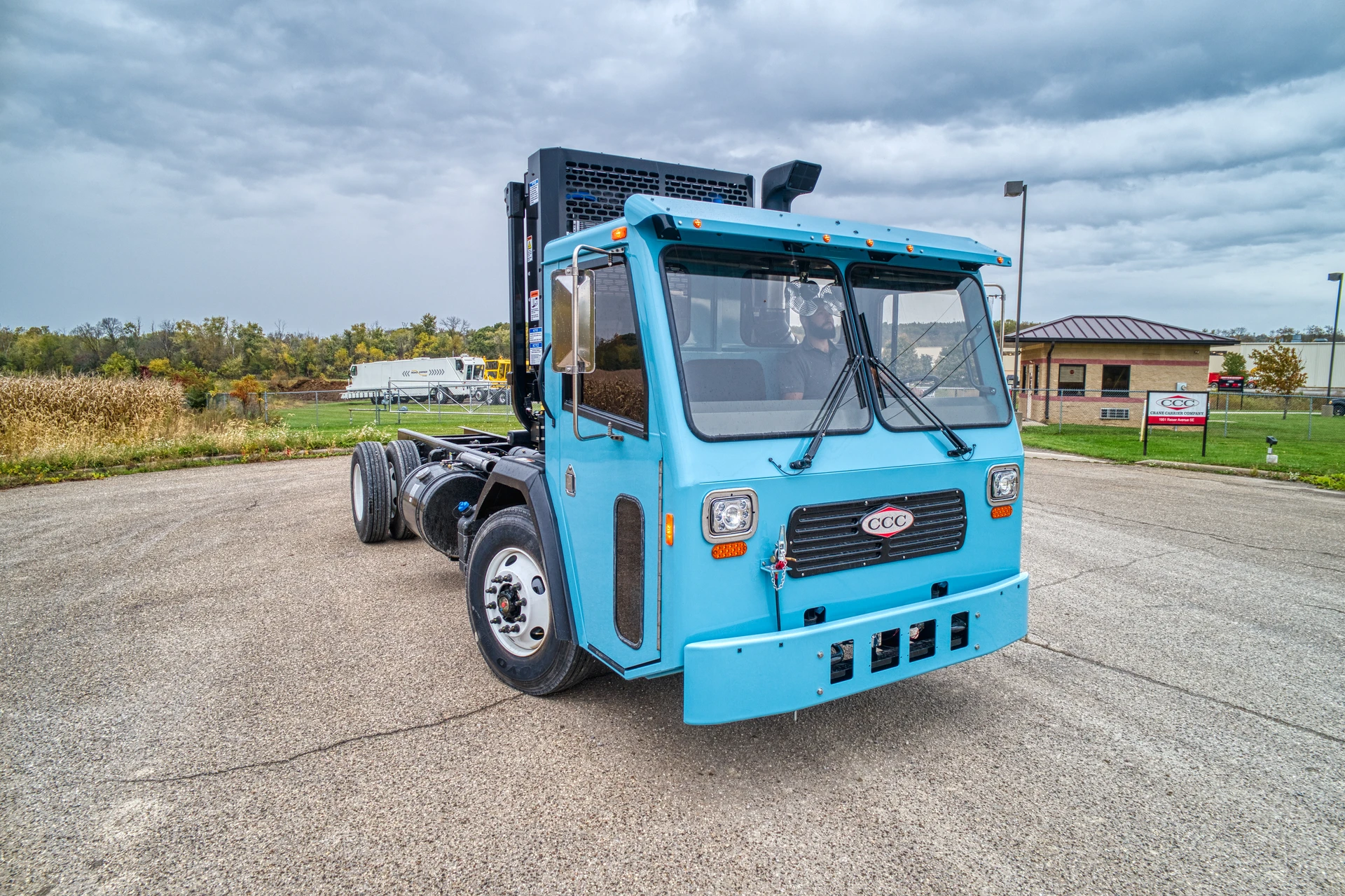
“Since Battle Motors purchased Crane Carrier Company, we knew we wanted change to come not just in the form of the engines we use but to the entire driver and fleet manager experience,” notes Scott Norris, director of on-highway vehicle engineering at Battle Motors.
While Crane Carrier chassis are designed to last 15 years, “we realized the plastic inside the cab was not always accomplishing that desired life cycle,” says Norris.
All plastic components from the cab interior—the dash, dash panels, overhead console, shift console, and door panels—have been swapped out for steel components.
Another change: transitioning from a proportionally driven hydraulic fan to all-electric fans.
“Not only does an electric fan reduce noise and complexity, but it also cuts down on the need for fan maintenance and upkeep,” says Norris. “The auto-reversing fan feature continuously cleans the radiator.”
Another change: using LED lights as standard to reduce amp loads and improve light longevity. The AutoCraft LED headlights provide a bright, consistent sweep across the entirety of the road, designed to give the driver greater visibility.
Autocar has started wrenching its trucks through its Power of One integration process.
“We work directly with the body company to understand where the brackets are going to go,” says Tim Thornton, vice president and general manager, refuse.
“We are integrated with the body companies to where they send us their components and their parts,” says Thornton. “When we build that chassis, we have pre-drilled or pre-punched all the holes and we mount all the brackets. We have some of the main components onto the chassis in the factory. We also do the pre-wiring.
“We’ll run all of the 3rd Eye camera lines if they have those. We install the joysticks into the cab. We run all the electrical lines, all the hydraulic lines. We can install the PTO.”
All of the work is conducted and tested at the factory.
“When it goes to the body company, they just drop the body on, plug into the components and they're not having to breach the electrical system or weld on the frame,” says Thornton. “These trucks have a lot of complexity built into them with electronics, telematics, and advanced driver assistance systems built into them.
“If the body companies are opening up the cab, tapping into wires, and moving things around, unintended consequences can occur. We’re trying to avoid that breach to the electrical or hydraulic systems moving wheelbases. All of these have impact on the truck performance and the body.”
Doing as much pre-engineering integration work at the factory before it goes to the body company is more important than ever because of the technological complexity of today’s trucks, says Thornton.
Heil and its parent company Environmental Solutions Group has focused on a series of technologies that mirror chassis improvements regarding safety and ergonomics, notes Brandon Volner, vice president of product management.
“Additions like J1939 digital connectivity allowed chassis OEMs to design and implement Advanced Driver Assistance Systems that offer a next generation of safety to fleet owners,” he adds. “Better-designed cabs, instrumentation, and cab features provide drivers with more comfort and less strain on their body and their eyes.”
There also is a focus on body maintenance, productivity, and overall vehicle performance metrics via the company’s Connected Collections digital strategy and its Odyssey Controls option.
“With Odyssey Controls, our hydraulic engineers focused on developing a control system where hydraulics were considerably smoother, faster, and more reliable,” says Volner.
“Hydraulic cylinders were electronically cushioned and body operations were tuned to dump containers faster and smoother, reducing cab shake and arm shock loading while improving overall performance by eliminating troublesome maintenance items such as proximity sensors and air systems. This technology is being adapted to new Heil designs due to its success and popularity.”
With Connected Collections, company engineers took advantage of the existing J1939 digital backbone to connect both the chassis and body systems to transmit performance data back to fleet owners, allowing them to make better decisions faster.
“Our vehicles transmit geolocation, service verification events, maintenance status of various systems, driver and driver environment monitoring, and contamination identification,” notes Volner.
“All of these systems are offered as SaaS modules so fleet owners can custom-configure the services that best fit their needs. Data is converted into information via Eye-Site business intelligence, allowing them to develop reports that help them streamline how their fleets operate.”
New Way is using stronger and lighter material in its collection vehicle designs, says Don Ross, vice president of sales and marketing for New Way & K-PAC.
“There’s also an increasing focus on technology,” he adds. “Digitization of the refuse collection platform continues in the form of electronics, telematics, diagnostics, route intelligence, and CAN bus operating systems.”
Chassis and refuse body integration is another focus.
“Chassis manufacturers are working in conjunction with body manufacturers to make a more reliable, user-friendly unit,” says Ross. “We are chassis-agnostic at New Way and work with an array of chassis providers.
“Our engineers develop integration strategies with each chassis manufacturer to ensure that the vehicle chassis and its New Way refuse body operate optimally as a complete refuse collection vehicle.”
Case in point: the Autocar truck. The Power of One New Way/Autocar truck system represents a seamless integration between chassis and body and is designed to improve manufacturing lead times, reduce rework and warranty claims, and improve performance, says Ross.
Ross notes although CNG and battery-electric are hot topics, new clean diesel technology is often overlooked.
“Engine manufacturers have focused on reducing emissions for more than a decade and they now claim that current tailpipe emissions are cleaner than the air entering the engine,” Ross notes.
Citing an RV Industry Association statement, Ross points out “The California Air Resources Board (CARB) has implemented more stringent emissions standards for heavy-duty vehicles set to take effect in 2024.
“The CARB Omnibus Low NOx rule requires heavy-duty diesel engine manufacturers to comply with incredibly strict standards, amends in-use test procedures, creates modifications to the durability demo, lengthens warranty and useful life periods, and increases emissions data collection and reporting. As a result, a handful of engine manufacturers are considering whether they’ll even produce these types of diesel engines.”
Electric vehicles are becoming a design priority.
“There’s a lot more involved between the body and the chassis when you're running an electric vehicle and power draw and efficiency,” says Thornton. “The two have to work very cleanly together to optimize performance and maximize route performance. We are doing a lot of work now on design of our EV ACX refuse truck, working with the body companies on that design and integration.”
The top priority for Battle Motors is the BEV (Battery Electric Vehicle) design validation and infield testing.
“One of the biggest internal changes is going to be a new design from a traditional dash to an all-digital dashboard,” says Norris.
The RevolutionOS dashboard includes a digital instrument cluster, over-the-air updates, and actionable intelligence. QR codes attached to the dashboard allow for easy access to data on the truck, part identification, and order placement, as well as quick access to the manual.
“We want our EV vehicles to be powerful, reliable, and efficient with the ability to tackle various kinds of terrain and climates,” says Norris.
Each build is equipped with 240–420 kWh battery pack, multi-speed transmission, and EV motor power inverters.
New Way design priorities focus on more user-friendly, gender-neutral equipment, specifically in regards to units that do not require a Commercial Driver’s License (CDL) to operate in order to better help address the CDL driver shortage, says Ross.
“Select New Way rear-load models come in under-CDL configurations, and we’re developing a mini automated side loader as well,” he says.
Volner notes data ultimately runs a business and provides the needed information to ensure the fleet and its customers are best served.
Bodies and chassis need to be easier to both troubleshoot and service, he adds.
“Predictive and prescriptive data needs to be available to allow fleet owners to better maintain their assets to ensure they are out on route versus stuck in the shop or broken down on the road somewhere,” Volner says. “Refuse collection vehicles need to be easier to operate, allowing fleet owners to attract and retain newer drivers.”
The COVID pandemic has resulted in drain on experienced drivers and maintenance personnel, notes Volner of the factors necessitating design changes.
The Heil Autonomous Lift Option (H.A.L.O.) allows new drivers of automated side loaders and commercial front loaders to be productive on day one, he says.
“With H.A.L.O., drivers drive. H.A.L.O. identifies the can and with a push of a button or optional foot switch, the arm engages the can, dumps the contents, and replaces the can exactly where it was found,” says Volner, adding the innovation allows the driver to focus on safe vehicle operation.
Design changes are typically either customer- or chassis-driven or a result of safety and emission standards from governing bodies, says Ross.
“Designing for gender neutrality in a historically male-dominated industry continues to gain steam,” he points out. “Body and chassis manufacturers continue to implement ergonomic improvements that create opportunities to better include the nearly 47% of the workforce not traditionally represented in refuse collection.”
Two leading issues facing the refuse industry are organics management and the shortage of CDL operators, Ross points out.
“New Way is driving the industry forward in organics management with our fully-automated models for residential and semi-automated models for commercial of the auger-driven ROTO PAC, which works equally well with organics and food waste as it does with municipal solid waste (MSW),” he says.
Within five years, it’s projected that half of all CDL drivers in the United States will retire, Ross points out.
“The shortage of CDL drivers necessitates body and chassis manufacturers to collaborate in producing under-CDL refuse trucks,” he says. “This makes finding and training new drivers much easier. New drivers can focus on safety, customer service, and manageable route footprint in a smaller rear-load or side-load vehicle, eventually graduating to a full-size unit bringing those skills to a larger—yet still familiar—refuse collection vehicle.”
New Way offers multiple under-CDL rear-loaders and is currently developing an under-CDL automated side-loader set to debut this year.
“Advances in chassis and refuse body design have made it easier for municipal and private haulers alike to recruit and retain vehicle operators, and these jobs are as stable—and safe—as ever before,” says Ross.
New technology is a response to the many challenges faced in driving a solid waste truck.
Battle Motors is developing a cloud-based, multi-modal transportation management system with built-in automation to help streamline its logistics operation.
“These new technologies will help increase safety in the field with audible alerts when user-defined rules like speeding and harsh braking are violated,” says Norris. “Our EV trucks are also equipped with thermal systems, regulating the temperature of the battery and ensuring longer battery life, quicker charging times, and enhanced reliability.”
New Way is focusing on battery-electric vehicles (BEVs) and compressed natural gas (CNG), improved automation and safety, and organics programs, all with a focus on customization, says Ross.
Organic waste collection and processing continues to expand because of the beneficial reuse qualities of collected materials and the subsequent reduction in waste disposal, he adds.
The New Way ROTO PAC auger-driven ASL is specifically designed to collect and process organic waste but has also proven itself collecting MSW, he adds.
“The auger replaces a conventional packing panel and hydraulic cylinders and generates a higher compaction per cubic yard as a result,” Ross says, adding it liberates material from bags and offers a high legal payload.
“We see organics management as the future and continue to develop the next generation of the ROTO PAC designed for commercial collection of organics and food waste.”
The ROTO PAC is available in fully- and semi-automated configurations.
“The speed, compaction, and maneuverability of the refuse truck remains the same, with the added ability to service semi-automated roll arts,” says Ross. “Commercial food waste, on-street parking, and urban environments are all now within easy reach. The semi-automated ROTO PAC’s shorter wheelbase allows for better maneuverability in dense areas.”
“Advanced Driver Assist is the biggest technology we’ve engineered to our trucks,” says Thornton. “Driver Assist is forward collision mitigation, blindside detection, rollover stability control. These are important innovations that have been built into a refuse truck.
“One of the challenges of putting this technology in the refuse trucks is there are arms moving while the truck is moving: an arm that comes up and down and a side arm. There’s a lot happening with the advent of the single driver automated side loaders. That driver is now a one-driver vehicle and they're looking at their target, which is the can they're picking up.”
Having camera systems and blindside detection technologies for collision mitigation technologies helps with overall truck safety and driver protection, Thornton adds.
Given the move toward electric and hybrid drivetrains, New Way has electric vehicle chassis integration projects underway with every major North American chassis manufacturer.
Development partnerships are underway that focus on developing software enhancements, operator assists, and pack system efficiencies to help maximize battery life and make the collection operations more intuitive for electric vehicle applications, notes Ross.
New Way has made significant strides in battery-electric vehicle refuse applications, with many vehicles currently on routes and more on order for private haulers and municipalities nationwide, he adds.
Additionally, New Way serves as a certified installer for providers of CNG fuel systems, including Hexagon Agility and Momentum Fuel Technologies.
“These include back-of-cab mounts, tailgate mounts, frame rail/side mounts, roof mounts, and custom hybrid designs,” says Ross. “Our engineers carefully analyze each chassis and situation to determine the ideal placement for each CNG fuel system.”
Heil is currently working with several chassis OEMs that offer electric-powered offerings.
“Given the complexity involved with power consumption combined with an often 12-hour duty cycle, the task is daunting,” says Volner. “We’ve been working to identify and design technologies that allow our products to pick, pack, and dump while minimizing the use of battery-draining hydraulics.
“This has to be allied to ensuring fleet owners get the maximum payload possible while ensuring the vehicle has enough power to last throughout the route.”
Battle Motors is expanding the Crane Carrier factory in Ohio by 200,000 square feet to accommodate increased output required for the EV, CNG, and diesel trucks.
“In order to implement electric drivetrains, we are removing the cooling systems, engine, mountings, Cummins engine, Allison transmission, intake system, exhaust system, fuel tank, and driveshaft from our diesel build,” says Norris.
“In place of the diesel parts, we are adding an e-battery mounting system, battery pack, power electronics, charging system, EV motor power inverter, and multi-speed transmission to the EV build. These changes allow for us to keep the integrity of the truck intact, while successfully creating vehicles that retain the strength of Crane Carrier bodies.”
Another item of note in the industry is haulers doing waste-to-energy conversion at their landfills, notes Thornton.
“When you look at that ecosystem, being able to take the landfill, convert it to natural gas and then power natural gas clean trucks has a negative carbon footprint,” he adds.
“They’re also doing a waste-to-energy conversion to electric and then use that same electricity to power their electric trucks. That can be an exciting thing for the industry because now you got almost a closed ecosystem to where you're collecting the trash with the trucks. The trash is then used to generate natural gas or electricity and then is used to power the same truck.”
Latest from Waste Today
- Vermeer announces plan to build new facility in Des Moines metro area
- Buffalo Biodiesel shares updates on Part 360 application to DEC, Tonawanda facility progress
- Capstar Disposal expands roll off dumpster rental services
- Supreme Court strikes down IEEPA tariffs
- Casella details facility closures, expansion efforts
- Zero harm: Building a SIF prevention program for waste and recycling operations
- Casella posts a loss in Q4 2025
- McNeilus names Haaker Equipment first Dealer Partner of the Year