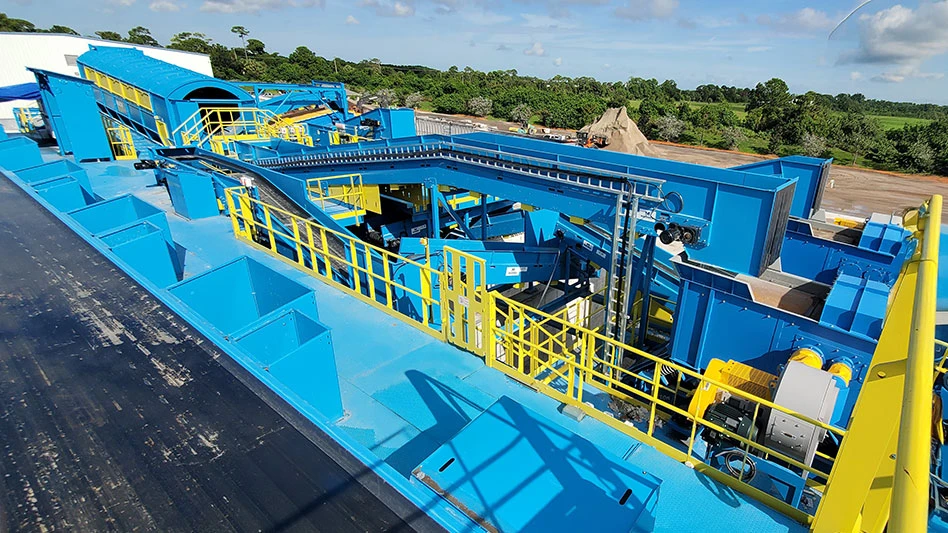
Designing a MRF for current and future needs includes addressing common obstacles, identifying "must-haves," and incorporating safety features and new technologies.
Budget constraints can limit facility size, be it a new MRF or retrofit, notes Betsy Powers, senior project manager, SCS Engineers.
Of late, the economic impacts of the COVID-19 pandemic meant MRFs were taking in more residential tonnage than commercial, with the former sector having less value, leading operators to re-evaluate their capital expenditures for the next year or two on that factor alone, Powers says.
Site selection is an obstacle, notes Doug Allen, Tetra Tech client manager.
“Does it have suitable truck access? Does it have signalization to and from the access area roadways? Is the MRF going to engage with rail?” he points out.
Overcoming potential nuisance considerations such as noise and litter in local jurisdictions is another challenge, he adds.
Available floor space is a concern.
“When it’s a new MRF, we can have a new building where the right space will have been considered or use an existing building and work according to the floor space dimensions,” says Chris Hawn, CEO, Machinex.
“With an upgrade, we have to design with a current building and sometimes, there is no space to extend it,” he adds.
Consider both vertical and horizontal space to accommodate the material that goes up and down the system from one end to the other, notes Powers.
Allen says MRFs need adequate and robust areas for material that comes in on the tipping floor and receiving areas.
On the facility’s back end, space is needed to process material going through the MRF treatment train to get it in a condition such as baling to make it available for offsite shipment and avoid front- and back-end bottlenecks or compromise employee safety, Allen says.
MRF operators must understand their materials to successfully build a framework for the system integrator to fill out, notes Mat Everhart, CEO, Stadler America.
“This can be difficult because most of their resources come from output materials rather than input materials unless they contract a materials study by a qualified firm and properly frame out the scope of the needed information for them to measure,” he adds.
Another common challenge in co-mingled curbside recycling markets is finding available end markets.
“That has been somewhat challenging in the last couple of years with China and Asia not being willing to take our MRF material,” says Allen.
Automation adaption can be a challenge.
“Everyone is trying to design a system to make it as totally automated as possible so you have fewer employees to keep the overhead down,” notes Donald Suderman, product manager for recycling equipment at Bunting Magnetics.
Procuring reliable labor is an obstacle, concurs Mark Neitzey, sales director, Van Dyk Recycling Solutions, adding the industry experiences high turnover, thus turning to temp services.
Given such obstacles, there are "must haves" in every MRF design.
It starts with adequate tipping space.
Everything between the front and end points depends on a facility’s needs, its incoming wastestream, available labor, and the type of equipment being included, says Powers.
Key components that all MRFs of more than 8 to 10 tons per hour must have include presort to remove large items that can damage equipment, notes Hawn.
Optical sorters are another "must-have" component.
While optical sorters have been used for years to sort out popular plastic grades such as PET and HDPE, they have recently become essential to building flexibility, especially regarding fiber sorting, says Neitzey.
“Today’s material stream at most residential single-stream MRFs has such high levels of contamination, it is no longer feasible for MRF designs to ‘negatively’ sort paper, such as removing contaminants from the stream and expect to be left with piles of clean paper,” he adds.
“Optical sorting can reverse the logic and target the paper ‘positively’, such as removing the paper from everything else,” Neitzey says. “You will get much cleaner paper.”
Plus flexibility, he adds.
“When you first start up your MRF, you can have an optical targeting newspaper and making news bales,” says Neitzey. “If you notice more brown fiber in your stream or market prices for that material rise significantly, you can press a few buttons on the optical and now it will target OCC and OBB. You can make and sell a different product.”
A fines screen or glass breaker screen breaks the glass and removes it. It’s essential early in the process to avoid a burden on equipment and stream contamination, says Hawn.
“There needs to be a uniform distribution of the metering of the material in the line because there are various ways of loading it into the system when you have trucks dumping it and transferring to the system itself,” says Suderman.
A series of conveyors are necessary up front for good magnetic separation of any ferrous materials, he adds.
Some operations will then either institute manual picking or automated high-tech robotic picking to minimize downstream feed.
“Then, almost every line will have one or multiple eddy currents to throw out the aluminum fraction,” says Suderman. “There are two fractions that are very easy to get out from a MRF line: ferrous with magnetic separation and the second is aluminum cans and aluminum pots and pans.”
“Since many single-stream systems across the country have seen a massive growth in the amount of film and plastic bags coming into their system, it is imperative to have non-wrapping screens at the juncture of 2D/3D separation,” says Neitzey. “The old-style screens cannot handle today’s dirty stream and will become clogged by the wrapping and jamming of film bags.”
After the paper has been separated from the containers, the container line will still have some 2D contamination in it due to high contamination rates in today’s material, says Neitzey.
“An elliptical screen is perfect for scalping off the last bit of 2D material before the containers go off to be sorted,” he adds.
Finishing equipment such as a disc screen or a ballistic separator ensures the separation of remaining fibers in the containers stream, notes Hawn, adding a reliable baler is a must.
Safety features are a must.
Single point of lockout is the biggest trend Everhart notes, with access design being second.
“The largest key to safety is arranging equipment in such a way that reduces how often equipment has to be entered for service and how long the technicians have to be in the machine,” he says.
E-stops along the equipment line enable employees to stop the system by pushing a button if there is an issue posing a hazard, she adds.
Safety equipment should be factored in to consider that employees hang over the edge of the equipment reaching for materials, Suderman notes.
“There has to be ergonomically designed belly rests for employees to pull products out of the stream, especially on the pick lines,” Suderman says. “There needs to be adequate walkways or mezzanines along the side that are safe for employees to work on and around to get by each other.
“It’s important that not only each individual component is designed safely with adequate guarding on everything, but the whole system is so both components and system-wise so you have a safe operation.”
Fire safety is a significant MRF concern, Allen says.
If a MRF is taking in combustible materials such as papers, woods, or shingles, interactions with local fire protection officials becomes critical in terms of obtaining necessary MRF construction approvals, he adds.
Lithium-ion batteries are causing more fires, Powers notes.
“Many times, the fire protection issue will set the upper limits for the amount of material you can have stored in the facility’s front and back end,” says Allen. “Almost certainly, MRFs are required to have active fire protection systems and sprinklers.”
One fire technology Allen cites is Fire Rover.
“Onsite equipment with sensors is monitored from a central command unit where if a fire is identified, the system kicks on and shoots a fire protection foam. It can be controlled by an operator offsite to try to mitigate the fire as soon as it starts to keep a MRF from going up in flames,” he says.
"Having adequate space for receiving and stockpiling waste also is a fire safety consideration, providing fire equipment access throughout the facility,” Allen adds.
Components that help prevent trips, slips, and falls are necessary as well as cameras to monitor MRF traffic, Powers says.
New technology is increasing efficiency and safety efforts.
Robotics and artificial intelligence (AI) “are a big mover in terms of new technology implementation,” says Allen, adding it’s being implemented for organic separation as well as comingled MRFs for curbside recyclables and C&D waste as to necessitate fewer human hands on the pick line.
AI vision can now be implemented into optical sorters, notes Hawn. That, combined with detection infrared hyperspectral technology camera and metal sensors, recognizes virtually all materials in the average MRF incoming mixed stream, enhancing recovery and purity rates, says Hawn.
"The high-speed, high-resolution cameras with three-dimensional sensors and the near-infrared (NIR) optics identify and sort the waste,” says Powers.
Van Dyk Recycling Solutions is a distributor of TOMRA optical sorters.
TOMRA has developed Deep Laiser to recognize objects that NIR or cameras don’t detect such as food waste, glass, and especially black items such as to-go containers, says Neitzey.
TOMRA has technology to detect the black objects and make a sorting decision to eject them from the paper or other plastic stream, he adds.
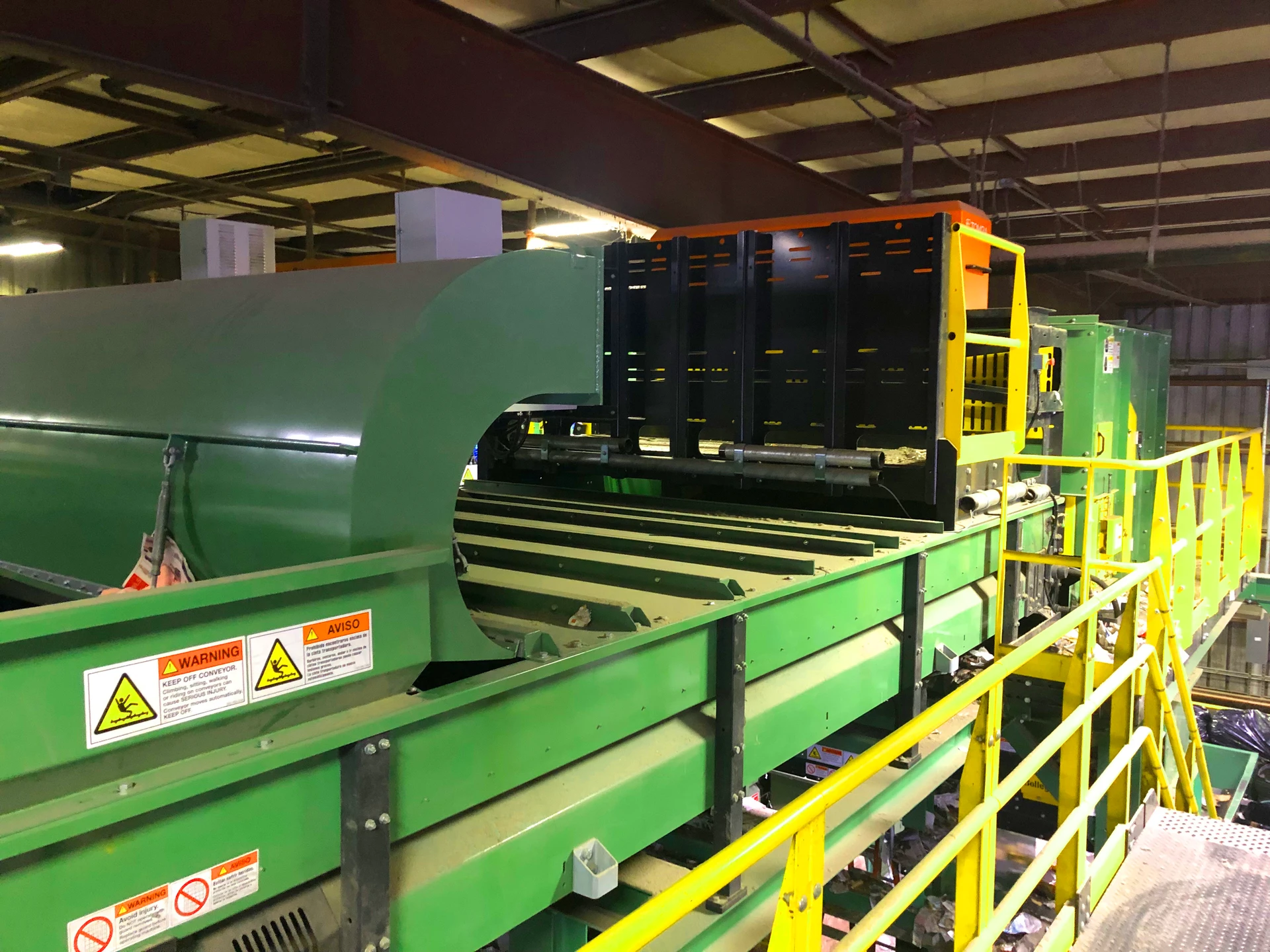
Deft Air is a wind tunnel that sits over the belt directly in front of the optical sorter. As the material on the belt approaches the optical sorter scanner, the wind tunnel blows air onto the belt that presses the material down so it lies still.
“This is most helpful on applications where either the optical is targeting paper or the material has a high percentage of film because light sheet paper and film are the most likely items to catch air and fly up,” says Neitzey.
Robotic sorters such as SamurAI help MRF operations adapt to changing industry practices and commodity markets for recyclers looking to purify their streams and reduce output contamination, notes Hawn.
The SamurAI robotic sorter is taught to recognize various materials via its camera and AI.
“Different materials are labeled according to their size, shape, and composition, and then loaded into the AI of the robot,” says Hawn. “Based on this information, robotic sorters can recognize and sort—either positively or for quality control—a wide range of plastics, aluminum, cartons, and film plastic.
“The cost efficiency and safety benefits of automated pickers as an addition to or replacement for human pickers are catching on.”
SamurAI robotic sorting—introduced in 2018—has greatly evolved due to MACH Cloud, a central database software including all the latest learning of SamurAI robots working globally, says Hawn.
The MACH Vision System analyzes the material stream composition in real time. It is connected to MACH Intell, an online software platform delivering real-time information.
The system is powered by AI and in some cases can be combined with other high technology, such as infrared camera and metal detectors, and enable operators to quickly respond to changing trends to optimize plant performance, says Hawn.
AI essentially audits a MRF facility, giving operators efficiency information upon which to make OPEX and CAPEX decisions, says Powers.
Bunting Magnetics provides a line of magnetic separation equipment that removes metal contaminants from material streams, metal detection equipment to alert operators of ferrous and non-ferrous metal hazards within the product flow, and removes or rejects contamination for a purer product stream.
Bunting also offers conveyor systems and components.
MRF design criteria encompasses all key components.
“Different areas of the country have different zoning and safety regulations,” says Suderman. “It’s very important for solid waste operations to be aware of the regulations they have to design for.”
Another criterion: building dimensions and appropriate measurements.
“For the processing area, all clearances available need to be properly noted,” says Hawn. “Aside from building length, width, and height, there are areas of potential interference such as columns, sprinklers, and HVAC.”
The type of inbound composition—be it residential, mixed commercial, or only cardboard from commercial, MSW, and others—varies in each region, notes Hawn.
“If the facility received residential collection and only cardboard from commercial, we can design a specific area where the cardboard will be discharged and sent directly to the baler because there is no need to process it,” he says. “If the inbound commercial is an industrial mix, then we can set up the line to handle a dirtier stream.”
It is ideal to measure the composition of incoming material down to the percentage of each material, notes Neitzey.
“Don’t just take the data that the municipality has to share based on outbound shipment of material from the previous contract holder,” he adds. “Try to get true, accurate, physical sampling of inbound material. Outbound shipment information is good, but it doesn’t always give a 100 percent clear picture.”
Flexibility is key not only in understanding what the end product looks like now, but in being able to pivot with changing criteria, such as when China stopped taking US recycling products, says Allen.
MRF operators need to understand how the material arrives during the day, says Allen.
“What is the day of arrival? What would that flow look like in terms of truck loading? Does it all come in one big rush in the midday or is it spread out? That sets into play sizing inbound areas.”
Throughput (the required capacity for present and future tons) determines the number of sorting lines, with future tons addressed immediately or planned for future growth, says Hawn.
“If there are some specific commodity quality requirements, we integrate equipment to provide the desired quality,” says Hawn. “If the MRF has a market for colored HDPE and natural HDPE separate, an optical sorter dedicated to this task could be equipped with a color vision to separate both colored and natural HDPE in a different bunker.”
Paper quality grade also is a factor.
“To obtain the best ONP quality, additional equipment like a dedicated optical sorter to clean fiber will be required,” says Hawn. “The higher the purity required, the more automation or manual sorting depending on the budget and overall OPEX of the facility.”
Evolving tonnage is another factor.
“There is always effort made to get information on the existing incoming stream and to potentially scale these to tonnage growth projections, but oftentimes trends in emerging materials such as flexible packaging get overlooked,” says Everhart.
Decisions on utilizing manual versus automated sorting equipment are based on an issue many facilities face in having consistent labor, Powers says.
Through having a well-designed facility, MRFs gain operational efficiency, increased safety, a more enjoyable workplace, a higher quality end product to market, easier maintenance, and more positive community relations, Allen points out.
Latest from Waste Today
- Interchange 360 to operate alternative collection program under Washington’s RRA
- Waste Pro files brief supporting pause of FMCSA CDL eligibility rule
- New Way Trucks expands US network with Joe Johnson Equipment
- Tire Industry Project publishes end-of-life tire management guide
- Vecoplan to present modular solutions at IFAT 2026
- Terex Ecotec appoints Bradley Equipment as Texas distributor
- My Green Michigan expands depackaging capacity
- Washington selects Circular Action Alliance as PRO