All the Brakes
Curtis Dorwart, refuse product manager for Mack, claims there’s nothing new in refuse trucks except radial tires and antilock brakes. Anti-skid ABS brakes are now standard, saving wear and tear.
Despite a long history and much success with drum brakes, disc brakes are growing in popularity.
“Moving forward, many fleets are ordering only disc,” says John Thompson, sales manager for TMD Friction. “Disc is more expensive up front, but has a longer life and is meant to run at high temperature. Today’s disc brakes are very good.”
Heat is a challenge for brakes, but the refuse industry is rife with heavy loads and frequent stopping and starting that generates heat. Due to the severe nature of the industry, brake life is measured in weeks. Drum brakes break down at 600–650°F, but disc brakes work well at 1,000°F, Thompson estimates.
Working with the OEs, TMD Friction has developed some new materials over the last couple of years to withstand the heat brakes commonly endure in this industry. For severe duty, their legacy material TO143 is rated up to 29,000 pounds. “It’s good under heat and stress,” mentions Thompson.
Less expensive products are available, such as the TO135, rated at 26,000 pounds, and the TO132/T2300, rated at 23,000 pounds. “We know these OE-approved materials will be excellent in the after-market.”
They also know that fleets are concerned about price. “We listen to fleets and we try to address their concern about price,” continues Thompson.
The cost of $30 per axle for brake kits should result in savings of both money and labor. Thompson estimates savings of $200–$500 per vehicle once the labor rate and the price of brake kit hardware are included in calculations. It also saves downtime, he notes.
“Fleets save when trucks don’t come in for brake jobs,” he says.
When they do come in for service, Thompson says relining rotors takes about 15 minutes, or 25% of the time of a drum brake job. With TMD products, he promises a reduction from four relines, to three, which saves $200 or more.
Getting Air
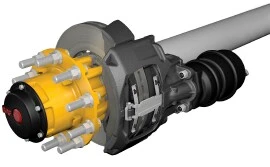
Despite stops and starts in production, Dorwart says air disc brake technology has matured. When a vocational air disc brake specific for the refuse industry was launched last year at the World of Concrete exhibition, it drew a lot of interest.
The EX+ air disc brake is a “heat machine,” says Dorwart, converting the heat generated by 1,000–1,200 stops per day into kinetic energy for superior stopping performance in harsh conditions. The benefit is improved stopping ability and wear. When this brake gets hot, it grabs more—as opposed to traditional s-cam brakes that fade. It has a “quicker feel.”
The secret is to manage the friction couple to achieve shorter stopping distance, Dorwart explains. Field testing and more than 2.2 million miles of real-world service in North America indicate it lasts twice the life of conventional s-cam brakes and requires less maintenance, which translates to more uptime. Boosting uptime lowers overall life cycle costs.
Mack’s air disc brakes utilize a flat rotor concept to prevent heat distortion in heavy-duty service, rather than “hat-shaped” rotors, which are prone to distortion and shorter life. The brake pads are engineered by Mack to deliver top performance in all situations and minimize brake fade during extreme braking cycles and frequent use.
The refuse industry has a good safety record, but it remains a dangerous business. “Guys can get hit while loading the trucks,” observes Dorwart. He believes the significant improvement in stopping performance provided by EX+ air disc brakes adds to the safety element for vehicle operators and workers.
Operational Concerns
Just as the right brakes can provide a safer working environment for the operators, the drivers can have a significant impact on the performance of the brakes—and tires— and virtually every component on the truck. Drivers with great safety records have the best brakes.
“There is a diverse group of drivers in the industry,” explains Thompson. “The real professional is someone who understands maintenance, is off the throttle, coasting, using the brakes as little as possible.”
Those drivers will also conduct daily inspections. For brakes, Thompson suggests looking for broken air hoses or brackets. “If they have EX+ brakes, they can see how much material is left.”
Drivers and maintenance managers need good preventative maintenance programs for their vehicles that include daily inspections. “These simple tasks can help extend the life of tires, brakes and the vehicles significantly,” says Link’s Langton, who suggests that fleets also look at cost-of-ownership as opposed to purchase price. “Spending a little more money up front can result in decreased service costs and higher resale value than less expensive options.”
Unfortunately, some contract/hired drivers “drive it like they stole it,” says Thompson. “They want to do their route and go home. The driver pool is not what it was. Very aggressive drivers making 6- to 10-second stops, going from throttle to brake, have a significant impact on the brakes. You’ll see more wear and shorter life.”
That’s why TMD Friction engineers products so that they’re “operator-resistant.”
TMD also tries to reach operator he chemistry of the formula and how heat changes it, design, theory, and “speccing” for fleets.
One piece of accurate information is changing the industry. Beginning in 2015 in California and Washington, new rules will impact brakes by requiring manufacturers to get the copper out of disc pads. Although the Better Brakes Law (2012) requires manufacturers to reduce or eliminate several toxic chemicals, heavy metals, and asbestos in automotive brake pads and shoes, the major focus is on copper. The target is to have less than 0.5% of cooper in disc pads by 2025.
“High levels of copper have been found in fish,” explains Thompson.
It has been determined to come from brake dust. As brake pads wear down, copper and other metals are deposited on roadways, where they are washed into our streams and rivers. Copper is highly toxic to fish and other aquatic species. Salmon are especially susceptible to the effects of copper.
Copper helps braking, so this is a blow to the manufacturers, but TMD presented a formula to the manufacturers that would maintain performance and wear.
In January 2015, brake manufacturers signed a memorandum of agreement with the United States Environmental Protection Agency and the Environmental Council of the States to adopt standards based on Washington and California’s brake laws. According to this agreement, every new brake pad sold in the US will meet Washington’s standards for copper and other toxic chemicals.
Latest from Waste Today
- Vermeer announces plan to build new facility in Des Moines metro area
- Buffalo Biodiesel shares updates on Part 360 application to DEC, Tonawanda facility progress
- Capstar Disposal expands roll off dumpster rental services
- Supreme Court strikes down IEEPA tariffs
- Casella details facility closures, expansion efforts
- Zero harm: Building a SIF prevention program for waste and recycling operations
- Casella posts a loss in Q4 2025
- McNeilus names Haaker Equipment first Dealer Partner of the Year