Scales and software play a critical role in waste management.
“Collected information provides a view into how much material is coming in and going out and how long landfill space will last. The scale software transaction—typically tied into a software solution like WasteWORKS—is where waste becomes dollars and data,” says Jon Leeds, Carolina Software vice president.
Data helps project income, staffing requirements, future site improvements, and state and local regulatory requirements, notes Leeds, pointing out the importance of its being “right, complete, and timely.”
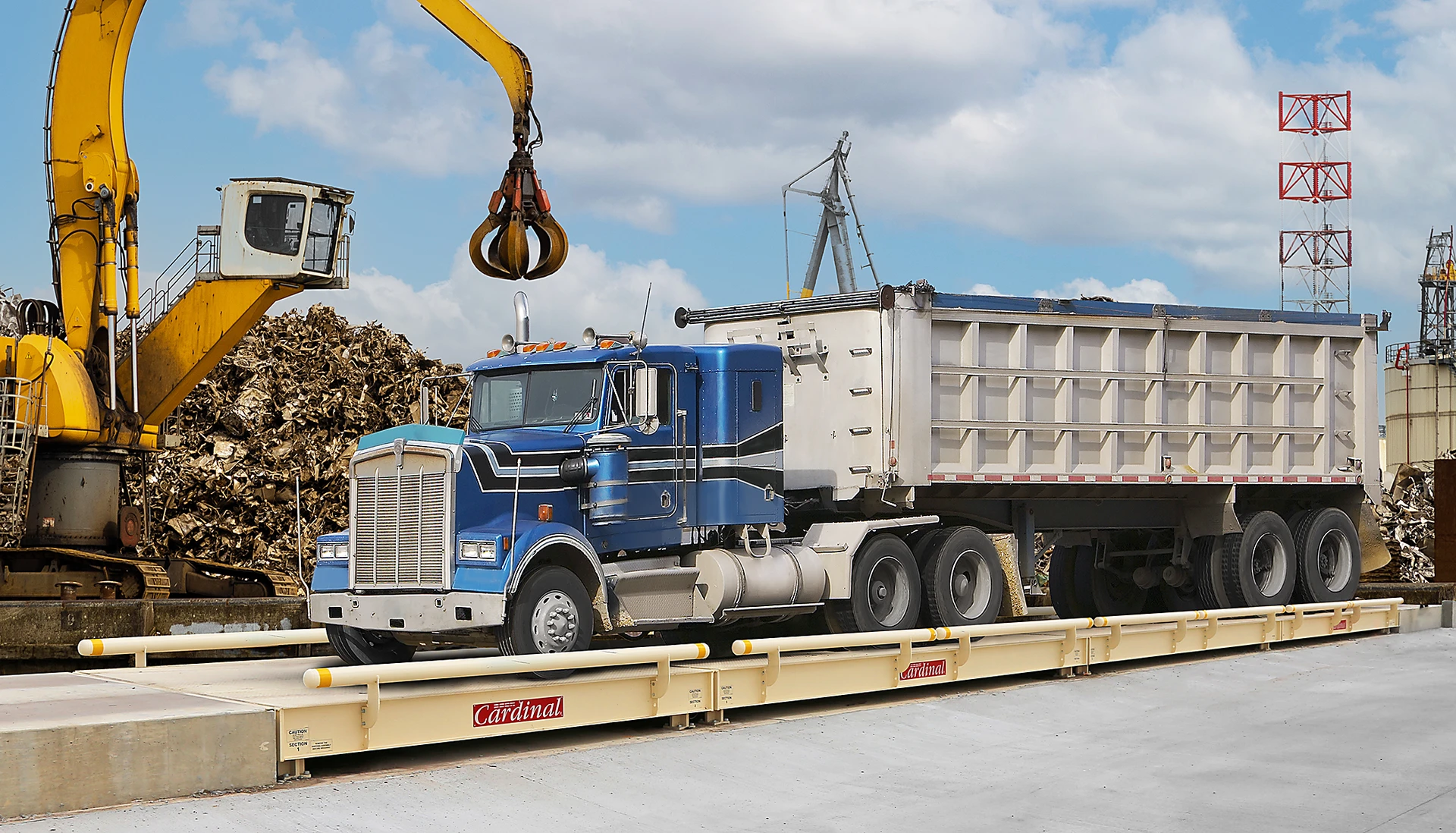
Full-length static truck scales are typically positioned to weigh inbound and outbound trucks at solid waste facilities.
“These truck scales can weigh up to entire semi-tractor trailers all in one weighment as they settle completely onto a scale’s weighbridge platform,” notes Jonathan Sabo, Cardinal Scale vice president, marketing and customer support.
“Typical platform sizes are in the range of 11 feet wide by 70 feet long. They can also provide NTEP legal-for-trade weighing transactions.”
Truck weight places stress upon load cells in the corners of the scale’s weighbridge. A weight signal from each load cell is sent to an indicator. The read-out is sent to a PC and added into vehicle tracking software for general book-keeping, Sabo adds.
Scale data often includes information about the vehicle, customer, waste type, and origin and is entered by an attendant or the driver or pulled in from stored defaults, says Leeds.
That can be a complete transaction or the first half of a two-part transaction, with the second half occurring on the outbound scale.
Several possible functions are triggered: ticket printing, the opening of gates, changing of lights, and captured images.
“At this point, you’ve created something meaningful from a data standpoint and either collected money—cash check, credit card—or created a receivable line item to be billed to the customer at a later point,” says Leeds.
In a typical landfill or transfer station charging weight-based tipping fees, at least one scale measures the difference between the vehicle’s gross and tare weight to determine how much waste is left behind at the site, notes Chris Butler, business development, Strong Data Automation.
“Sometimes stored tare weights are used so vehicles only have to be measured once each time they visit the site,” he says. “While stored tare weights speed up processing, the most accurate way to record net weights is by weighing all customers in and out each time.”
“Weighing needs vary from one municipality to another,” says Morgan Clarke, Global Marketing Manager Vehicle Scale SBU, METTLER TOLEDO. “In the simplest applications, all waste is delivered directly to a landfill. In complex applications, waste flows through several facility types.
“Household and commercial waste might be delivered to a transfer station for material separation and transport to a recycling facility, incinerator, or landfill. Each facility weighs the material it receives and ships.”
“A highly operational system with digital load cells saves downtime and wasted efforts trying to diagnose load cell failures,” says Sabo. “Waste management locations benefit greatly from scale systems promoting less load cell wiring since installation times are quicker. Seek out a system using cloud-based diagnostics for the scale service company to monitor truck scale performance for maximum uptime.”
Air-Weigh’s onboard scales are designed to enhance waste haulers’ operations in a variety of ways inclusive of providing overload protection on all vehicle types and profitability optimization on front-end loaders (FEL), notes Jack Ewing, national refuse sales manager.
Air-Weigh’s BinMaxx Arm Mounted Scale specifically for FELs provides individual commercial container content weight for each container that is dumped along any FEL commercial route, he adds.
“Haulers can ensure that each commercial account on every FEL route is profitable regarding revenue generated when compared to disposal costs for the known average container content weight for that account,” says Ewing.
Non-profitable accounts can then be identified and managed to ensure profitability optimization over the entire customer base, he adds.
“Once the commercial container has been dumped in the FEL, the individual weight readings can be linked to a time/date stamp and GPS coordinates and then transmitted back to the office,” says Ewing.
“This allows the information from the cab to be sent to the appropriate decision-maker in real-time. This also can function as a means of enhanced service verification in real-time that can then assist in mitigating customer concerns.”
Air-Weigh suspension-mounted overload protection scale systems, known as LoadMaxx and QuickLoad, are designed to provide GVW, NET payload, and individual group axle weights to the driver in the cab in real-time as loading takes place.
The weight readings also can be transmitted to others in real-time in a variety of manners, including the free Air-Weigh LoadMaxx App.
Ewing points out that Overload Protection positively affects hauling operations by giving drivers the tool that provides the information needed to eliminate overload fines.
“Trucks running under the legal weight limit significantly reduce their liability when accidents occur,” says Ewing. “Drivers will now have the tool that provides the information needed to eliminate overload-related maintenance issues.”
Disposal site decisions can be made before reaching the site, based on the known weight of the load. The technology promotes the safe operation of the vehicle by not running overloaded, he adds.
“Running trucks below their designed capacity will increase the longevity of the asset, providing an increase in ROI for these assets through longer in-service time and/or higher resale value,” says Ewing.
Air-Weigh Onboard Scales are powered by its proprietary firmware and algorithms coupled with air pressure and deflection sensors.
Today’s systems and software technology are much improved over previous generations.
“Information transmission is immediate and more accessible than older analog systems,” says Sabo. “Diagnostic methods are quicker and prevent a great amount of time spent trying to correct load cell issues. Load cells are easier to wire and change out in case of failure, with the installation time much faster than older analog truck scales.”
“Our service data shows a clear advantage of the reliability of POWERCELL load cells when compared to other technologies,” says Clarke, adding that its failure rate is less than 0.02%.
The BinMaxx FEL scale in particular is a vastly improved offering with regard to the previous fork and body scale solutions for FEL applications, Ewing points out.
“By moving the weighing sensors away from the forks and/or under the body, huge advancements in durability have been achieved as well as a reduction in installation time and system pricing,” he adds.
While weighing hardware has not changed much, scale software has changed dramatically, says Butler.
“Older software is localized to each site computer; combining data from multiple computers at multiple sites can be an arduous task,” he adds. “Newer software systems combine information at a central server for easier and more secure data management, yielding several benefits including easier invoicing, better-informed management decisions, efficient reporting, and more.”
Customer portals have become more popular among software producers, says Butler.
“These online portals typically allow customers to view their information captured at the scale, including invoices and sometimes photos. Some even allow customers to pay their bills online or update a pay-as-you-go balance without having to contact the organization directly.”
Newer software is more user-friendly, an important benefit when training new staff members or when a less experienced staff member has to cover the role unexpectedly, he adds.
“The best way to experience the new generation of weighing systems is to request a demonstration from several different competitors,” Butler says.
Waste operations need faster and better software, says Leeds. “It’s our goal to tweak things to make processing faster while continuing to make enhancements that make billing and reporting better and more flexible,” he adds. “Much of our focus has been on improving automation and giving customers better tools in the office to make revenue collection simpler and reporting more automatic.
“Our Auto-Email Module provides customers with tools to automatically e-mail customers with items like daily tickets, transaction reports, and billing.”
Solid waste managers can receive daily tonnage reports at a set time. Paying bills online means less work for administrative staff, Leeds adds.
When customers are charged by weight, accurate and reliable scales are essential for accurate billing and ultimately profitability at solid waste operations, says Clarke.
Smart POWERCELL load cells offer digital signal processing for advanced accuracy and a durable design ideal for harsh waste management environments, says Clarke.
DataBridge Transaction Management Software is a smart data management system designed to boost productivity, ensure proper data tracking, and help block cheating at the scale, says Clarke.
“These solutions help your business be compliant with local regulations while being efficient and profitable,” she says, adding the solutions also help with regulatory compliance.
Digital truck scales enable truck scale service companies to remotely diagnose load cell and wiring integrity through a cloud-based system throughout the lifespan of the scale, notes Sabo.
“ARMOR digital truck scales feature a high concentrated load capacity due to tighter I-beam spacing under the weighbridge, digital load cells that are less susceptible to moisture and waste damage, axis load cell stands promoting less movement and don’t require external checking,” says Sabo.
“The load cells are placed up high within the scale deck, away from where debris accumulates and affects scale performance over time. Load cell stands are designed for easy switch out.”
Today’s weighing technology is all about the data, says Paul Corder, head of technology for Trimble Loadrite.
“It’s about understanding how much material a hauler is putting out—what is the profitability in terms of what they’re being paid to pick up versus the costs, including the landfill disposal fees, travel distances and times, and the truck’s capacity.”
“The hauler’s response may be they’re not making a profit on a particular customer and need to raise the price. It could be that to make this customer profitable, more pickups need to be done for the same truck in that same location.”
Accuracy brings advantages, says Corder.
“In Canada, our scale technology is certified as legal for trade, so they can bill by weight,” he says. “This shifts the whole business model of the waste collection market. Instead of being a game of averages where you lose on some customers and win on others, it has become known when every customer is profitable.”
Haulers can pass along data to customers such as supermarkets, government agencies, or large corporations undertaking waste minimization programs, Corder says.
“We’ve seen a supermarket chain have bonus structures in place for managers to minimize the supermarket’s waste. Waste minimization makes excellent business sense.”
“Onboard scales can be the difference between profit and loss for haulers,” notes Corder. “Without the ability to measure everything that has been collected, you don’t have the data needed to understand the profitability, sustainability, and safety of the hauler’s operations. When it comes to sustainability, waste producers need data to understand how waste minimization and diversion efforts are going.”
After Loadrite’s front-end loader scales weigh every bin that’s been picked up and emptied in the Dumpster, it automatically works out what the contents are without input from the truck driver, says Corder.
Waste-industry-specific software can account for nuances like waste surcharges and complex pricing schedules, thus minimizing administrative costs, he says.
“Since most major software brands will integrate with any brand of indicator, there is little benefit in matching the brands of weighing system hardware and software,” says Butler. “Choose hardware offering a low total cost of ownership, reliable onsite support, and that best matches the organization’s requirements. Tenders and RFPs for hardware and software should be issued separately to ensure the best combination of the two components.”
Systems are implementing new technologies such as license plate recognition, artificial intelligence, unattended EMV credit card acceptance, and other state-of-the-art processes, notes Jackie Barlow, Paradigm Software chief operating officer.
“These new technologies help facilities provide better reporting, increased data entry accuracy, and acceptance of payments through PCI-compliant credit card processors,” he says. “Modular systems expand the functionality based on the facilities’ requirements. Some additional features could include Accounts Receivable and Aging, Web Reporting, and Payments.
“Real-time data is a must for users and their customers. Options such as Web Reporting and Payment functions allow a facility’s end-users to report on their data and pay invoices online.”
Examples of success in the field include Larimer County, CO, which upgraded its WasteWIZARD system to incorporate RFID and added the Auto-Email Module, with favorable results at the scale house and the office.
The RFID sticker on the windshield of the large volume trash haulers links to the customer’s account and volume information.
An RFID reader installed at the operation’s fourth gatehouse serves as an express lane for customers. Most of the compacter trash trucks use the WasteWIZARD link to reduce wait times and traffic backups.
The electronic billing model has greatly improved the county’s billing process, taking it from five hours to less than one hour, with copies of daily tickets and monthly statements sent via email, reducing paper, ink, and postage costs.
Latest from Waste Today
- Worn Again Technologies unveils Accelerator plant to advance polycotton recycling
- Nashville Waste Services launches new digital route system
- ACUA landfill expansion project unanimously approved
- Clean Energy announces multiple RNG deals with fleets nationwide
- Interchange 360 to operate alternative collection program under Washington’s RRA
- Waste Pro files brief supporting pause of FMCSA CDL eligibility rule
- New Way Trucks expands US network with Joe Johnson Equipment
- Tire Industry Project publishes end-of-life tire management guide