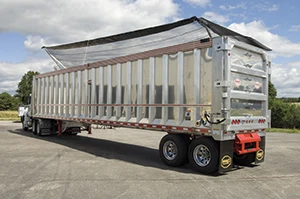
“Form follows function” is a basic rule of architecture, engineering, and industrial design. Transfer trailers serve a specific function. Their large hauling capacities make it financially feasible to transport large quantities of waste over long distances. This allows for the construction and operation of larger, regional landfills replacing dozens of smaller landfills. It also justifies the use of transfer stations which serve as transport nodes for the shipping of waste from a community within the regional landfill’s service area. In combination, transfer stations and transfer trailers make overland bulk transport of waste economically feasible.
By themselves, transfer trailers are not nearly as efficient and safe as they would be with the use of important add-on systems such as live floors, tippers, and tarp deploying systems. Live floors allow for the cost-effective discharge of waste at the delivery point since they are automated systems requiring little in the way of manual operation. Tipper mechanisms make possible the quick deposit of waste near an active work face, saving precious time (and money) in the delivery cycle. Tarp deploying systems provide a relatively inexpensive method of safely containing bulk waste during transport, with associated increases in transport safety, aesthetics, reduction in blown debris and dust, etc. Together, the basic design of the transfer trailer augmented by these three systems provides the form necessary to fulfill the function of mass shipment of waste.
Transfer Stations
As the base of operations for transfer trailers, we should begin with the design and operation of transfer stations. Basic accounting clearly shows it is cheaper to haul the same amount of waste tonnage with a few large trucks as opposed to many smaller trucks.
Transfer stations are nodes connecting the branches of local collection routes with the main trunk lines leading to the regional landfills. They are consolidation points where tributaries of waste merge. In function, they operate with the same goal in mind: the cost-effective transport of bulk waste. In form, they do vary somewhat depending on whether they are publicly or privately owned, their pass-through capacity (measured in tons per day), floor space and pit configurations, location and access (which can indirectly determine truck queuing lengths and offloading cycle times), and whether they are open or enclosed. They can offer auxiliary services such as waste compaction and baling, recycling and material separation, etc. And they don’t necessarily have to load onto trucks. There are transfer stations that ship out waste on barges and railroad cars depending on the station’s location and local transportation costs.
All of these factors converge in the design of the transfer station’s layout, both within the facility itself and the immediate land around it. At its center is the tipping floor where the incoming waste is offloaded. A transfer station with just a simple tipping floor that does not perform compaction prior to shipping usually has to rely on larger (with minimum 100 cubic yard capacity) transfer trailers to carry bulk quantities of loose waste. Though less efficient, the simple transfer station saves on capital costs for additional structures and equipment needed to process waste for delivery.
More complicated transfer stations utilize mechanical means of compacting waste prior to loading for transport. The most commonly used is the hydraulic ram. The ram’s force creates high pressure that efficiently compacts waste to a fraction of its loose volume. The ram operates directly into the transfer truck’s bed, whose frame has to be modified and constructed with reinforced steel to withstand the resultant impact and compaction forces. There is a trade-off in load capacity since the additional weight of the reinforced steel is deducted from the truck’s overall hauling capacity. Together, the waste load and reinforced steel increase a truck’s axle loadings, which can limit the types of roads and bridges it can use as well as increase maintenance and fuel costs.
A baler solves this problem by achieving high waste densities without the need for heavily reinforced truck bodies since the compaction takes place outside the truck in the baler itself. The baler compresses waste into individual logs, bales, or bricks which are tightly wrapped with wire to ensure they keep their shape and don’t shed loose pieces of waste. The compacted bales are loaded mechanically into the beds of the transfer trailers by forklifts or overhead cranes. The bales are stacked like bricks and don’t need to be contained by side walls around the truck bed.
Transfer Trailers
After examining the form and function of transfer stations, we should do the same for the transfer trailers themselves that operate out of these stations. With volume capacities in excess of 100 cubic yards, large transfer trailers measure up to 70 feet in length. These dimensions, in turn, have an impact on the exterior layout of the transfer station since vehicles of this size require large turning radii and result in physically long queuing lengths. Therefore, the access roads entering and leaving the transfer stations have to be designed to accommodate them and allow for safe movement and minimize the impact on nearby traffic.
Tonnage capacity of larger transfer trailers ranges up to 25 tons per load. So, at the high end, the waste being hauled by a transfer trailer has a density in the truck bed of 0.25 tons per cubic yard (or 18.5 pounds per cubic foot). This is slightly less than the typical density of waste deposited directly by refuse collection trucks (20 to 25 pounds per cubic foot), but overall the cost of transportation per ton-mile is considerably less for transfer trailers. Higher loads can be achieved by transfer stations utilizing railroad cars and river barges which can haul thousands of tons. However, since convenient locations next to rivers and railheads may be limited, multi-modal systems of transfer stations are possible with stations loading trailers, which in turn deposit at transfer stations loading rail cars or barges. So, we can see how the design limits of an individual transfer trailer also affect the overall operations of transfer stations and even regional waste management operations.
Transfer stations and landfills are harsh working environments, harsher than a typical construction or mining site. Dust, debris, odor, and sharp objects are commonplace. Every part of a vehicle or piece of equipment (engines, drive trains, undercarriages, wheels, and tractor treads) is severely impacted from even typical day-to-day operations. This results in excessive wear and tear compared to similar equipment in less harsh work zones. Transfer trailers like other waste handling equipment need modification to minimize these impacts. These modifications include different engine specifications (displacement, horsepower, fuel and oil requirements), transmission and drive trains, and suspension systems. They also have customized structural modifications in addition to the reinforced steel required for waste ram operations, such as heavy-duty impact resistant floors and truck bed side walls. Top loading waste containing potentially large, sharp objects results in several impacts on the truck bed below.
While broadly similar in operation, transfer trailers are specialized to meet specific needs. These unique designs include specially designed and customized frames, alignments, body designs, interior cab layout, safety features, and instrumentation. And these are just modifications to the trucks themselves. Further modifications are allowed with add-on features including tarp deployment mechanisms, suspensions, tires and brakes, and live floors. At the point of delivery, an additional mechanism such as tippers can be used to greatly increase operational efficiency. All of these add-ons, individually or in combination, can greatly extend the capabilities of the transfer trailers.
Live Floors
As there are several ways to load a transfer trailer hauling bulk waste, there are several ways to offload them at their destination. First, a truck can self-unload, tilting its truck bed with heavy-duty hydraulic lift jacks. Second is an exterior tilting mechanism. Last is perhaps the most efficient, the live (“walking”) floor. This is a modified floor bed that consists of a series of parallel planks arranged horizontally along the entire length of the bed. Each plank (often acting in combination up to three planks simultaneously) move up and down, sequentially lowering and raising themselves. When done in a continuous and reciprocating sequence, this creates a wave motion along the floor that lifts and carries waste out of the back of the truck. This motion (often assisted by pusher blades) is repeated until the last of the waste is gone.
Landfills servicing waste hauling transfer trailers equipped with live floors do not require the additional expense of acquiring a tipping mechanism or the potential safety issues involved with raising a truck bed out on the landfill working face. A live floor provides operational flexibility, increased off-loading efficiency, and overall cost savings. A live floor can be retrofitted into existing trucks, providing new life to old equipment. The additional hydraulics and a reservoir kit required to operate the live floor do represent an additional cost compared to simpler transfer trailers, and can also add to their operating weight compared to simpler trucks. But not being dependent on tippers for off-loading makes transfer trailers equipped with live floors more efficient and very useful for operations at remote landfill locations.
Trailer Tippers
When transfer trailers equipped with internal live floors are not available, an external trailer tipper remains an option. This mechanism actually lifts up the front of the truck’s bed, pivoting it on its open end that remains near the ground. Tippers can be portable or fixed. Fixed tippers tend to have greater lift capacities and can handle larger, more heavily loaded transfer trailers. Portable tippers, on the other hand, allow for greater operational flexibility as they move around the site from one work face area to another. While it can be a cost saver compared to equipping every transfer trailer in the fleet with a live floor, in any mode it limits the area of disposal to one location compared to a transfer trailer equipped with live loads that can be maneuvered to dumping sites anywhere within the landfill.
Another advantage of using trailer tippers is it allows the transfer trailers to dispense with the additional weight required for a live floor and its associated control and hydraulic systems. This, in turn, allows the transfer trailers to carry heavier waste loads, reducing the number of trucks required to service the same wastestream and reducing the time spent by each transfer trailer in queues, thus lowering the fleet’s overall transportation costs.
The operation of a trailer tipper is something of a dance with multiple steps required to complete the off-loading process. The transfer trailer enters the work site and then backs up into the tipper with the help of a spotter. Once in place, the truck bed is decoupled from the truck frame and cab. The driver then moves out of the way. The end of the open end of the truck bed is locked into place so it can be rotated by the tipper. The tipper then proceeds to elevate the front end of the truck bed to a full 90 degrees to the horizontal with the open end at ground level. The waste inside the truck bed then falls out of the open end via gravity. Once empty, the tipper lowers the front end of the truck bed back to ground level, pivoting off of the open end. The transfer trailer driver then maneuvers his cab and truck frame back into place and hooks up the truck bed. The now empty transfer trailer then drives off to return to the transfer station. Though it sounds complicated, the entire process takes less than half the time required for a self-unloading truck to deposit its waste.
Since the waste is deposited in the same location, it can allow for an effective reduction the size of the landfill’s current work face. Or conversely, landfills with limited elbow room can utilize a tipper to keep the waste in one small area. Since it has its own engine, a hydraulically operated tipper can be very efficient and cost-effective. Tipping platforms are best suited for off-loading high volumes of waste and are thus best coupled with a fleet of larger capacity transfer trailers.
Suspension Equipment
Truck suspensions include tires, springs, body frames, shock absorbers, and linkages. The linkages provide both connections between the various parts while being flexible enough to allow relative movement between them. The foremost factor affecting the design and operation of transfer trailer suspensions is the fact that these trucks operate in the extremely harsh operating environments of transfer stations, material recovery facilities, and landfills.
Given this harsh operating environment, truck operators must take special care to ensure a safe and smooth ride. Therefore, the suspension systems utilized by bulk waste hauling transfer trailers require a more extensive design similar to the design of the suspension systems utilized by long-haul trucks. A rugged suspension allows the waste hauling transfer trailer to operate on rough, unsurfaced service roads at landfills, the exposed waste of the landfill working face, and long hauls over paved highways.
One option is the use of rubber suspensions. Rubber bolster springs act in shear and compression to provide optimum spring deflection. Rubber bolster springs absorb vertical road inputs as well as fore and aft shocks. They do so by compressing and stiffening as the load increases. A progressive load spring is always engaged to maximize empty ride quality.
Tarping Systems
Open-topped transfer trailers and flatbed trucks need to have their loads covered with tarps to both protect the load from weather and to protect nearby motorists and pedestrians from debris flying off of the load. To provide this protection, there are several different types of tarps and just as many tarp deployment systems.
Tarps used to mean any oiled sheet of fabric. Today, they are either plastic sheets or plastic coated fabrics. They come in many varieties, including mesh tarps, poly tarps, vinyl tarps, and canvas tarps. Each design is a trade-off between strength and weight, each being inversely proportional to the other. Poly tarps and vinyl tarps are waterproof (as are HDPE or PVC geomembranes that are often used in place of tarps). Mesh is lighter and is designed to let in both water and air while holding in waste debris. Most heavy-duty truck tarps are made of vinyl. They are strong enough to withstand the force of the wind while driving and the tensile loads applied by bungee cords used to tie them down at their D-rings.
Tarps can be deployed over a truckload manually, and this method is typically used for irregular loads with odd shapes and sizes of materials. For regular load with consistent dimensions and smooth outer surfaces, mechanical tarping systems are preferred for their low labor costs and overall efficiency of use. These can deploy tarps either from front to back or from side to side. Made from vinyl or PVC, front-to-back systems include asphalt tarp and dump truck tarping systems. The system has two rigid metal arms that are slid into pockets that are only located on the sides of the tarp. The tarp starts rolled up at the front of the trailer just behind the cap and is rolled out lengthwise into position. Side-to-side tarping systems are referred to as “roll tarp” systems. The top of the trailer is covered with a series of metal bows often augmented with sidewall panels that serve as a rigid frame for the tarp deployment. The deployment mechanism unrolls the tarps out into position. The power for deploying the tarp can come from either a manual crank or an electric motor.
Major Suppliers of Transfer Trailers and Equipment
TRAILERS
J&J Truck Bodies & Trailers produces several models of specialized transfer trailer trucks led by their DynaHauler Steel Push Out (SPO) trailer system. Ranging in size from 65 cubic yards to 92 cubic yards of capacity, this steel push out trailer is designed to manage municipal solid waste as well as commercial and industrial waste. The steel blade is hydraulically driven and operated which acts to eject the waste out of the back of the truck bed. This horizontal push out capability removes the need for any method of tipping the trailer. To resist the resultant pressure and impact forces, it is manufactured from high-grade steel.
Since 1975, Trinity Trailer Mfg. Inc has been building self-unloading conveyor belt trailers for both agriculture and industry with its patented EagleBridge design. Supported by an in-house engineering department utilizing the latest in Computer Aided Design and backing up the design with finite element analysis, their sales force can quickly match the right set of trailer options to the right application.
Designed for hauling bulk commodities, the company’s signature EagleBridge trailer is ideal for use on rough country roads and uneven fields. The belt trailer provides flexibility via a frameless design that allows the EagleBridge to flex and twist as the ground demands, helping prevent the trailer from cracking.
Industry applications (coal, construction, excavation, waste) can all be met by the Trinity EagleBridge trailer. Diamond Trucking owner Gerald Stokely of Stanaford, WV, a thirty-year veteran of the coal industry, uses Trinity trailers in his coal-hauling business because they perform better than his old dump trailers. Trinity trailers allow his drivers to back in, unload in four minutes, and be off to their next pickup. Dump trucks take longer just to get level. Stokely says the faster turnarounds allow his truckers to pick up an extra two loads, netting him an extra $500 per day. “We run six days a week, all year round,” says Stokely. “Those extra loads add up.”
Keith Manufacturing’s CleenSweep Tarp
LIVE FLOORS
Keith Manufacturing builds their Walking Floor unloader. This system is designed for efficient bulk removal of waste from a transfer trailer without the need for tipping with either hydraulic jacks or a tipper. This system can handle pallet and bulk material loads because it has a unique horizontal unloading and loading design. The company manufactures both mobile as well as stationary walking floor systems. Their Walking Floor conveyors have found applications in the management of a wide variety of materials in numerous industries, such as waste management and recycling, agriculture, aggregates and asphalt, wood products, and energy production. It consists of a series of reciprocating slats, which serve as the flooring of the mobile unloader or bin. When activated, the conveyor “walks” the load in or out.
TARPING SYSTEMS
Since 1987, Mountain Tarp, a Wastequip brand, has been one of the most trusted manufacturers of quality tarping solutions for construction, agriculture, transportation, and waste applications. Known for flip tarp systems designed to securely cover dump truck loads, Mountain Tarp provides safe, compliant transport of construction and demolition materials. Service is provided at several installation and repair facilities in Ohio, Kentucky, Texas, and Massachusetts. They serve tarping customers across Ohio, eastern Kentucky, and West Virginia for a flip tarp, flatbed system, cable system, side-roll tarp, and rack and pinion repairs, Mountain Tarp’s new mobile program offers free tarping system inspection, assessment and consultation for light repairs, and parts delivery. Offering a comprehensive line of hydraulic, electrical, semi-automatic, and manual tarping systems, Mountain Tarp also provides cable-style solutions for trailers and rolloff systems and a variety of specialty tarp systems for the waste, construction, paving, landscaping, scrap, and oil/gas industries.
Unloading at the landfill
Their side flip tarp systems integrate well with transfer trailers. These lightweight systems are 300 pounds or less—half that of typical systems, reducing the weight that the tarping system is adding to the load. This makes it ideal for waste and scrap hauling. Mountain Tarp’s ultra-strong side flip tarp systems provide perfect trash containment for trailers 45 feet in length or more. Mountain Tarp’s side flip tarp systems can even cover heaped loads.
Roll-Rite LLC provides customized, state-of-the-art, automated tarp systems. These systems are designed, manufactured, and assembled by their experienced in-house staff and are used in a variety of industries (construction, agriculture, waste, and recycling). Roll-Rite’s side-to-side system, which features automatic shutdown and the Multi-Flex rear arm, has been designed specifically for use on transfer trailers, live floors, and tippers used in the waste, agriculture, and recycling industries. Keeping the driver in the cab or on the ground prevents injuries that can occur with any type of manually operated tarps. Roll-Rite has been manufacturing automated tarp systems for over 25 years and, with their recent acquisition of Pulltarps Manufacturing, has seven facilities in the US. Roll-Rite is the innovation leader
Latest from Waste Today
- Vermeer announces plan to build new facility in Des Moines metro area
- Buffalo Biodiesel shares updates on Part 360 application to DEC, Tonawanda facility progress
- Capstar Disposal expands roll off dumpster rental services
- Supreme Court strikes down IEEPA tariffs
- Casella details facility closures, expansion efforts
- Zero harm: Building a SIF prevention program for waste and recycling operations
- Casella posts a loss in Q4 2025
- McNeilus names Haaker Equipment first Dealer Partner of the Year