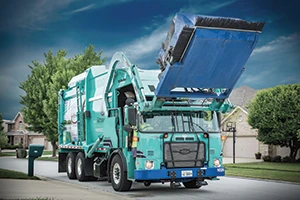
Trash collection might be the most unfairly maligned public service that rarely merits public attention for its community service. Unless there isn’t any. And then practically overnight, the hue and cry of anxiety of uncollected trash escalates into a community’s worst nightmare, making customers downright giddy to hear the familiar noise and clatter of the big trucks coming to restore neighborhood order. But in the 21st century, that comforting and familiar whine of diesel engines and compaction doing their job is getting quieter and quicker.
For centuries, horse-drawn wagons did the job; then, mechanized and self-propelled vehicles hit the streets in the 1920s—first in Europe, as cities were more densely settled, and then in the US. But complaints about falling garbage and odor sparked innovators to rethink collection and develop covered, and then more fully mechanized, vehicles. Today’s latest technologies in front, side, and top loaders would surely astound those early municipal collection pioneers trading in harness for horsepower.
According to spokesperson and waste historian specialist Zachary Geroux, one company saw the opportunity to consistently leverage innovation and improve the concept of the cab, box, and collection process, evolving into what is now Bridgeport Manufacturing.
Innovation Done by Hand
“In the 1950s, Ed Kouri founded Bemars Inc, a Los Angeles-based refuse truck manufacturing company. This building of front loaders and rolloff trucks quickly dubbed him as the ‘father of the front loader,’” says Geroux.
After selling Bemars to Maxon Industries in the early ‘70s, Kouri then began another firm, Able Body Company, where Geroux says he added side loaders to the inventory line and turned his attention to designing vehicles that would address the unique needs of an emerging recycling market.
Soon after, Kouri turned the business over to sons Matthew and Tony who saw the future in automated refuse collection.
“With Tony guiding a welder and an engineer, they hand-crafted the first rudimentary arm design that would later introduce automation in trash collection,” says Geroux.
“The Able Body company closed and Tony then relocated operations to begin a full line of automation technology in Bridgeport, Texas, where the company continues to flourish today, making the company the longest running privately owned manufacturer of garbage trucks.”
Geroux highlights the latest innovations on their vehicles, including an improved piston pump technology installed on all vehicles.
“These pumps drive the vehicle hydraulics, and for years these trucks have used a dual vein pump that runs off the truck transmission. But as a driver, you don’t want to leave the pump on during the entire route or you’ll burn the transmission up.”
He says the technology of piston pumps is not new—they’ve been standard features mostly on construction equipment—but, he adds, “they really shine on the waste side.”
“There’s two types of pumps—the dual cavity piston pump, and a power on demand pump. Once it is activated, it will only send hydraulic fluid when you tell it to. The benefit is this keeps fluid cooler through continuous motion. Otherwise, if you consider that the motor is hot, the hydraulic fluid is hot just sitting, and if you are working in a hot temperature climate this is a recipe for overheating and shutdown.”
“So, now we are using a single cavity, ‘skinny pump piston technology,’ and we can keep the fluid cool by constantly keeping it moving, but ready to send when and where it is needed. When the operator pushes the arms out to start collecting carts the fluid is already circulating, and on our trucks—especially our Confined Space Collection (CSC) model—if you are never exceeding 25 miles per hour, the unit stays below a default setting sending fluid to the packer, which is constantly moving. Between collecting and packing, the fluid is in constant circulation and the very act of circulation is what keeps it cool versus sitting and getting hot.”
To get more power, he says operators will often step on the accelerator of the truck to increase the revolutions per minute (rpm), and this, in turn, increases pressure of the hydraulic pumping power to generate more needed energy to the packer, for example. The downside, however, is this makes the transmission work harder and can cause overheating.
“With the skinny piston pump system, you can step on the accelerator but these have a 1400-revolutions-per-minute limiter on them and they are set at a certain speed of 25 gallons per minute. And since the fluid is always moving, it is kept cool.”
He adds that the skinny piston system, while it adds more in cost “is a lighter system—about 60 to 70 pounds—when compared to the 90- to 120-pound vein pump system, and on the road, every bit of weight counts toward payload capacity and efficiency.”
True Zero Kick Out
Bridgeport’s latest model, the Confined Space Collection (CSC), does exactly what the name says and was designed to meet the needs of urban areas with tight alleys and virtually no place to extend arms or approach a trash cart, Geroux adds.
He explains that in every other automated truck design you have to close the gripper and push the arm out to grip the can. This can be a variable distance, but the new CSC gripper assembly is stowed inside the width of the truck body itself.
“What this allows for is now you can actually put a cart flush with the side of the truck body and the arm can move out, close the gripper, grab the cart, and dump the trash without going past the width of the truck. In other words, a true zero kick out.”
While the prototype came out less than two years ago, Bridgeport has been putting demo models through their paces to further refine the operations. He says that several cities with tight urban areas have expressed interest in bringing these units to their fleets, and he cites Dallas as an example that’s already using the CSC and very pleased with performance.
“[For] some cities with dense urban environment […] collection is a logistical issue for vehicles. With the CSC all you need to worry about is getting down the roadway to facilitate collection which makes operators and residents happy.”
Another feature Geroux describes on the CSC includes the safety benefit of a kick-down door on the hopper.
“This is hydraulically actuated by a switch under the driver seat if in the event they had to manually load and/or retrieve a cart. If the driver is dumping a cart he can hit the emergency stop button and the cart doesn’t get crushed by the packer when he exits the truck to retrieve it. You can lower the operating door and kill any arm movement so you can safely and manually retrieve any cart—you never want the driver to have to enter a hopper.”
He says that because of the economy of movement in the CSC design, the air operated loading door is eliminated. “And all the maintenance guys love this feature and also the ease of working on the vehicle hydraulics, which follows our mission statement ‘simplicity by design,’” explains Geroux.
“Each function that uses hydraulics has their own cartridge system that governs that operation. So, if there is ever a malfunction, all the operator needs to do is to replace a cartridge on that individual unit, like the crusher panel, or the hoist arm, or the packer, versus having to pull out the entire system for repairs. We really are simplicity by design,” he affirms.
A Century of Purposeful Engineering
“With the legacy of building America’s first truck in the late 1890s, Autocar has stayed true to its founding purpose, which is to custom engineer trucks for the toughest jobs,” says Craig Teune, Autocar director of sales/refuse applications.
Adding to their legacy of innovation are alternative fuels, and Teune says the biggest new thing “is engine technology with our natural gas vehicles reporting to near zero emissions.”
“This includes the factoring in of the energy usage when making the engine, which then measures basically the same as electric,” he says.
“Our clean Autocar collection vehicle has been a leader in natural gas and over 50% of our refuse vehicles are now built in this manner.”
He adds that Cummins built the engine in collaboration with Autocar “who helped pioneer the compressed natural gas (CNG) technology to its current state-of-the-art in natural gas design.” Another change for refuse vehicles is their new programmed transmission system from Allison Transmission, called FuelSense 2.0.
“We’ve developed through programming a smart system that changes the shift point in revolutions per minute. So what this does is realign the engine function with the transmission that will save 2 to 6% in fuel economy.”
He adds that new fuel systems “have been evolving for the last 20 years, but the biggest challenge has been to keep vehicles on the road with adequate fuel for as long as they need to be. If you have electric for example, and it runs down during the route, you have to go and recharge. Natural gas, however, is perfect for the refuse collection market because you can fuel up overnight in the yard, go back out with a full tank and run your route without any interruptions over fuel shortage.”
Teune describes how their highly interactive business model works with customers.
“Completion of the sale is where we start, not where the relationship ends,” he says. “Basically, we work with them to engineer and create the truck they are going to be needing. This automatically puts us in touch with decision makers on the buyer end.”
After their truck is delivered, Teune says, “There is a training program our customers can opt into. We don’t charge for this and it’s a good orientation to CMG and how that system works. Operators can get used to the transmission, plus the distributors are involved, so everyone plays a role to ensure satisfaction and optimum operations.”
This connected relationship between manufacturer and customer is bridged with their Autocar solutions team “that are factory trained service technicians.”
“We know our solutions guys by name and we hear what customers say they want through this channel. The opportunity for this feedback lets us be responsive so if someone says ‘our drivers are tall and we need more space’ we can design a cab for them to work for that size, or if they are looking for a greener technology we offer the near-zero emissions engine.”
But to achieve this customization is more than filling a request. “We work to assess what their route is like, and California, for example, has a lot of weight restrictions, so we will design the lightest truck to fit all the stops, so they’re not losing half a day in collection time by running back and forth to the landfill. We take in all these considerations.”
By working with body companies, each cabin chassis is custom built, depending on which body they use. The ACX Xpeditor is “the strongest frame and cab in the industry with the best overall strength-to-weight ratio, and the ACMD Xpert is a medium/heavy duty model,” says Teune.
“Our front, side, and rear load models range from 11 yards to 40-yard capacity, and generally the rear loaders hold 25 yards and the front loaders carry 40 yards.”
Other attributes Autocar boasts is having an all steel cab that is the biggest in the business with driver benefits of 325-degree visibility that maximizes safety. And the ACMD model easily handles a three-man crew. As for power, the refuse trucks range from 300–350 horsepower with smaller models at 260 hp.
When managing weight, Teune explains that the cabin chassis “is where we have some leeway to manage weight restrictions.” But he cautions that when managing weight, it’s not just about how heavy and where you distribute it, “it’s how you actually go about doing the distribution properly.”
“The truck needs to be set up so that the wheelbase is supporting weight on the front and rear axle, but also ensuring that you are legal on both those axles. One process that makes us different is that most truck manufacturers build the truck, then ship it to the body company where they adjust it to what they need, and then mount the truck on the body.
“What we do is change how we work with the body company so we build it right the first time. As you go into a lighter weight truck, you are still hauling the same amount. For example, the Allison transmission can be fitted to a CNG and while you give up some torque, you will get a lower RPM on the highway so it’s fuel and money saving.
“It’s essential to have these conversations early in the manufacturing process to make sure we get it right—the first time,” affirms Teune.
Autocar trucks are sold through their network of distributors but Teune says, “One of our unique specialties as the OEM is to stay in contact with customers.
“We don’t just rely on the distributor’s relationship with customers; while we rely on them for the selling aspect, as the manufacturer, we continue to maintain customer contact. This keeps our company on the pulse of the industry, what it needs, likes, and wants, and this allows us to adapt and continually be responsive to diverse solutions.”
And the Award for Lightest of All…
All across North America and Canada, the Labrie name is known as a premier brand and a manufacturer that consistently offers new technologies across its Enviroquip Group of collection and recycling: Wittke front loaders, Labrie side loaders, Leach rear loaders, and the Organics line for organic refuse collection.
Spokesperson Louis-Charles Lefebvre reports on their latest innovations, including a new body design that tags their Wittke Featherweight model as “the lightest of the industry.”
He describes the existing Starlight and Superduty Wittke models as popular front loaders “already well known in the residential and commercial market for low body weight that can maximize legal payload collection.
“Both models have a 40-cubic-yard capacity, with a lifting capacity of 10,000 pounds, which is about 75% of their 15,500-pound weight, and do it in just a 14-second lift cycle,” says Lefebvre.
Originally designed in the mid-‘90s, Starlight was targeted specifically for California and the western US, which set the stage for further models.
“Now, the line has a new model that even surpasses these. Our Featherlight is now the lightest front loader in the industry weighing in at just 15,100 pounds,” he adds.
The lightweight model was an engineering feat that involved a new body with a different, “curved floor which studies show helps to save a lot of weight.”
Available in gas or diesel engine, Lefebvre says all three models are made of single sheets of Hardox steel that gives the body tremendous tensile strength and yet is lightest in its class.
Seemingly a contradiction, Hardox steel wear plate has unique hardness and toughness properties. But according to the manufacturer, this material can perform as a load-bearing part in diverse applications; the company says it is a perfect solution for collection vehicles that must be rugged to perform, yet light enough to meet payload regulations.
Lefebvre says that the Wittke line was “first manufactured in Mexico, and now they are being made in a new US factory, acquired by Labrie in 2015. The Featherlight is undergoing intensive demo testing in California and Utah,” he says, “where trucks need to be very light.”
He adds that the bridge formula in the US varies with local, state, and federal highways, “but by designing the lightest truck that meets the California requirements, we can then go anywhere in North America and assure customers they will meet local weight compliance.”
“Our manufacturing intent was to make this Featherlight model specifically for California markets, and being just 15,100 that gives you a 10-ton payload, you have a lighter body, and fewer axles with more weight. This combination helps increase income for people who carry garbage.”
Lefebvre adds that the fast cycle on the arms can also increase daily productivity.
He describes another Labrie innovation as “our special winter package for our CNG models.”
“We’ve been doing natural gas for 17 years but the problem in very cold climates in the US and Canada is that when the temperature drops, it decompresses the natural gas and you can’t be operational with engine starting and stalling problems. What we did was create a winter package that helps remove the cold and heats the gas before it goes into the engine so it starts up and stays running.
“Plus, natural gas is a quieter truck compared to diesel, and about 30% of our sales are now in the CNG market, although California is nearly 100% CNG.”
Purchasing the base truck is an investment in the low to mid six figures, Lefebvre says, and “for about 20% more, you can upgrade to CNG.”
“But in the long run, the CNG will be more economical and save you money when compared to the costs of diesel fuel. Plus, it’s greener by 23% and is virtually foreign-fuel independent as it is 99% sourced from North America.”
Adding the CNG is easily done since the tanks are roof-mounted and very accessible. “You can choose tanks from 60–100 gallons of fuel which will allow efficiency for every route.”
The company also has a range of new mini-rear loaders that Lefebvre says are perfect “for those areas where you can’t or wouldn’t want to take a large collection vehicle.”
Customers can choose from an 8- to 17.5-cubic-yard mini-rear loader designed to serve in light duty situations.
As the 8- and 10.5-cubic-yard hoppers are suitable for mounting on non-CDL type chassis of a light duty pick up truck, a commercial driver’s license is not needed by the operator, which makes getting work done an easier task.
“These are perfect for taking into small spaces, narrow alleys, or in a public space like a park, where you wouldn’t want to see a big waste truck coming through. The flat floor hoppers handle 800 pounds per yard compaction so while small, they are rugged to do the job,” says Lefebvre.
“These are a great solution for a corporate or academic campus, entertainment venues, any place where there is steady stream of trash to be collected on a less intrusive basis or having a restrictive area footprint.”
Lefebvre says that all Labrie customers have access to the around-the-clock Labrie-
plus customer support, located in Lafayette, GA, near their manufacturing facility. With field support ready and available, customers from all the Labrie truck lines can be reassured they can find replacement parts and receive technical service assistance around the clock.
All companies continue to push their unique technology in refuse collection in fast forward toward continuous evolution to keep communities clean and customers happy, efforts which would surely astound those early collection pioneers who a century ago were just trading in harness for horsepower.