In the world of landfills, the transition from active to closed status is much like the transition from feast to bed. When a community is done “feeding” the landfill, i.e., finished actively adding waste to it, owners pull a cover from the toe to the crown of these giants and allow the necessary digestive processes to take place. The digestive process in this analogy equates to solid waste degrading over time until the landfill can move into a “post-closure” care step and, eventually, into productively reusing the land.
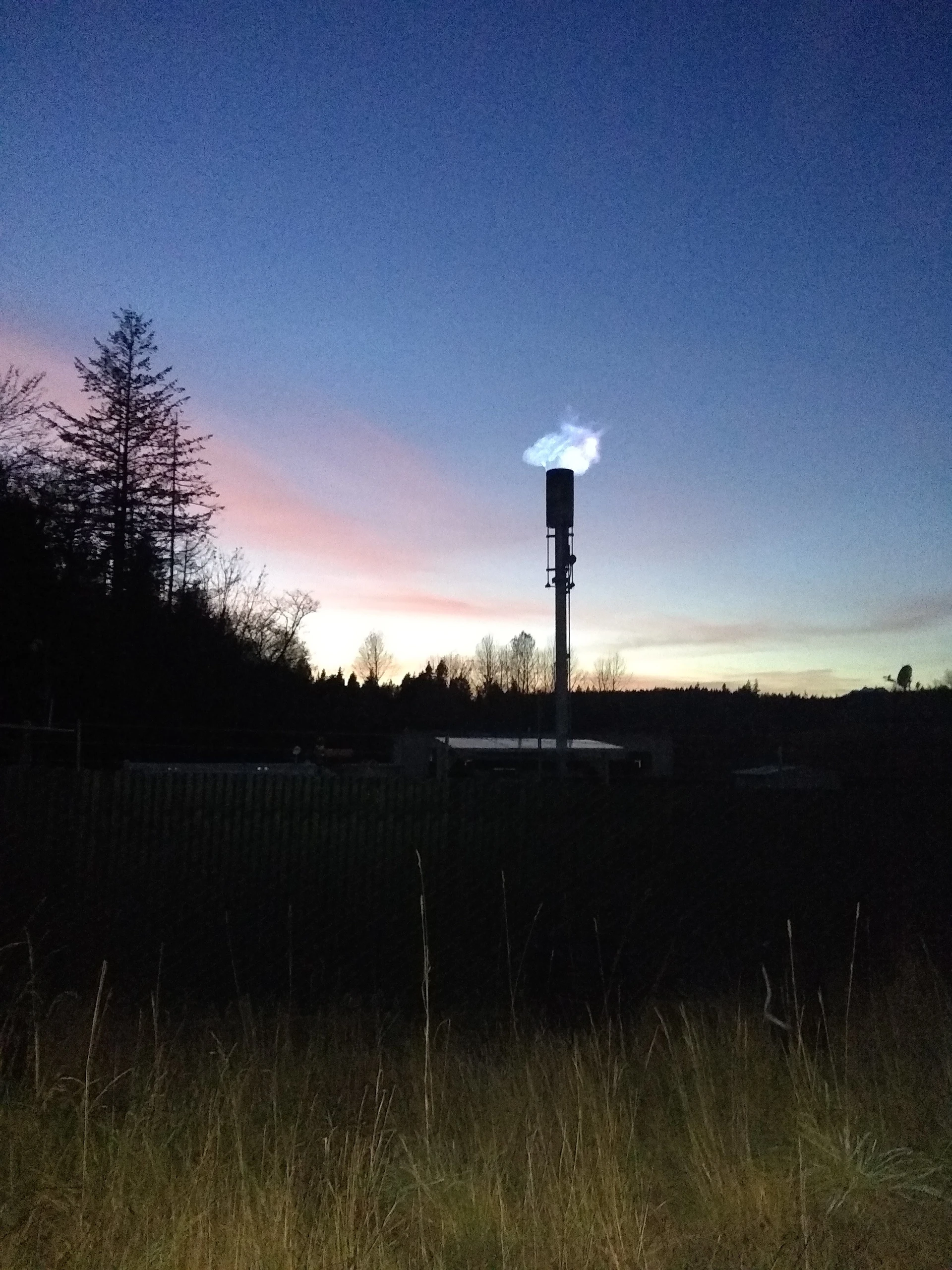
Often, the landfill flare—the controlled flame that burns off excess landfill gas—is the most conspicuous sign of the digestive process. Flares, in tandem with a landfill’s post-closure slumber, may operate for several decades during which time owners diligently keep watch. Some landfills sleep soundly, while others may suffer indigestion—often in the manner of excess landfill methane and other contaminants impacting landfill area groundwater, soil, and gas—and require special attention.
When the flare or “Night Light” goes out, landfill owners and operators can move on from active to passive landfill gas treatment, which means being one step closer to ending post-closure activities and considering potential future land uses.
AFTER NEARLY 30 YEARS, JEFFERSON COUNTY CELEBRATES A RARE LANDFILL MILESTONE
Near Port Townsend on the Olympic Peninsula in Washington State, the flare at the Jefferson County landfill has run since 1993, until this year when owners, regulators, and Aspect partnered to turn it off—a rare milestone in the life cycle of closed landfill operations.
Those responsible for watching and caring for these sleeping giants rarely see true milestone moments as the years roll on. Aspect has supported the team at Jefferson County for over 10 years with monitoring and reporting post-closure care at this landfill. Over the last year, Aspect has guided the Jefferson County team toward ending post-closure care. As one of the final milestones, they finally turned off the flare installed in 1993, nearly 30 years ago, effectively turning out the “night light.”
Closed landfills don’t get new waste but still have active engineering controls and monitoring to ensure digestive byproducts, like gas and leachate, don’t impact air quality or groundwater quality. At enormous landfills, like the Cedar Hills Regional Landfill Facility in King County, WA, landfill gas is often used as an alternative energy source. At smaller landfills, like the Jefferson County landfill, flares have been used to treat landfill gas to control odor, prevent air pollution, and reduce greenhouse gas emissions. Over time, the digestive processes slow down and less gas is created. Eventually, there is not enough landfill gas to directly fuel a flare, and supplemental fuel (like propane) may be used to keep the flare going—which erodes the value of using a flare for landfill gas treatment.
RISKS VS. REWARDS IN GOING FROM ACTIVE TO PASSIVE LANDFILL GAS COLLECTION
There is a rational reluctance to transition from active to passive landfill gas collection at older landfills without bottom liners. We all have zero tolerance for explosive gases migrating laterally from a landfill and potentially into a neighbor's basement. Landfill gas migrating vertically can also impact groundwater quality. But landfill owners may back into passive landfill gas collection because the flare keeps shutting down.
If there is insufficient methane generation to support a flare, it may be insufficient to migrate. Converting from active to passive landfill gas collection may nudge the decomposition process from anaerobic methane generation to aerobic carbon dioxide (CO2) generation. Under passive landfill gas collection, the barometric pressure changes allow the landfill to breathe, inhaling atmospheric air during rising barometric pressure and exhaling CO2-rich landfill gas during dropping barometric pressure.
SWITCHING OFF THE NIGHT LIGHT IN FAVOR OF 14 BIOFILTERS
It takes a coordinated effort to turn off a flare. After years of intermittently operating the flare with supplemental fuel, Aspect coordinated with Jefferson County and regulatory agencies to help move to a better solution. The regional air quality authority, ORCAA, confirmed air quality would be protected without the flare. Jefferson County Public Health approved removing flare treatment from the closed landfill permit. Consistent with community goals, the Jefferson County Public Works team built and installed 14 new biofilters and is now monitoring them to ensure they effectively do their job.
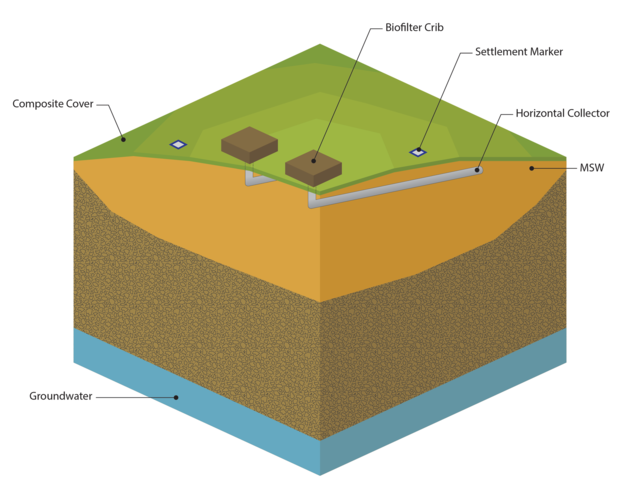 Ending post-closure activities at this landfill meant adding settlement markers and biofilters.
Biofilters are increasingly used to treat landfill gas during the final stages of digestion and gas generation because they provide "polishing" treatment with little monitoring or maintenance. Landfill gas is directed from horizontal collectors below the cover system through a perforated pipe, which is buried by wood mulch. Naturally occurring microbes develop on the mulch and break down methane and hydrogen sulfide as landfill gas passes through the biofilter.
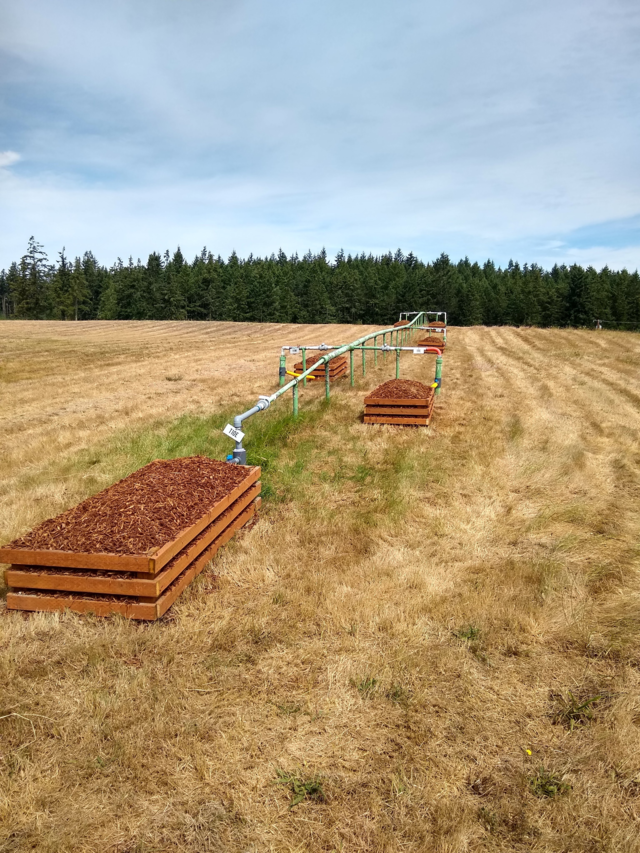 The horizontal collectors promote the microbial breakdown of landfill gas as the gas passes through the biofilter.
Barometric pressure changes will allow the landfill to breathe, inhaling atmospheric air during increasing pressure and exhaling landfill gas during decreasing pressure.
DESIGN CONSIDERATIONS
After switching to passive landfill gas collection, it is important to keep the active system operational—just in case. The distance between the edge of the landfill and the compliance probe or groundwater often determines the success of passive landfill gas collection. In cooperation with regulators, selecting which triggers would restart the active system is important, such as methane exceeding 50% of the LEL at compliance probes or groundwater quality showing gas-to-groundwater impacts.
Biofilter sizing was based on the observed methane collection rate and the potential methane uptake rate per cubic yard of biofilter media material. If routine monthly monitoring at the biofilter surface shows greater than 25% LEL, the biofilter volume will be supplemented to support greater methane uptake.
SAFELY REDUCING MONITORING COSTS AND SEEING THE END GOAL
Turning off the flare brings the Jefferson County team one step closer to ending post-closure monitoring at the landfill. The next steps include showing:
- There is little to no landfill gas generation. No subsurface landfill gas migration has been observed recently under the intermittent operation of the flare. Compliance gas probes near the property boundary will be monitored during passive landfill gas collection to ensure explosive gases remain in very good control.
- The cover system has good integrity with little to no settlement and is resilient to erosion. The cover system prevents rainfall from infiltrating through the landfill and creating leachate. Settlement surveys have begun, and the vegetated surface is in very good shape.
- There is little to no leachate generation. Like most older landfills, the Jefferson County landfill started receiving waste before bottom liners were required. So, any leachate that is generated due to infiltration or during digestion will reach groundwater. A network of groundwater monitoring wells is being sampled for a wide range of potential contaminants, and results look favorable.
FOCUS ON THE FUTURE OF JEFFERSON COUNTY
Until August this year, the transfer station supervisor would head down to the landfill flare every morning to push the reset button. There might be just enough methane to run the flare an hour or two or it might just shut down. He would then head back to do his real job—helping colleagues and neighbors at the transfer station. With the flare now idle, Jefferson County staff can focus on helping more neighbors as their community grows.
Following a couple of years of monitoring, Aspect will provide the final report to end post-closure activities. We will all be able to sleep a little better at night once we’ve demonstrated that human health and the environment are protected from this sleeping giant of a landfill. Then, the Jefferson County team will be able to consider future land uses that won’t disturb the sleeping giant. Will it be a park? Will it be part of the newer, bigger transfer station? To be continued…
Latest from Waste Today
- Vermeer announces plan to build new facility in Des Moines metro area
- Buffalo Biodiesel shares updates on Part 360 application to DEC, Tonawanda facility progress
- Capstar Disposal expands roll off dumpster rental services
- Supreme Court strikes down IEEPA tariffs
- Casella details facility closures, expansion efforts
- Zero harm: Building a SIF prevention program for waste and recycling operations
- Casella posts a loss in Q4 2025
- McNeilus names Haaker Equipment first Dealer Partner of the Year