With a history stretching back to the early 1900s, Wm. Miller Scrap Iron & Metal Co. had earned a reputation in the Winona, Minnesota, community as a trusted full-service scrap recycling and waste facility, offering customers a “one-stop shop” with its transfer station and roll-off services.
In 2023, when the largest locally owned residential waste provider in Winona, about two hours south of Minneapolis, sold to an out-of-state corporation, Miller Scrap Chief Financial Officer (CFO) Jeremy Miller, who also is a state senator, received feedback from community members who desperately wanted a local option for residential waste service.
That community outcry coincided with a noticeable loss in volume at the Miller Scrap transfer station. Miller Scrap long had maintained a mutually beneficial working relationship with the acquired local waste company, which previously had used Miller’s transfer station to dump the vast majority of its mixed solid waste.
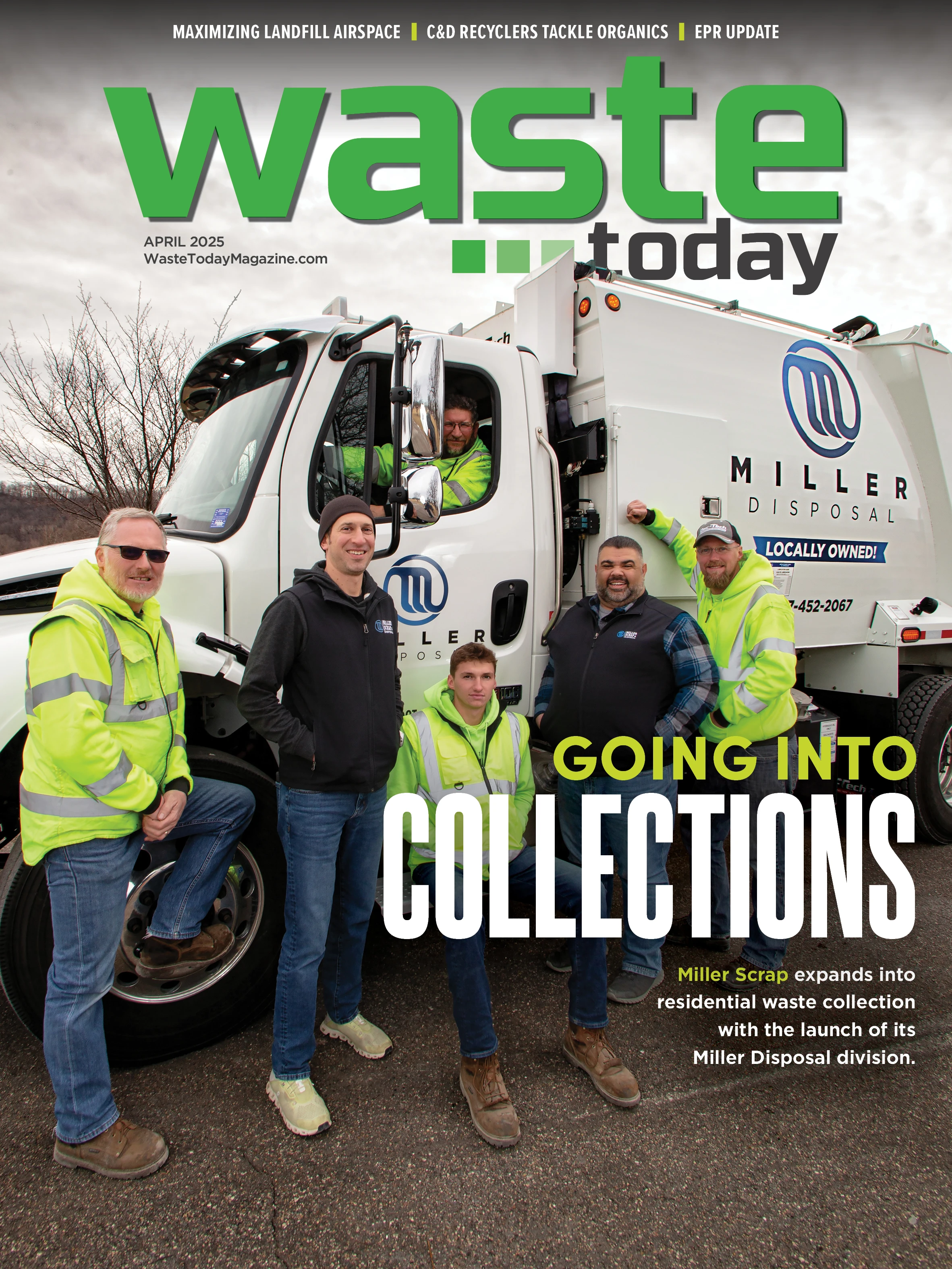
Prompted by these factors, the family launched Miller Disposal in June 2023 to offer residential and commercial waste collection services.
“Being local and providing recycling and waste solutions to the community has been a priority of the Miller family and our dedicated team since my grandfather started collecting furs and recyclables by horse and wagon through the alleys of Winona in the early 1900s,” says Jerry Miller, Jeremy’s father and the company’s chairman and CEO. “Our family is deeply rooted in this community, and we are committed to providing local service people can count on.”
The company dates back to 1910, when Jeremy’s great-grandfather Louis Miller started the business. Decades later, Jeremy’s grandfather William joined the family business as it evolved into a consumer tire and supply company, which sold tires and purchased rags, paper and scrap metals to sell for recycling. The family eventually formed Miller Salvage and Supply Co., which became Wm. Miller Scrap Iron & Metal Co. in 1955. When William died in the 1960s, his wife, Esther, took over the company and expanded the scrap recycling operation to include roll-off containers for mixed solid waste. She also built the company’s transfer station.

Today, Miller Scrap & Disposal operates a full-service scrap recycling facility, a transfer station, a roll-off business and a collection business on a 12-acre property on the east side of Winona.
Jerry was the third generation to become involved in the business. Now 85 years old, Jerry still comes to work every day to keep an eye on the operations and to “keep my brothers and me on our toes,” Jeremy says.
Jeremy’s brother Willie is chief operating officer (COO), and their eldest brother, Todd, provides support where needed throughout the operation. Two of Willie’s sons work at Miller, as well, with Charlie driving a truck and Jake working in the warehouse.
“A lot of family businesses usually have a tough time making it past the third generation, so it’s pretty cool that we have made it to five,” Willie says. “It’s a special thing to work with your father, and I’m happy that my boys will get that opportunity like I did.”
Miller operates its multiple divisions and businesses from one main facility in Winona. The full-service scrap recycling facility buys, processes and sells ferrous and nonferrous scrap, servicing foundries and mills locally, nationally and globally. A transfer station handles mixed solid waste and construction and demolition (C&D) debris. Roll-off service is provided for scrap, municipal solid waste and C&D projects.
In 2010, Miller launched a brokerage division that buys and sells scrap across the U.S. and ships globally, as well.
In 2023, when the company launched Miller Disposal, the staff expanded from 20 employees to 25.
“Our hard-working team of 25 is incredibly dedicated and has been instrumental in the success of Miller Scrap & Disposal,” Jeremy says.
He grew up in the business, often working Saturday mornings and in the summers going back to his middle school days, biking to a can collection facility. After he graduated from high school in 2001, Jeremy headed to Denver to pursue a degree in sports entertainment event management.
“I could not wait to leave Winona and I had no interest in joining the family business,” says Jeremy, whose time working in a professional sports arena convinced him it was not the right career path. “After being out in Colorado for a year, I realized that I couldn’t wait to get back home, and I realized that maybe the family business was a better fit for me.”
By 2002, he was working full time with Miller Scrap, beginning in the warehouse and doing office work. He quickly realized an accounting department was needed.
“We didn’t have an accounting department and, as a scrap recycler, we were writing out probably 600, 700 checks per month,” Jeremy says. “My dad and uncle were handwriting the checks, and the challenge was you couldn’t read the check register. … I realized very quickly that that was an area that I could help contribute to the family business.”
Shortly thereafter, he earned an associate degree in accounting from Minnesota State College Southeast Technical.
“The great thing about that was I could work and go to school at the same time, and then I could quickly implement many of the things that I was learning in school into the family business,” Jeremy says. “We had zero computers at the time, so we modernized and computerized our accounting.”
Jeremy began computerizing all of the billing, accounts payable, accounts receivable, financial statements and payroll. His efforts led to a modernization of the entire operation.
“I was really focused on bringing our business into modern times, which, with a multigenerational family business, is not always an easy thing to do,” he says.

Miller Disposal
Jeremy took the lead in launching the disposal business, as well. Even with considerable experience in the waste and recycling industry and growing alongside his family’s business, starting a collection company was a daunting endeavor, he says.
“It was a huge undertaking,” Jeremy says. “I was familiar with the garbage business, especially with having the transfer station and the roll-off dumpsters, but I was far from an expert. I’m still learning something new every day, and here we are almost two years later.”
In the lead-up to launch, Jeremy would arrive at work early in the mornings and work late into the evenings doing research, leveraging business relationships, taking field trips and trying to learn everything he could about the collection business. He embarked on a crash course in trucks, carts, software, containers and more.
“When we first launched, it was crazy, crazy busy,” Jeremy says. “I was answering phone calls, I was signing up customers, delivering carts, making routes, dispatching our truck. It felt like a combination of organized chaos and just pure madness.”
One of the most important things the company did in launching the collection division, Jeremy says, was to put in place a strong, experienced team. Miller recruited a veteran lead driver who grew up in the waste business as well as a seasoned dispatcher with industry experience to become operations manager. Since those first two instrumental hires, Jeremy says, the company has brought on three more full-time drivers as well as an office support staffer.
At launch, the disposal business operated residential routes Monday through Friday. Soon after, Miller added commercial routes in the city of Winona as well as in two surrounding communities, Goodview and Minnesota City. While residential customers make up a larger percentage of total stops, he says the commercial division is growing at a rapid pace.
For Jeremy, one unexpected challenge of branching into the disposal business was familiarizing himself with all of the available options for software and trucks, from side-arm to rear-load to front-load. One factor he took into consideration while deciding which types and sizes of trucks to purchase is that the city of Winona has a lot of alleys, both in residential areas as well as downtown, which is where many commercial accounts are located.
In addition to purchasing two used 20-yard packer trucks manufactured by McNeilus, Dodge Center, Minnesota, Jeremy went with a Mini Bandit side-arm, a compact offering from Pac-Tech, also based just an hour away in Dodge Center, that allows for greater agility. The company’s most recent truck purchase, a 13-yard Pac-Tech rear-load truck, was chosen for the same reason.
“It just allows us to maneuver better through the alleys of Winona,” Jeremy says.

Competitive advantage
What sets Miller Scrap & Disposal apart from the competition, Jeremy says, is the company’s local presence and strong focus on customer satisfaction.
“Not only are we local from sign-up to pickup to payment, but our customer service is second to none,” Jeremy says. “Simply put, our priority is to meet the needs of our customers, and we will go above and beyond to do that.”
It’s also long been ingrained in the family’s culture to support the community, which Miller does in many different ways, from donating financially to volunteering in the community. As part of the company’s Community Give Back Program, Miller partners with a different local nonprofit, school or community organization monthly, donating money for every new customer that signs up for Miller Disposal’s collection service.
The Miller family has a history of civic engagement, as well, with Jeremy following in his father’s footsteps as an elected official. In 1982, Jerry was elected to the Winona City Council and went on to serve as the city’s mayor from 1997 to 2012. That dedication to public service inspired Jeremy to run for the Minnesota Senate in 2010.
“I learned from my parents the importance of getting involved and giving back to the community, and I always knew that I wanted to get involved in public service. I just wasn’t sure when or at what level,” Jeremy says. “The opportunity was there in 2010, and I decided to run. I was an underdog. I was not expected to win.”

Thanks to a strong team of volunteers, Jeremy defied the odds, winning by less than 1 percentage point. He’s since been reelected five times and is serving his 15th year in the Minnesota Senate.
When policies related to waste come up for consideration in the legislature, Jeremy can act as a resource for his colleagues.
“Most folks don’t have my level of knowledge or expertise if it’s related to, say, recycling or waste services,” Jeremy says. “I can bring a unique perspective because I’m the only scrap and trash guy in the legislature.”
Looking to the future

Miller Scrap & Disposal always is looking for opportunities to grow, with an immediate goal to continue growing locally with more residential and commercial accounts, Jeremy says.
“We do have some smaller neighboring communities who have asked us to consider expanding our routes into their areas, but we just really remain focused on continuing to grow within the current communities we serve,” he says.
Because the company is relatively new to residential waste, its top priority is to provide the best service possible to customers at a competitive price. Jeremy says he welcomes competition in the community, which is ultimately good for the consumer.
“If you are good enough at your job and you know what you are doing, you should be able to overcome any challenges that come your way,” says Scott Pozanc, lead driver for Miller Disposal.
As for Jeremy, his life philosophy centers on hard work, building relationships and surrounding himself with a core group who can help get things done.
“I learned about the importance of working hard and building relationships from my dad. He also taught me the importance of being patient and allowing time for things to materialize,” Jeremy says. “On the flip side, I learned about being persistent from my mom. She taught me that no doesn’t always mean no, but sometimes it just means you have to find a different path to yes.”
That combination of life lessons instilled in Jeremy something he calls “patient persistence.”
“If I’m working on putting a deal together or, in this case, launching a new business and trying to grow our customer base, it’s important to be patient and not push too hard,” Jeremy says. “But it’s equally important to be persistent by respectfully keeping the pressure on and keeping up the hustle.
“Not too many things in life worth having come easy, so if you want something, you have to work for it. You have to earn it—and if you don’t, someone else will.”
Explore the April 2025 Issue
Check out more from this issue and find your next story to read.
Latest from Waste Today
- Republic Services spends big on acquisitions, reports growth for 2025
- Arcadis, CCI BioEnergy partner under Master Service Agreement
- SWANA, Fire Rover develop fire incident reporting tool
- Anaergia, Eni and CREvolution forge renewable fuels partnership
- Iron Crest forms waste equipment manufacturing platform
- SES opens second zero-waste facility in Kansas City
- Vanguard Renewables acquires E-Z Recycling
- Cemex Ventures increases investment in waste-to-energy startup