The necessities for compaction are those enabling landfill operators to gain as much air space as possible, notes Bert Erdmann, product manager for BOMAG Americas.
“Air space is like pure dollars,” he points out. “The more trash you can put into the landfill site, the more money you can make with that particular site. Compaction is the essential operation aspect to regain as much of that available air space as possible.”
Martin Mattsson, key accounts director for waste and recycling, Volvo Construction Equipment, notes that dozers and landfill compactors play a significant role in that effort.
“The key is making sure the specs include the correct tires, buckets, wheels/cleats, and blades,” he adds. “Pre- and post-inspections are important to make sure machines are in working condition, greased accordingly, and have any debris removed from the machine.”
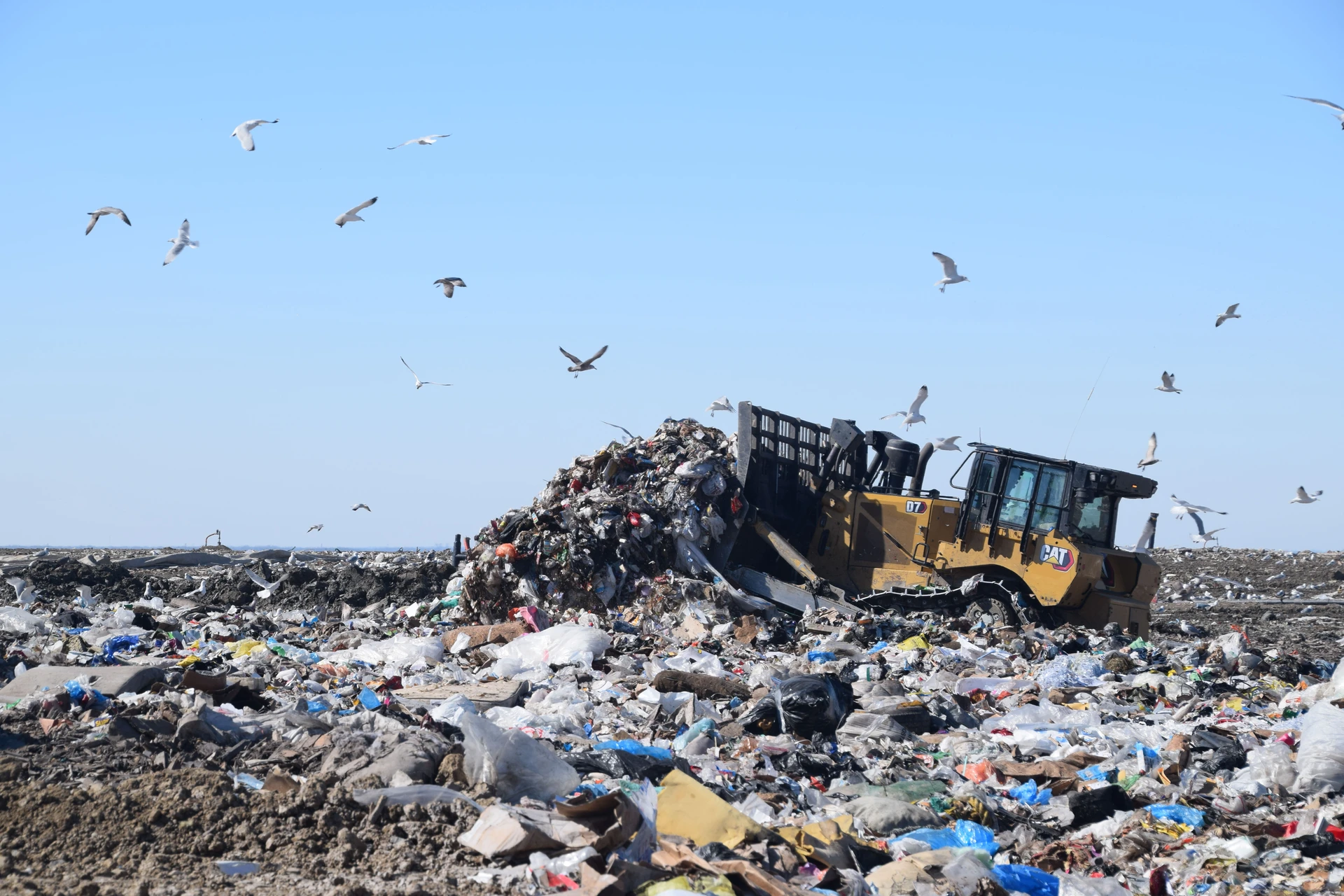
Caterpillar offers the Track-Type Tractor (dozer) and Landfill Compactor system.
“Dozers are built with tracks and designed to have the machine float and apply minimal ground pressure,” points out Travis Schwark, Caterpillar product application specialist. “This allows the dozers to be agile and move quickly around the tipping floor, pushing the waste onto the working face.”
Dozers and other tracked machines are engineered to push and move material as quickly as possible and manage slopes on the sides of the landfill cell, while compactors are engineered to compact material as quickly and efficiently as possible, finishing cleaning up the tipping floor, Schwark says.
Landfills taking in 200 tons or less a day can get by with just a landfill compactor, such as the Cat 816 Landfill Compactor, as to avoid idle time, he adds.
Landfill operators are faced with constantly changing conditions, notes Matt Goedert, solutions marketing manager, John Deere Construction & Forestry.
“Something as simple as changes in the weather requires the equipment and the operator to be able to work in a variety of ground conditions from snow and frost, to rain and mud, to wind and dust,” he says, adding that each scenario requires different attributes and features from the equipment.
One of the most difficult combinations to overcome is wind and dust, says Goedert.
“This often creates airborne debris that can affect visibility, shorten air filter life, and drastically reduce equipment cooling capability,” he says, adding that a properly equipped machine can operate in varying conditions more effectively.
Various waste types are another challenge, says Goedert.
Changes in C&D and consumer packaging that have evolved over time affect how the waste is handled, creating new and challenging requirements for the solid waste industry and equipment manufacturers, Goedert notes.
“This could be something as simple as foam packaging or laser dust that easily becomes airborne and plugs radiators to something more complicated like powder-coat paint waste that has a low melting point and can adhere to hot radiators and coat them,” he says.
"These materials further complicate the operation due to the way the waste compacts, clings, and wraps around moving parts. Most skilled landfill operators know how to attack each different truckload to minimize disruption to the flow of the dumpsite.”
John Deere has worked with landfill operators to develop crawler dozers designated as waste handlers.
“They need to run cool and be productive, have robust guarding providing protection from hidden objects, and a cab to keep the operator comfortable,” says Goedert.
John Deere’s lineup includes the 850L crawler dozer waste handler to complement the 950K and 1050K waste handler dozers.
The machine’s configuration plays a significant role in compacting for maximum efficiency, says Goedert.
“Sizing track shoes is always a balance between compaction and floatation,” he adds. “Narrower shoes can increase ground pressure for added compaction. Wider shoes allow the dozer to float on top of the trash and provide better stability.
“Trapezoidal-hole or open-center shoes allow trash that may have built up in the chain pockets to be extruded through the face of the shoe to prevent trash packing and associated over-tightening of tracks. Recessed sprocket segments provide even more capacity to clean out the chain pocket, increasing the undercarriage life.”
Keeping machines running cool can be a challenge, says Goedert.
“Features like service doors that have improved sealing prevent airborne debris from being sucked into the internals of the machine,” he adds. “These large doors provide unobstructed service access to the cooling system and greatly reduce overall time to clean the coolers when the time comes.”
A square-wave radiator fin design with wider spacing helps prevent plugging and aids in clean-out. Coupled with the fully automatic proportional reversing fan and reinforced, perforated front grille, the features are designed to keep the machines running cool in demanding situations.
Landfill equipment choices affect maintenance.
“The more compaction you get, the less there is a need for interim cover, which will consume large amounts of landfill space," says Neil McCartney, managing director, MACPACTOR.
“Greater compaction means less wind-blown litter on perimeter fencing. When operating an efficient tipping face, waste should be handled and compacted in a metered area so as not to leave pockets of uncompacted waste.”
Correct tip patterns on a wheel also are important, says Dale Mills, MACPACTOR North America manager. Case in point: a standard pattern is not optimal for C&D waste which requires more tips to break up the material, he adds.
Safety is a key consideration in dozer and compaction equipment.
Cat Landfill Compactors include a rear vision camera. To address fires resulting from the wastestream entering every open void space around the machine, the fire suppression product initiates in a thermal event.
Object detection or a proximity alarm system are developing technologies to further ensure safety.
“These future technologies will need to be able to distinguish the difference between a couch or large object in the waste and a person,” he notes.
Safety and stability are another concern.
"If you maintain optimal tip height, the machine is a lot more stable, increasing traction and compaction,” says Mills.
Other essential safety elements include rollover protection built into the equipment and HEPA systems to keep as much of the inside cab air as clean as possible, Erdmann notes.
Don't overlook seatbelts, warning beacons, backup alarms, and Lock Out Tag Out equipment, Mattsson adds.
As landfill compactors and other equipment reach their design limits from an iron perspective, the way to improve efficiency and productivity is through technology, says Schwark.
Cat Compact GPS mapping is an existing technology that is being more rapidly embraced by landfill operators while onboard pass mapping enables operators to see in real time where the machine has been and how many passes it has completed.
“The higher accuracy option or elevation-based mapping takes it a step further and shows an operator in real time when that location of the waste is compacted,” says Schwark.
The data can be transferred to a back-office suite or cloud-based server that a landfill manager can leverage to track compaction density, cut and fill, and airspace.
Landfill operators have derived from 6 to 18% productivity as a result, Schwark says.
Through John Deere’s JDLink telematics system, landfill operators and fleet managers have access to a large data list to help them understand their machines’ health and condition, says Goedert.
“Fleet and operations managers have access to a large list of data to help them understand the health and condition of their machines,” he says. “This allows managers to remotely see fuel levels, operating temps, load levels, geographical location and usage hours all from a computer or smartphone.
“This system also can provide alerts for diagnostic codes when the machine may need some extra attention,” he adds. “Customized maintenance plans with custom time intervals can be created to best suit their working conditions.”
A John Deere dealer also keeps an eye on the machine via the Machine Monitoring Center to proactively keep it running at the maximum level, notes Goedert.
Several systems on the market help measure compaction and volumes.
The John Deere SmartGrade mastless 3D grade control system can be used for a variety of landfill tasks, including measuring elevations, repairing slopes, crowning haul roads, developing new cells, or placing cover material.
“Not having masts or exposed cables greatly increases uptime and helps control expenses related to broken cables and equipment failure,” says Goedert.
Mattsson recommends utilizing telematics in combination with remote machine monitoring to help operators and fleet managers monitor maintenance needs and machine alerts proactively and reactively. Trends can identify opportunities for improvement as well as scheduling services.
One such technology is Volvo’s ActiveCare Direct, which analyzes data for actionable items.
Wheels, teeth, and tracks play a key role in landfill compaction.
"Landfill operators need to specify the correct cleats and cleat pattern based on municipal solid waste and/or construction and demolition applications,” notes Mattsson.
Tip layout is crucial for shredding and pulverizing the waste while preventing material from packing on the wheels and maintaining traction, notes Schwark.
“Tips themselves are the key component of the wheel that pulverizes and shreds the waste, while the wheel is designed to do the actual compaction,” he adds.
CAT tip options include the Paddle Tip for performance and traction; the heavier and wider Plus Tip for crushing C&D material and side slope stability; the Plus and Paddle combo offering performance and traction as well as side slope stability, given their location on the outside rows; and the Diamond Tip for when extended wear life is a concern due to abrasive wastestream, cover material, and C&D.
Striker bars and available cleaner fingers help keep wheels free of debris for more efficient compaction and higher densities.
Among the offerings by MACPACTOR is the laterally opposed multi-directional and all-traction M-Trax Diamond Tooth system.
MACPACTOR has designed the M-Trax Diamond tip range to be robust and offer optimal wear, compaction and machine wheel cleanliness. This marked reduction in wheel plugging prevents loss of tip penetration that would dramatically reduce compaction, notes McCartney.
Height options include 7, 8, and 10 inches.
The company’s Cleat-Guard stops solid waste matter from getting in around the back of the wheel, damaging axle seals and resulting in transmission failures.
The Multi-Directional Diamonds have an increased ability to rapidly reduce bulky wastes. The stability it also offers is considered ideal when working across the tipping face.
On entry, the tri-action tooth design splits the waste in three ways, reducing particle size and increasing compaction.
The Diamond Traction configuration is an option suited where traction is required and plugging may be an issue. It is ideal in landfill situations with a large amount of C&D.
MACPACTOR’s soil wheel compaction system includes new Diamond Cleat Pad replacement tips and tip saddles. The company also offers Semi-U and M-Blades with multi-angled designs to fit all landfill dozers and compactors. Waste is channeled directly in front of the compactor wheels or tracks.
MACPACTOR also manufactures specialty guards for powertrain protection on landfill compactors.
“Landfills are an environment of extreme wear,” points out Mills. “The powertrain drags in the landfill, which can result in high dollar powertrain failures. This is accentuated when wheel diameters are reduced to allow the fitting of longer tips as a way of increasing their life due to inferior materials being used in their manufacture.
“Landfill space is running out, so people are beginning to realize they need to make as much use of their air space as they possibly can. The recognized way they do that is to fit the Diamond Tips to their machine.”
MACPACTOR designs the wheel to suit the landfill, be it sludge, MSW, or C&D, McCartney adds. More teeth are added in areas where site conditions are abrasive.
"Another consideration is the wrappers," Mills says. "Some wheel manufacturers will cut the tips off and reweld the new tips on the same wrappers without sonically checking for thickness. As the worn wrappers flex the tip welds fail, resulting in tip losses or even the tips punching clean through the wrappers.”
Caron Compactor Company’s Pin-On teeth have been designed specifically for machine size, weight, and horsepower.
The company’s wheels are made with different-sized teeth and incorporate patterns to adapt to job conditions including weather, solid waste composition, sludge, C&D materials, and soil conditions including rock, sand, loam, and cohesive clays.
Airspace conservation to extend landfill life and prolong the expense of future cell or expansion construction is key, notes company president Jim Caron.
“Demolition qualities to reduce the particle size to improve compaction and achieve higher density are of utmost importance,” Caron adds. “The number of teeth on the wheels and the machine along with two types of teeth, traction and contour, allows the ability to achieve more penetrations into the refuse per day.”
“The height of each tooth as compared to O.E.M. designs which are shorter and smaller, and the metallurgy to accomplish higher wear life, are all important additional factors.”
Caron also builds the Double Semi-U trash blade, designed to funnel trash under the compactor wheels to improve density. A Semi-U trash blade is constructed for optimal internal support structure with thicker wear material and a steel plate.
Caron’s Double-Crown Shed Edge tooth, measuring 8.5 inches, has features designed to aid in demolition capabilities by allowing the wheels to run cleaner without the use of cleaner bars, notes Caron.
All Pin-On configuration teeth are available in a one-piece Weld-On design.
“The Pin-On is more cost-effective on new machines with longer wear life maintaining the taller teeth for demolition capabilities whereas the WeldOn is primarily made for secondary wheels for used and higher hour machines that usually become backup or standby units,” Caron says.
Wheel designs offering optimal crushing and kneading effects while rolling and compacting such as offered by BOMAG increase efficiency and productivity, Eerdmann says.
BOMAG Compactor Scraper Cleaning Bar keeps trash from building up on the wheel to ensure efficient compaction without dragging the material around, he adds.
Wire cutters at the wheels protect against wire wrap-around and subsequent component damage.
BOMAG is introducing new landfill compactors designed with intuitive operations enabling the operator to use foot pedals, joystick controls, and an accelerator to make changes on the fly for increased efficiency and ease of operator support, notes Eerdmann.
BOMAG compactor’s abrasion-resistant teeth are designed in such a way where the material is penetrated and crushed for the best possible material displacement and compaction gains, notes Eerdmann, adding they were designed for perfect overlap between the front and rear wheels.
To simplify maintenance, BOMAG's landfill compactors are designed with sealed frames on the bottom so no trash can penetrate the frame and the inside of the engine compartment stays clean.
“It’s much easier to do maintenance and service on a clean engine than if it’s packed with trash,” Erdmann points out. “It also keeps the machine safer because if there's nothing accumulated inside of the engine bay, nothing can get incinerated. It's not unheard of that landfill compactors will catch on fire just because of the trash buildup inside of the engine bay.”
Latest from Waste Today
- Vermeer announces plan to build new facility in Des Moines metro area
- Buffalo Biodiesel shares updates on Part 360 application to DEC, Tonawanda facility progress
- Capstar Disposal expands roll off dumpster rental services
- Supreme Court strikes down IEEPA tariffs
- Casella details facility closures, expansion efforts
- Zero harm: Building a SIF prevention program for waste and recycling operations
- Casella posts a loss in Q4 2025
- McNeilus names Haaker Equipment first Dealer Partner of the Year