It’s like the word, “sale.” I remember my dad telling me that 50 years ago, when something was “On Sale” it actually was. A sale was a big deal. Nowadays, a sale sign doesn’t mean diddly.
Yet even though familiarity has bred contempt with “sales,” perhaps there is some hope for airspace. Consider this fact: During a recent webinar, I polled a group of landfill managers, asking them how important compaction was. How did they answer? Very well, thank you: 80% said that compaction was their most important operational issue—most important!
So what are these landfill professionals actually saying? Is it that they are, “Excited about spending a million bucks on a compactor?”…or that they, “Just can’t wait to rack up $7,000 a month in fuel bills?” I doubt it. They are saying that optimizing their landfill’s airspace is so important that they will do whatever it takes to get it right.
Clearly, these folks believe that compaction and reducing cover soil use is a major factor in the airspace equation. So do I. And, I believe there is much more to the airspace equation than our industry generally plugs into it. Not convinced?
Consider this level of detail: One of the models we’ve created for evaluating landfill operations contains a separate equation for calculating the optimum daily (or multi-day) cell geometry. It’s a Differential Equation that takes into account things such as dozer cost versus push distance, soil cover cost, ADC cost, compactor speed, slope, compactor productivity, etc. That’s right: a differential equation—applied to landfill operations! It’s the kind of math engineers slugged through in college. Punching away on their HP calculators, wondering: “Will I ever use this stuff in the real world?”
Well, the answer is: “Yes, if you want to solve big hairy equations—and then apply those solutions to the real world of, say…airspace optimization.”
The other “most important” factor in landfill operations is cover soil—or rather, it is the volume of airspace that is consumed by cover soil. In more than 30 years of measuring landfill production rates, efficiency and airspace utilization, overuse of cover soil is still the most significant issue.
Sure, I could go on about how rich I’d be if I had a dollar for every cubic yard of airspace that’s been unnecessarily filled with soil, but let’s stick to reality. Just think how rich you could be if you stopped filling your landfill with cover soil!
Like an old dog turning in circles, looking for someplace to lie down, we go round and round the idea, never quite getting comfortable with airspace as the landfill issue. That’s right: it’s not an issue—or even an important issue. Airspace is the issue.
But I’m concerned that—as it did for the rebellious dog in Gary Larson’s The Far Side comic strip—more talk about airspace will just sound like so much blah, blah, airspace, blah, blah, blah.
So, let’s forego the word and take a look at the many ways to improve your bottom line by effectively managing your landfill’s you-know-what. We’ll examine some of the first string benefits, along with some that are a bit less evident—but which still qualify as heavy hitters on your balance sheet. We’ll finish up by reviewing how to rope, corral, and put your brand on some of those hidden benefits.
Since we’ll be evaluating a number of different factors, let’s start by characterizing what might be a “typical” landfill. It’s a landfill that receives 104,000 tons per year…or 400 tons of waste per day (at 260 days per year), charges $40 per ton and has an estimated closure/post-closure cost of $11 million. The current situation is as follows:
Current Operation
- 40 years of remaining life
- Cover soil ratio is 3:1 (25%)
- Effective density (a.k.a. apparent density) is 1,200 pounds/cubic yard
But with some simple operational changes we can increase the efficiency of the compactor and also implement a more effective ADC program to cut back on soil used for daily and intermediate cover. Based on making these kinds of changes, some landfills see dramatic change, but with even moderate improvement you could see numbers like this:
Improved Operation
- 46.7 years of remaining life
- Cover Ratio is 5:1 (16.7%)
- Effective Density is 1,400 pounds/cubic yard
Increased Landfill Life
Sure, longer life is an obvious benefit of packing the heck out of the trash you receive—and using less soil to cover it. Do these two things, and your landfill will last longer. And, based on the general public’s universal misconception that our landfills are running out of capacity, you’ll score some social points by telling folks your landfill life has increased from 40 years, to 46.7 years. But such facts just don’t generate much “Wow,” because most people “in the business” want benefits they can see and touch—during their lifetime…or at least during their career. Want wow? Focus on now.
Any of several ADC approaches can save a lot of airspace.
Deferred Capital Costs
So let’s talk about, “now.” Extend your landfill’s life, and you’ll also be able to shift subsequent liner cost projections further into the future. That savings can be expressed in dollars…that often total into the millions.
On one of our current projects, a long-time client is finally scheduling to build liner next year…after successfully deferring that $3 million cost for nine years beyond their original plan. How did they do it? By rebuilding settled perimeter slopes and becoming a lot more efficient in regard to compaction and use of ADC. At an average interest rate of 4%, $3 million delayed for nine years equates to a net present value (NPV) of approximately $2.1 million—about $100,000 per year ($900,000) in savings.
When you do a good job of compacting and covering at your landfill, you too will find that “liner” procrastination pays.
Of course this same approach can be applied to other aspects of landfill operation, such as closure. A common strategy is to bring portions of the landfill to within a lift or two of final grade, and then progress on the next area. Hitting the pause button on your fill sequence plan allows time for decomposition to do its work, creating more airspace through settlement.
However, by putting your landfill into a prolonged holding pattern, you may have to deal with the same issues you’d have if those areas actually closed. Drainage, infiltration, landfill gas, and erosion need to be controlled during this period of interim filling.
One way to do this is to apply additional soil to those areas, and then seed and maintain them. Sort of sounds like final cover, huh? Or you could utilize a synthetic material, such as VersaCap. This product, manufactured by WatershedGeo, is purpose built specifically for landfills that need a long-term intermediate cover system.
These are the same folks that manufacture ClosureTurf, a synthetic final cover system that performs like a geomembrane—because it is a geomembrane—yet it looks like green grass that never erodes and doesn’t require mowing.
Cut the Cost of Financial Assurance
Every time you do something to extend your landfill’s life, you’re taking another bite out of the annual cost of your financial assurance for closure/post-closure. So, how does this work? Well, there are many models for financial assurance, but every one of them guarantees—in one way or another—that money will be set aside during the active life of the landfill, so that upon closure, there will be enough money to cover the cost of closure and post-closure maintenance.
A simplified calculation—of what financial folks call a Sinking Fund—indicates that if we wanted to have say, $11 million on hand (at closure), we’d need to bank $116,000 every year…for 40 years, taking into account compound interest. But if we improved the operation (as previously described), we’d have 46.7 years to build that $11 million fund…and it would take only $84,000 per year to do it.
This is an often-missed collateral benefit of improving your operation: an operational gimme that saves you another $32,000 per year.
“Is this a big deal?” you might ask. “I mean it’s only 31¢ per ton.” Yes, it’s a big deal, if you consider that you could cut your tipping fee to become more competitive…or delay raising your fee to maintain your competitive edge. It could also mean hiring another laborer, buying a new pickup or replacing a small tractor. Yes, it’s a big deal—and it’s an automatic by-product of doing a better job of managing landfill capacity.
It’s like reducing the annual contribution to your kid’s college fund by asking them to postpone higher education…maybe until they are 45 years old. Oh sure, they might miss a fraternity party or two, but just think how much money you could save!
Reduced Machine Hours
Generally I’ve observed that operational improvements that result in better waste compaction and less cover soil consumption are the result of being more efficient with machines. And as operators focus on making the right moves, many of the wrong (and inefficient) moves are eliminated. This means reduced machine hours, and more often than not, fewer machines.
After making some key operational changes, another of our recent clients eliminated several machines that were not being used under the new and improved operation. They transferred several machines from the Rust-In-Place column, to the Sold-At-Auction column of their balance sheet—and pocketed nearly $900,000.
Wondering if your machines have some inefficiency? Try this simple test. Watch the dozer as it pushes a load of waste from where it is dumped—to the active face. Time how long it takes to push and return—let’s say 90 seconds. This is one complete dozer cycle. Next, estimate how many tons the dozer takes in a single push—we’ll assume it was 6 tons.
Now, get out your calculator. Divide 60 minutes (3,600 seconds) by the time required to make a single push/return cycle:
3,600 ÷ 90 = 40
Under ideal conditions your dozer could make 40 pushes per hour. At 6 tons per push, that works out to 240 tons per hour.
Finally, divide your daily tonnage by this production rate. The result indicates your dozer would have to work 1.7 hours per day in order to push a full day’s worth (400 tons):
400 tons/day x 40 pushes/hour = 240 tons per hour
Here’s where the math stops…and the thinking starts. If the primary job of your dozer is to push waste from the tipping pad to the active face—a task that takes 1.7 hours per day—what other things is it doing that requires it to log several times that many hours? Well, it is making clean-up pushes, and it’s placing soil and/or ADC—but mostly it’s just keeping busy and being inefficient.
Less Differential Settlement
We’ve talked about differential equations, but let’s move on now, to the topic of differential settlement.
Similar to differential equations, differential settlement is based on several independent, but interrelated factors, and then combines them all together, yielding an otherwise hard-to-estimate result.
Variables such as moisture content, waste type, inconsistent waste compaction, and random fill sequencing will usually result in some areas of the landfill settling faster/more than other areas. When that happens…Voila: Differential Settlement.
There is a cost—albeit difficult to quantify—associated with differential settlement that can range from repair of minor erosion and ponding, to outright failure of roads, landfill gas extraction systems, and stormwater control structures.
As you might have expected, differential settlement can be minimized by achieving good waste compaction during the active part of a landfill’s life.
It’s important to size your equipment for the task.
More Gate Revenue
It’s a simple concept: Pack more waste into your landfill…and pack more money into your wallet.
But here’s the tricky part about revenue. You won’t miss it until your landfill closes. In other words, the additional revenue generated by improving your compaction and daily cover operation won’t show up until after you would have otherwise run out of capacity.
This plays out with our sample landfill by considering that it starts with 40 years of capacity—without making any improvements. So, we don’t get the benefit of our improvements (i.e., additional revenue) until after 40 years. All of the revenue from that point on—until the landfill closes at year 46.7—is extra revenue.
If we simply run the numbers (an extra 6.7 years x 104,000 tons/year x $40/ton), that extra revenue is significant: nearly $28 million. However, by applying some economic factors to bring those future revenues back to a today’s dollars—usually referred to as Net Present Value (NPV)—the value decreases to approximately $5 million.
NPV is an economic term that’s rooted in the concept of compounding interest, and may seem a bit abstract if you aren’t used to financial analysis. Essentially, it says that today’s dollars are worth more than future dollars.
NPV gives us a tool for comparing today’s costs (i.e., buy a bigger compactor) with some future benefit (i.e., more revenue).
Albert Einstein is quoted as saying, “Compound interest is the eighth wonder of the world. He who understands it, earns it…he who doesn’t…pays it.”
When it comes to funding landfill closure/post-closure, extending the landfill’s life reduces your annual cost by putting compounding interest to work…for you.
Reduced Leachate Handling Cost
If your landfill is one of an increasing number of sites that is thinking about re-injecting leachate, here is something to think about. You could get rid of some leachate…and in the process, increase waste density and reducing cover soil use. “How?” you might ask. The answer is simple, but perhaps not too obvious.
The waste mass in a typical landfill is like a giant sponge that can hold a tremendous quantity of moisture. Of course this can vary widely depending on the type, age and initial moisture content of the in-place waste.
The amount of moisture waste can hold—without continuing to produce downward flow (i.e., seepage)—is referred to as “field capacity.” When you hold a wet sponge until it stops dripping—at that point it’s at field capacity.
The field capacity of waste can range from 0% for glass or plastic, to 80% for food or yard waste. Based on a conservative average of say, 25%, every ton of waste in your landfill could “hold” 500 pounds—or approximately 63 gallons—of water. Keep in mind that even though the waste already contains some moisture, like Jell-O: there’s always room for leachate.
In our experience, we’ve found that when re-applying leachate to the active face of the landfill, a typical MSW landfill can receive an average of 25 gallons of leachate per ton of inbound waste. This increases the moisture content of the waste by approximately 10%, and can increase the density of the waste by 15%.
It’s the landfill version of a perpetual motion machine. You spray 200 pounds of moisture onto a ton of waste, and by doing so it packs tighter, allowing you to add another 300 pounds of waste to its original volume. It would be like a diet where you ate two extra cheeseburgers…and lost 3 pounds!
So at our sample landfill, along with disposing 400 tons of waste at the active face, we could also re-apply approximately 10,000 gallons of leachate—every day. Assuming we could do this during a six-month dry season, the landfill could dispose 1.3 million gallons of leachate per year, onsite, and increase waste density in the process.
There are a lot of reasons for increasing compaction and decreasing soil, and while most of them are related directly to money, there are other reasons, too.
Landfills that effective compact waste and minimize soil use, end up with a waste mass that is more uniform and homogeneous. This means better gas production, easier gas extraction, and more uniform distribution of re-injected leachate. It also results in fewer seeps and less differential settlement. Like the farmer who puts in the effort early on, in order to have a good crop, if you operate your landfill the right way today, you’ll reap benefits right on down the line. That’s a good lesson for most things in life.
After more than three decades of solving problems and optimizing landfill operations, I’m still surprised at how simple most answers are. If you plant beans, you get beans.
But the how-to is often just as simple.
Compaction
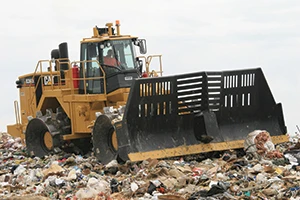
Yes, there is a lot of engineering and science involved in the process of waste compaction, but, in the end—as with Great Whites and T-Rex’s—it really comes down to the teeth. Compactors with big teeth, and a lot of teeth—operated effectively—will always achieve better compaction.
So, while it may not be appropriate to look a gift horse in the mouth, if you’re looking for good compaction, you want to see the teeth—and a lot of them.
Sure, a tooth pattern that’s too dense can plug up with wet waste or soil, but cleaner bars can alleviate that problem. Cleaner bars can be retrofitted to most machines—and some machines (i.e., Bomag) have them as an integral design feature. In the end, more teeth are better.
Same concept applies to machine weight. Operators recognize that heavier machines are more effective, and manufacturers have responded accordingly. In the ’70s, Caterpillar released their first landfill compactor: the 816. Weighing a tidy 40,000 pounds, it could easily hide in the shadow of today’s largest machines that are more than three times heavier!
The requirement for daily cover soil originates with Federal Rules—Subtitle D. These rules require landfills to cover with a minimum of 6 inches of soil—at the end of every operating day. However, after performing scores of measured tests, and observing hundreds of landfill operations, we’ve found that the 6-inch regulatory requirement for daily cover is an operational impossibility. Because of the unevenness of the waste surface, the average landfill uses 16 inches of soil for daily cover. This makes the use of ADC 250% more valuable than the regulations might imply! ADC manufacturers know this, and we all benefit by those who have made a career out of creating a useful product—and educating our industry regarding its benefits and use.
Take for example EPI’s Deployer Model 800. You won’t find one of these on eBay. No sir, this is a state-of-the-
Latest from Waste Today
- Worn Again Technologies unveils Accelerator plant to advance polycotton recycling
- Nashville Waste Services launches new digital route system
- ACUA landfill expansion project unanimously approved
- Clean Energy announces multiple RNG deals with fleets nationwide
- Interchange 360 to operate alternative collection program under Washington’s RRA
- Waste Pro files brief supporting pause of FMCSA CDL eligibility rule
- New Way Trucks expands US network with Joe Johnson Equipment
- Tire Industry Project publishes end-of-life tire management guide