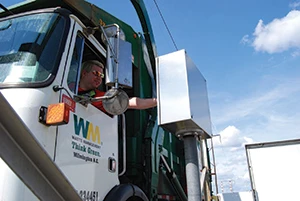
Truck scales begin with load cells. These mechanisms are the heart of any truck scale operation whether it’s an in-ground model, or integrated into the truck body. Load cells directly measure the weight of the applied loads. They do this by physically deforming under the resultant pressure. The loads are transmitted to the cells at the points where the cell is directly attached to the truck’s body frame or to the structural framework of an in-ground scale. Scale technology has advanced to the point where onboard truck scales are accurate enough to provide certification for billing from in-motion scales.
The actual measurement of deformation is performed by the transducer located at the heart of the load cell. The load cell itself is constructed of materials with known stress strain characteristics. All materials (metals, plastics, etc.) deform to some degree while subject to a load. Stress is a measure of applied force divided by the cross sectional area of the object being deformed, pounds per square inch (psi) being a typical measurement. The cross section is always perpendicular to the direction of the force. So, a load applied to the top of a cylinder shaped object at its very center would have a stress value dependent on the circular cross section of the cylindrical object.
Strain is a measurement of deformation, and compares initial length paralleled with the direction of the applied load with the resultant lengths along the same axis. The same cylinder would deform to a shorter length (compressive strain) than its initial length as a result of the applied load. A load in the opposite direction would tend to pull the cylinder apart, resulting in increased cylinder length (tensile strain). The materials used in the manufacture of loads cells do not permanently deform. After the load is removed, the load cell returns to its original pre-load dimensions.
It is this strain that gets measured by the transducer. Standard transducers include strain gauges connected to the core or frame of the load cell. The strain induced in the gauge alters the cross-sectional width of the strain gauge. As a result, the electromagnetic characteristics (resistivity and frequency) of the gauge are altered. In turn, an electronic signal or electrical current passing through the gauge responds to the gauges new physical characteristics and gets altered proportionally. In addition to this basic type of load cell there are several variations used for different functions.
Vibrating wire load cells utilize a vibrating wire sensor. This consists of a wire tension mounted between a pair of anchor blocks, one at each end of a cylinder structure. As the main cylinder deforms under applied stress, the distance between the vibrating wire anchors changes, which further changes the vibrating frequency of the tension wires. Initial and changed resonance frequencies are tested by an electromagnetic coil, which in effect “plucks” the wires. A computer in a readout device attached to the load cell via a signal cable translates the frequency resonance change into applied load for purposes of measurement. Having several wires per cell reduces the effects of eccentric loading by averaging the measurements of each wire.
Some load cells utilizing the compression of a working gas or fluid to measure resultant strain. For example, air-pressure load cells measure weight by gauging the increase in air pressure as a result of the applied loads. While this may seem like a less sophisticated approach, better quality air-pressure load cells can measure even minimal weight changes while compensating for environmental factors, like ambient temperature, that can indirectly affect air pressure.
Latest from Waste Today
- Vermeer announces plan to build new facility in Des Moines metro area
- Buffalo Biodiesel shares updates on Part 360 application to DEC, Tonawanda facility progress
- Capstar Disposal expands roll off dumpster rental services
- Supreme Court strikes down IEEPA tariffs
- Casella details facility closures, expansion efforts
- Zero harm: Building a SIF prevention program for waste and recycling operations
- Casella posts a loss in Q4 2025
- McNeilus names Haaker Equipment first Dealer Partner of the Year