The presence of paper—particularly newsprint—has receded in the wastestream, while there’s been an uptick in plastic. “Even an increase in small cardboard is noticeable, as consumers are increasingly ordering online and have goods shipped to their house,” adds Rutger Zweers, sales director for Stadler America. Essentially, material composition strongly changes per location, city or state, he adds.
“Paper volumes certainly continue to decrease, as has been the trend for a number of years now,” notes Brian Wells, sales manager for Bulk Handling Systems (BHS). “We also have seen some recent changes in the plastics market, including an increasing diversity in material types such as containers made from a combination of polymer types.”
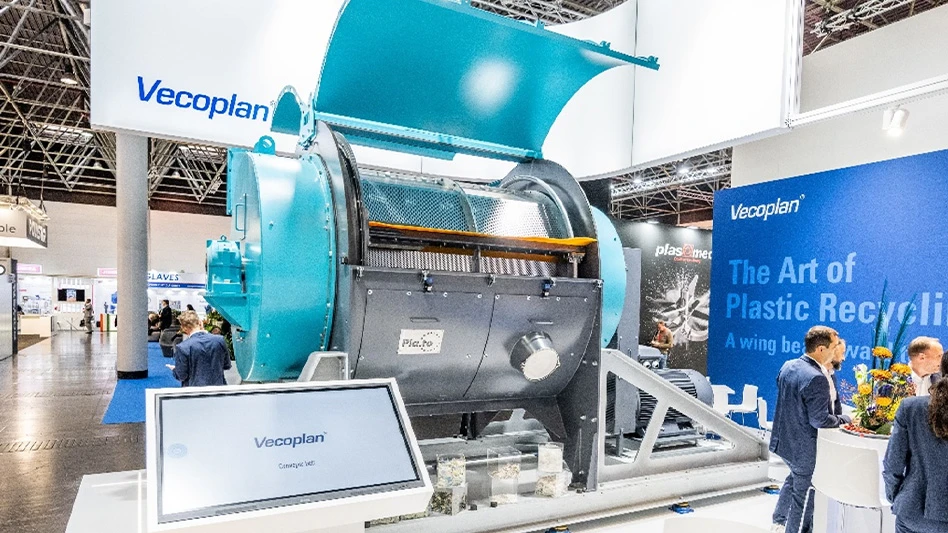
Matt Everhart, national sales manager for Vecoplan, concurs that there has been a virtual “disappearance” of old newsprint from the wastestream, while there has been an emergence of multiple layers being used in fiber- and plastic-based packaging, with different grades of plastic being used in a single container. “From the standpoint of the recycler, that’s something that we hate to see because it makes it that much more difficult to get a clean stream at the back end, but we can’t control the manufacturing,” he says. “We can only complain about it at trade shows and try to get the manufacturers to listen to the environmental conscience that says this is not the best way to do this for the planet.”
The material changes in the wastestream as noted by the CP Group include a decrease in fiber, as well as fiber end markets, while demand for post-consumer plastics is increasing. “In certain financial and recovery models, it makes sense to investigate mixed waste MRFs as the decrease in salable paper is offset by the increased diversion and sale of plastics,” notes Ashley Davis, marketing manager for the CP Group. “This is largely dependent on the availability of cost and energy-efficient conversion technology.”
Additionally, the company is noticing an increase in residue and “dirty material”, as many of the easy targets are already well covered, so it is moving into more difficult markets in the industry in general, such as dry waste, residual waste, and mixed waste. “As a result, we realized the need for providing solutions for efficient front-end separation systems for waste-to-energy facilities,” she adds.
Wayne Wamboldt is seeing the wastestream change in the county of Colchester, Nova Scotia, in Canada, and is responding accordingly. “There are changes in the wastestream, but a lot of those changes have been brought about by municipal policy,” says Wamboldt, the director of solid waste for the rural and small municipality with slightly more than 50,000 in population.
Over the years, the solid waste department has extended green carts for municipal green waste, with 2010 being the last expansion. “Every household, every cottage, any structure that people living in it has a green cart for putting in their municipal waste or kitchen scraps and that material is composted,” he says.
In 2010, Colchester implemented a clear bag policy for garbage. “We allowed a total of six bags of which five had to be clear, non-color transparent bags with the sixth bag being any color, opaque for people to put items in there that may be considered embarrassing or they just wanted to for personal privacy, like hygiene items,” says Wamboldt.
As a result of that new policy, there was an uptick in the increase of materials going to the recycling facility and to the compost facility, which resulted in a considerable drop in waste being buried in the landfill, he adds.
The changes have put Colchester’s recycling facility in a position of a possible expansion, including sorting equipment, says Wamboldt. He had planned to introduce an action item before the county council in April to ban Styrofoam from the landfill and include it in recycling.
“We will also be putting in additional line and equipment at our recycling facility for densifying the Styrofoam,” he says. “That will reduce material going into the landfill. We have just built a brand new compost facility to deal with the ever-increasing load of organics that’s coming into our facility over the last eight years. We’re also exploring waste- to-energy using the residual MSW as feedstock, gasifying this material and producing electricity.”
Latest from Waste Today
- Worn Again Technologies unveils Accelerator plant to advance polycotton recycling
- Nashville Waste Services launches new digital route system
- ACUA landfill expansion project unanimously approved
- Clean Energy announces multiple RNG deals with fleets nationwide
- Interchange 360 to operate alternative collection program under Washington’s RRA
- Waste Pro files brief supporting pause of FMCSA CDL eligibility rule
- New Way Trucks expands US network with Joe Johnson Equipment
- Tire Industry Project publishes end-of-life tire management guide