Dust and odor are unavoidable aspects of processing and handling waste and recyclables. However, they pose problems. At a minimum, dust and fugitive odors are a nuisance and disruptive to the community, and can lead to fines or lawsuits if a facility doesn’t demonstrate efforts to mitigate them.
More critically, in high concentrations, both dust and odor can cause health problems. For instance, says Laura Haupert, Ph.D. and Director of Research and Development, OMI Industries, hydrogen sulfide can be detected by the human nose in the parts per billion range. Exposure even in the parts per million range can cause health issues or death. And as for dust, it poses an inhalation risk as the concentration increases.
Not only do nuisance odors and dust present health risks, but they can also accelerate wear to equipment and pose building maintenance challenges.
Dust vs. Odor
To reduce the effects of dust and odor, it’s necessary to understand the causes of each. In general, Evan Williams, project designer with Cambridge Companies/Design-Build Solutions, categorizes the conditions that create odor and dust issues as incoming material composition, material processing and handling, and facility conditions.
He advocates collecting incoming material frequently to minimize odors and misting C&D streams to reduce dust while cautioning that excess handling increases dust generation, as do sorting lines and shredders.
According to Jesse Levin, president of NCM Odor Control, the conditions that lead to odors are very different from (and in some respects, the opposite of) conditions that lead to dust. At transfer stations, odor and dust issues correlate to operational practices—how quickly material is moved and the flow of truck traffic. “If the transfer station does not have a properly designed odor and dust control system and an effective odor neutralizer, [it] is more likely to experience odor- [and] dust-related issues,” states Levin. C&D landfills can experience an even higher volume of dust issues.
The process that often creates the most dust is the action of transferring material from one location to another, says Gordon Santry, HKD Blue. “The amount of dust and the severity of emissions is a function of the material itself, as well as the moisture content, and air conditions.”
At a materials recovery facility or indoor waste transfer station, material needs to be moved from the transportation vehicle to the “tipping floor,” where loaders and material handlers can organize the piles. The process of dumping the material from the truck onto the floor is where dust poses problems.
In the waste industry, the very processes used to collect and transport materials also dramatically increases the potential for odor, observes David Hill, a prevention/treatment specialist with GOC Technologies. Because economics require collection vehicles to carry as much waste as possible, the material is compressed with as little air space as possible. The increased pressure and decreased oxygen speed up decay, producing heat, which further increases the rate of decomposition. By the time the vehicle reaches the transfer station or landfill, the off-loading process releases the odors that were trapped. “So long as organic materials other than wood are collected and/or processed in the solid waste industry, odor can and will be a factor.”
And the vast majority of odor-causing materials in the waste industry are organic, Hill continues, adding that all organic waste that arrives at a transfer station or landfill is already in some stage of decomposition. “All organic decomposition produces compounds that are odorous!”
The type of waste factors into the type, amount, and strength of the odor. A MRF might have a high intake of organics in the form of decomposing food waste, leading to higher concentrations of hydrogen sulfide or mercaptans, Haupert elaborates. “Landfills and transfer stations may have a high intake of common household trash that is decomposing, causing a complex mixture of odor-causing compounds, including hydrogen sulfide and ammonia. Increases in temperature and moisture lead to higher concentrations of odor-causing compounds as well.”
A landfill’s odor issues are more complicated, Levin says. The biggest odor issues are related to the gas collection system, the size of the site’s working face, and leachate ponds.
At a landfill, odor comes from raw trash in trash cans and garbage trucks, but other types of compounds and odors have different origins, Josh Rembusch, vice president of business development for Byers Scientific and Manufacturing, explains. Leachate, whether from the working face or a collection system, can be the source of the odor. Methane, or landfill gas, produces a sulfur smell.
Quick Fixes vs. Long-Term Control
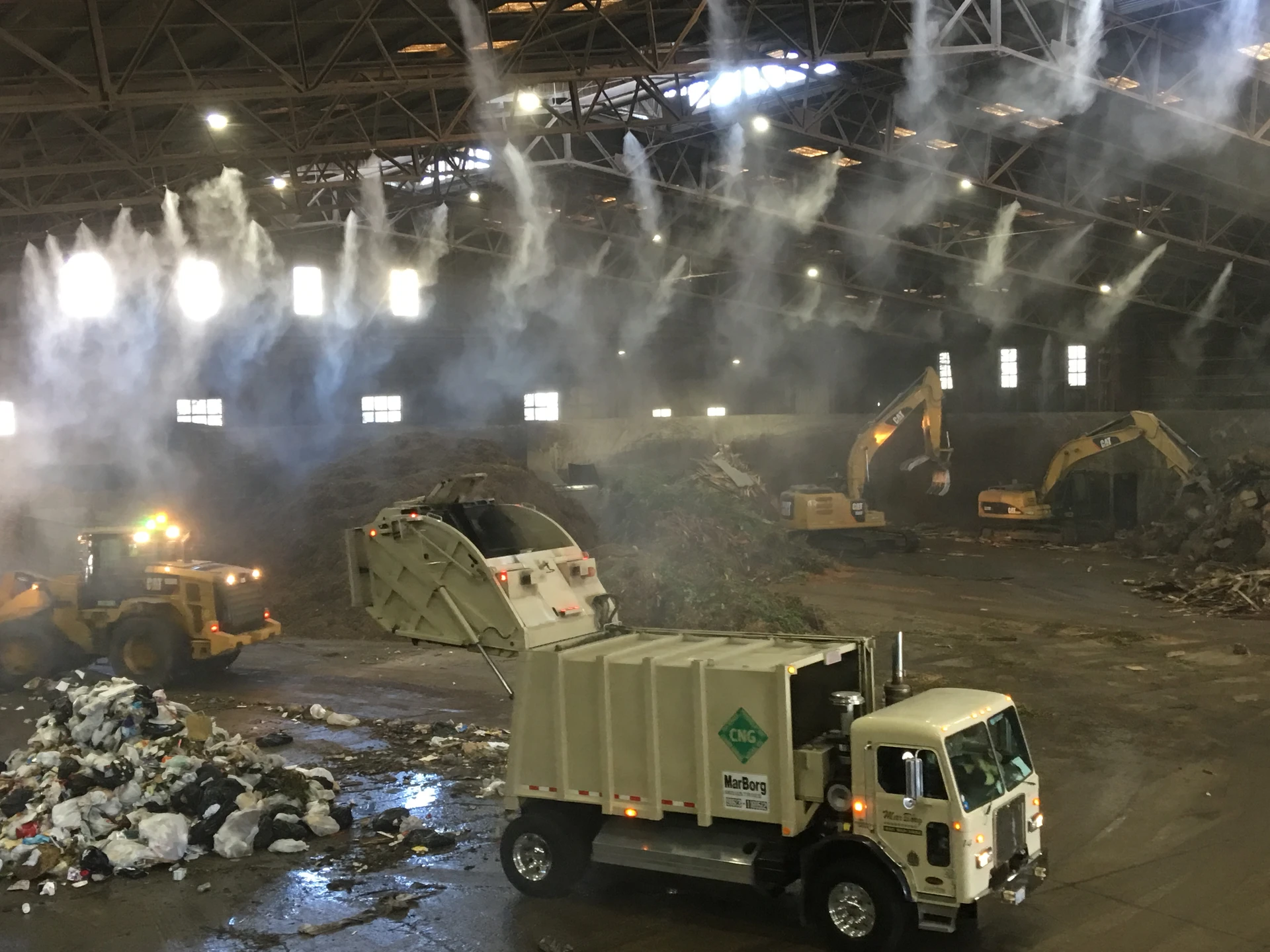
In tipping areas, Williams says a misting system could be implemented to address both odor and dust issues. “These systems can typically be designed and installed in a matter of a few weeks.” If the issue cannot be addressed by a misting system, a dust extraction started with a baghouse that could be installed, which could take several months to scope, design, install, and commission. “Long-term solutions will include misting and extraction systems. These are more capital-intensive, but can offer [reliable] odor control.”
As material is dumped from truck to the tipping floor, dust emissions rise and occupy the space. Depending on particle size and density, it may remain airborne for several minutes. HKD Blue manufactures water-atomizing misting cannons, such as the R-110, which Santry recommends as a quick fix for dust emissions at these facilities.
Transfer stations’ dust-related problems can be fixed by a properly designed facility with an effective dust-control system, Levin believes. “These two elements, combined with a good operating team that understands when the dust-control system needs to be on and how to effectively move the material, all play a role.”
Cost-effective quick fixes can come in the form of small portable odor-control foggers and easy-to-use odor neutralizers using equipment they already have, such as pressure washers and street sweepers, Levin continues.
For dust at a transfer station, Levin says the quick fix is the same as the long-term solution: a properly designed dust-control system that focuses on the areas that generate the most dust. “Quick fixes at transfer stations are easier to come by [than at] landfills.” However, sometimes, he cautions, quick fixes can contribute to long-term issues. Nevertheless, quick fixes provide an operational team time to create long-term solutions based on the recommendations of companies like NCM.
Landfills create the greatest challenge for odor control, Haupert believes, because the working face changes every day. OMI teams go out onsite to determine the sources of odors and then formulate a complete odor control solution, including types of equipment and formulation needed. “It depends on the situation, including how big is the site, what types of odors are produced, and what are the geographic conditions.”
OMI’s quick fixes include the placement of odor fans. The best long-term solution would likely incorporate vapor-phase technology. “These systems produce a smaller particle size than the odor fans, allowing for better odor control,” explains Haupert. This solution often involves perforated ducting around the perimeter of the location.
In the Zone
The most effective way to treat odor and dust issues at transfer stations is with a water-based high-pressure atomizing system, Levin suggests. Even more effective is the switch from a single-zone atomizing system, in which a site turns on and off every nozzle at the same time, to a multi-zone system. The ability to turn on and off spray nozzles associated with specific areas gives operators more control and uses less water and less odor control neutralizer. Typical zones in a transfer station include the tipping floor, the load-out bay, entrance and exit doors, and tunnels.
For landfills that want to use an atomizing spray system, NCM can apply their multi-zone approach. “Over the years, we have found tying weather stations into the operations of an odor-control system is another level of control,” observes Levin, adding that control at landfills has changed from exclusively atomizing misting systems to Vapor Odor Control Technology. This technology eliminates the maintenance issues associated with an atomizing misting system. “NCM has found vapor systems to be more effective to treat landfill gas odors that are low-lying.”
The ability to troubleshoot zones remotely by using Wi-Fi allows an immediate response and minimizes downtime. NCM can even monitor the level of odor control neutralizer that a site uses.
Play Misty For Me
For years, misting was little more than adding masking agents to cover up odors, Rembusch asserts. They weren’t natural chemicals and they didn’t degrade. Combining their patent-pending waterless Vapor-Phase System with OMI Industries EcoSorb formulation, they’re able to disperse a lighter-than-air gas into the air stream, where it contacts and eliminates fugitive malodors without using masking agents.
Using their hardware ensures measurable, controllable, and uniform distribution. The automated system features remote control and real-time data about weather, providing what Rembusch describes as a “defendable position against spurious complaints.”
“You can run the system 24/7 and pre-program the machine for times people are outside,” he continues. This money-saving system of manipulating the amount of vapor produced is a “fiscally responsible solution,” he claims.
It works by incorporating adsorption and absorption—the chemical modifies the molecular makeup of odor. OMI’s plant-based liquid deodorizer transitions into a dry fog that adheres to malodor through electrostatic bonding, at which point the oil in the system absorbs the malodor. Although he admits that it’s “impossible to capture 100% of odors,” Rembusch cites empirical evidence from an OMI lab study that indicates that EcoSorb mitigates certain compounds.
R&D
In search of new technologies and chemistries beyond the typical masking agent/neutralizer combinations that have dominated the industry for several decades, GOC generates new products, testing them against real-world odors in both vapor and misting formats to create a library of various compounds and chemistries that work on specific families of odors, primarily composed of amino hydroxy groups and aminoglycoside groups.
Various blends of amino acids are combined with hydroxyls and sugars in a proprietary process that converts the insoluble portions into homogenous, completely soluble compounds, Hill explains. “The non-amino portions of the chemistry are extremely reactive and can be used to break odorous compounds apart.”
Each blend is tested for effectiveness against multiple individual odors as well as types of mixed materials producing groups of odors. “Clients even send us samples of their materials, allowing us to customize their treatment for maximum impact.”
Innovation
Innovation in odor control products was at a standstill for years, Levin contends. It wasn’t until the early 2000s that NCM Odor Control started focusing on effective products that are safe for the public, environment, and site workers—and that was driven by the public holding waste facilities accountable for their odor and dust footprint within the community.
To raise the bar on health and safety, and to set themselves apart from their competition, NCM began using EPA guidelines to test their neutralizers, focusing on four major areas of toxicity: inhalation, eye irritation, consumption, and skin touch. Ultimately, Levin says, the underlying factor in the effective treatment of odors at any site is the quality of the odor neutralizer.
Latest from Waste Today
- Vermeer announces plan to build new facility in Des Moines metro area
- Buffalo Biodiesel shares updates on Part 360 application to DEC, Tonawanda facility progress
- Capstar Disposal expands roll off dumpster rental services
- Supreme Court strikes down IEEPA tariffs
- Casella details facility closures, expansion efforts
- Zero harm: Building a SIF prevention program for waste and recycling operations
- Casella posts a loss in Q4 2025
- McNeilus names Haaker Equipment first Dealer Partner of the Year