As a fourth-generation waste and recycling professional, Joe DiNardi-Mack, co-founder and CEO of Sourgum Waste, has deep ties to the industry. The family’s legacy started with his great-grandfather, who emigrated from Italy in 1897 and started his own waste hauling business with a horse and buggy.
Since those early days, the family has remained in the solid waste business, operating 17 different collection and disposal facilities, which allowed DiNardi-Mack to gain firsthand experience in a variety of roles. Growing up, he spent every summer working for his family’s collection companies, developing a deep love for the trucks and operations and an understanding of industry challenges.
After college, he worked at a small property technology company, where he learned full-stack engineering and saw how technology could transform outdated industries. This experience inspired him to bring technological innovation to the waste and recycling sector.
In 2019, he and his cousin started a small roll-off business, experimenting with different business models and technologies. By 2022, the pair officially co-founded Sourgum Waste, a technology-driven waste management platform.
In the following interview with Waste Today, DiNardi-Mack describes how family tradition, hands-on operations experience and a tech-forward approach are helping him modernize the waste and recycling industry.
There’s really no substitute [for] learning an industry from the ground up, understanding the operations, getting to know every corner of it.”
Waste Today (WT): What did the early days of Sourgum look like? How has the company transformed since then?
Joe DiNardi-Mack (JD): In the early days, it was long hours [and] late nights. Still is, but [it’s] a little different [from] when we were a four-person company to now [where] we’re about a 60-person company. So, [we experienced] a lot of learning, trials [and] tribulations as we went from three people to 10 people to 30 people, really learning those different stages and milestones and steps and how to evolve as a leader.
WT: Were there any growing pains that came with this process? How did you overcome them?
JD: Oh, every step of the way. And I’m sure we’re not even close to done. … Everything we built broke, and we had to rebuild it. Going from 10 to 30 [employees], every system we had started [failed] and had to be transformed. So, each of those inflection points was almost like reinventing the company … from an operational standpoint.
WT: What advice do you have for young professionals considering a similar path?
JD: Start by getting your hands dirty, both literally and figuratively. There’s really no substitute [for] learning an industry from the ground up, understanding the operations, getting to know every corner of it. Especially in this industry—working the back of the truck, working within the plants, picking on the sorting lines—all those things are pretty crucial to have a fundamental understanding of what you’re getting into. Second, I’d say don’t be afraid of legacy systems. [It] makes the industry ripe for innovation, but it does require a deep respect for both the people and infrastructure already in place. To go and say you’re going to turn industry on its head overnight just isn’t realistic. But it can be done; it can be changed. You just have to have that appreciation of how it’s already set up and why it is the way it is today.
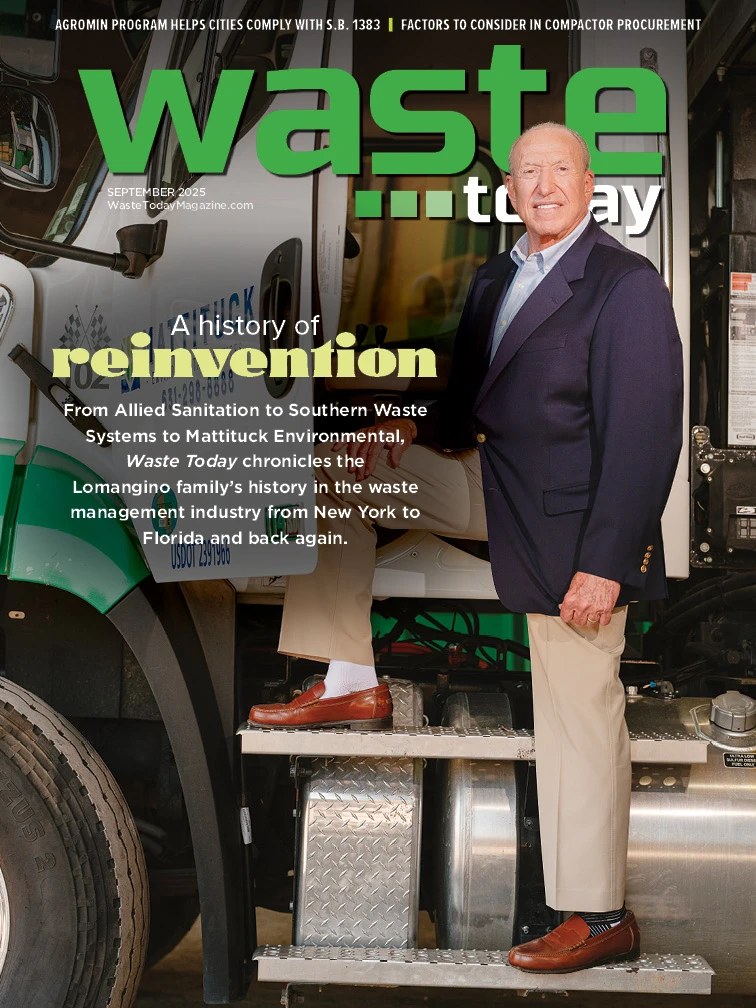
Explore the September 2025 Issue
Check out more from this issue and find your next story to read.
Latest from Waste Today
- Fleetio launches AI capability to accelerate fleet maintenance approvals
- Recycle Ann Arbor extends drop-off station operating hours
- Sybilion seeks to help manufacturers confidently address volatility
- Ecowaste Solutions partners with city of Trinity, Texas
- Bristal Hauling acquires G&R Garbage Disposal
- Baltimore trash collection expected to slow as WTE facility closes for maintenance
- Landfill Insights | Connecting the dots: Policy to practice
- FCC Environmental Services awarded collection contract in Florida