I must go down to the seas again, to the lonely sea and the sky. And all I ask is a tall ship, and a star to steer her by.
These words of John Masefield, the first few lines of his classic poem Sea-Fever, speak of the desire of a man to simply have the tools he needs to do his job and do it well.
Published in 1902, this classic work is still relevant to workers who take pride in their job and ask only for the right tools. Taking pride in a job well done is one of the most satisfying aspects of work.
Have you ever been frustrated with a basic household plumbing or auto repair project for lack of a specific tool? Sure, that’s what keeps your local hardware and auto parts store in business. This same issue also applies to your landfill operation, though on a much larger scale.
One of the most persistent complaints I hear is from workers who have been given a task without also receiving the tools to do it efficiently and safely. It’s an interesting phenomenon to see an otherwise well-organized operation lacking simple, basic tools. Here are a couple of examples that might sound familiar:
Wire Wrap
At one landfill, wire wrap around the compactor wheels and the dozer undercarriage had become a big problem. This facility, an otherwise well-run landfill with millions invested in heavy equipment, was experiencing lots of machine downtime because of that one problem.
Every landfill will occasionally receive cable, wire, and banding material, and this landfill got its share. Of course, even the most diligent operators will sometimes tangle with wire wrap, but that wasn’t the root problem, because usually, removing wire wrap is a normal part of machine maintenance. But not at this landfill.
The issue was related to the response. Some wire wrap will always occur, but if machines are properly guarded, and if the wrapped material is removed promptly, it doesn’t have to be a big deal.
Unfortunately, at this landfill the tools were inadequate. The maintenance crew had two 24” bolt cutters, a hand crank come-along winch, and cheap leather gloves. As a result, nobody wanted to tackle the difficult job of removing wire wrap. As you can imagine, the more it was avoided, the worse it got—to the point where final drive seals failed and machines were down. What should have been a regular maintenance activity became a major service call. This was a recurring issue—and it was all because they didn’t have the right tools for the job.
Wire Wrap Tools
Had they been willing to invest in a hydraulic or electric wire cutter and a bumper-mounted or portable power winch, the work could have been done more easily …and more importantly, it would have been done.
A good hydraulic or electric cable cutter might cost around $10,000. This isn’t something you’ll find at your local hardware store, but fortunately, companies like ENERPAC manufacture various sizes and styles of cable cutters.
Similarly, an electric cable winch, set up to mount on the receiver of a bumper, might cost another $5,000. For another $2,000, we could also include a portable electric cable winch for getting to those hard-to-reach areas. Finally, the toolbox should include a collection of hooks, prybars, hammers, and chisels.
This should have been a simple cost/benefit analysis. For less than the cost of a single service call to replace the final drive seals, the landfill could have purchased the tools to solve the problem.
Here’s another example, something we can all relate to—litter.
Litter Control Tools
Thousands of smart and dedicated people have built their careers at a landfill. In most cases, those folks do a great job of protecting the environment while handling other people’s waste. Certainly, that’s something to be proud of. But when litter gets out of hand, even the best facility can start looking like a dump, and nobody takes pride in working at a dump.
There are many factors that can make an otherwise well-run landfill look like a dump, but none is more common or more obvious than litter.
The difference between a landfill that controls litter, and a dump that doesn’t, usually comes down to one issue: tools. Yep, here we are again, talking about having the right tools. Litter control tools.
Here’s a list of several tools that successful landfills use to help control litter. Keep in mind that specific policies and training are also tools.
- Ordinance or policy requiring that inbound loads be covered.
- Standard procedures for where and how trucks un-tarp before dumping.
- Standard procedures for where and how trucks clean out after dumping.
- Fill sequence planning that provides sheltered fill areas to use during particularly windy days.
- Standard practice of building soil berms or placing wind deflection fences upwind of the active fill area to create areas of calm to reduce litter generation.
- A policy of dumping loads with a high potential for litter, behind a load of bulky material, to help protect it from the wind.
- Operating practices that define how trash is pushed, spread, and compacted.
- Policies for how quickly trash is covered after it’s been compacted, especially for trash that has a higher litter potential.
- Adequate quantity of portable litter screens to effectively control litter around the tipping pad and active face.
- Strategically placed temporary litter fences in areas downwind of the active fill area.
- Tall perimeter screens to prevent litter from leaving the landfill property.
- A 4x4 pickup or utility vehicle to allow the litter cleanup crew to access all parts of the landfill.
- Gloves and grabbers for the litter crew so they don’t have to stoop to pick up litter or pick it up with bare hands.
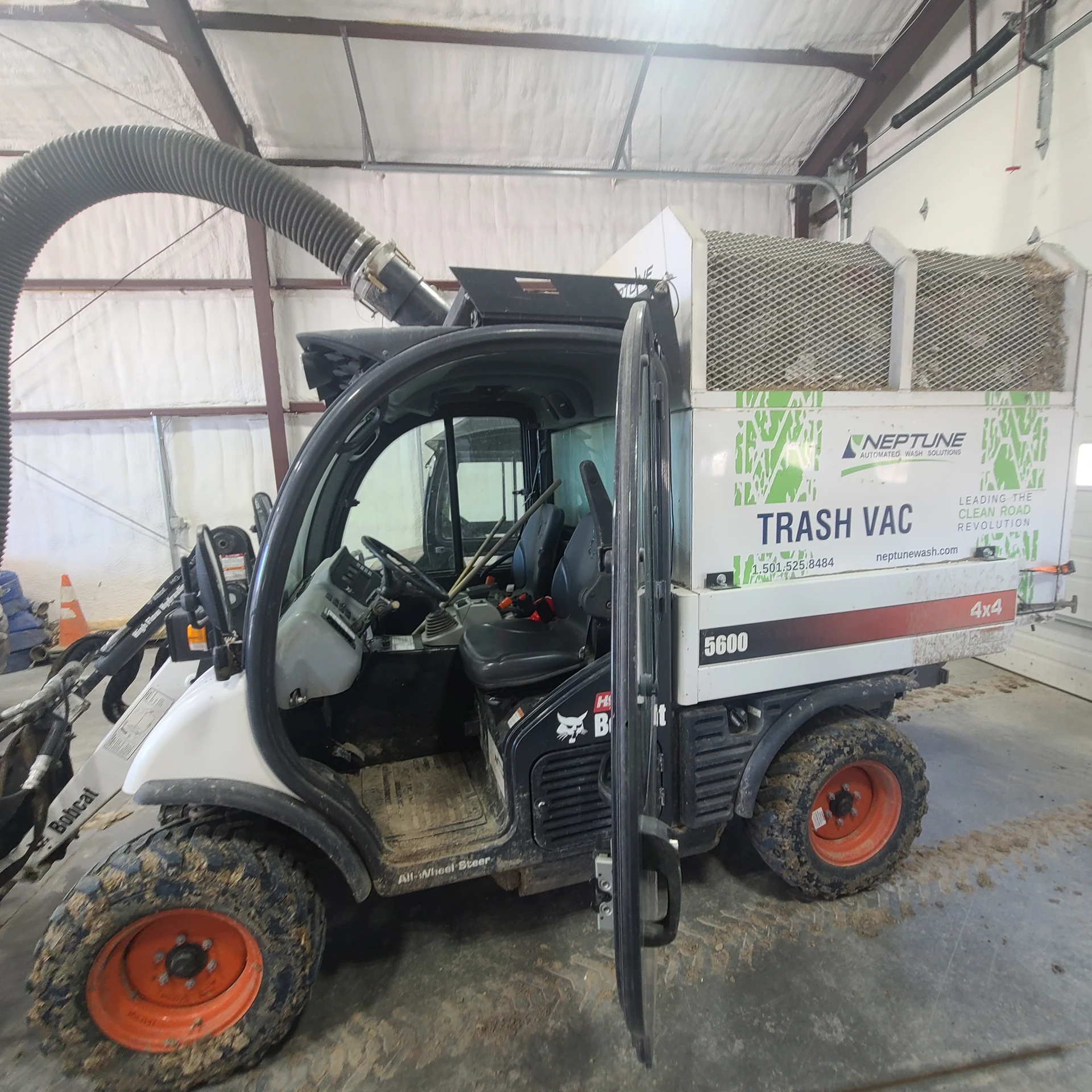
- A vehicle-mounted vacuum to make litter collection faster, easier, and maybe even a bit fun (See Photo: Lewis & Clark County Landfill, Helena, Montana).
- A “Close-the-Gate” policy when windspeed exceeds a certain threshold.
- An adequate budget for hiring temporary laborers as needed for litter cleanup.
When it comes to litter control tools, these things listed above are obvious and simple. This is Litter Control 101. Yet, I’ve seen scores of landfill operations that had big litter problems because they were not using any of these systems!
On the other hand, managers like Pete Anderson are far ahead of the curve when it comes to litter control. His folks benefit by having the right tools, and it shows. The Lewis & Clark Landfill in Helena, Montana is a model operation. Of course, it helps that Pete has experience doing the work, and so understands the “right tool” concept.
We could talk about other landfill tasks and come up with similar lists of tools necessary to do the job. The concept of having the right tools for the job applies to every aspect of operating a landfill—or any other business for that matter.
If you want to begin the process of equipping your team, start with a broad look at your operation. Every part of it requires certain tools. That includes administration, scale house, maintenance, customer relations, and of course everything related to push, pack, and cover.
Also, look at any recurring problems. There’s a good chance they could be solved if you had the right tools. Talk with your crew. If they are lacking a specific tool, they’ll be quick to tell you—maybe they already have.
As a final caution, don’t let a desire to provide every possible tool lead you down the path of overdoing it. Just because an operator asks for a D9 doesn’t mean you should buy one. The same thing applies to the latest technology or software.
Every organization has room to improve in this area, and in many cases, it would cost less to provide the right equipment, than trying to just make do. Your job is to set your team up to succeed, and that starts by providing them with the right tools for the job.
Neal Bolton is an engineer with more than 45 years of experience in heavy construction and solid waste operations. As president of Blue Ridge Services Montana, he and his team provide operational consulting to all aspects of the waste management industry.
Latest from Waste Today
- Vermeer announces plan to build new facility in Des Moines metro area
- Buffalo Biodiesel shares updates on Part 360 application to DEC, Tonawanda facility progress
- Capstar Disposal expands roll off dumpster rental services
- Supreme Court strikes down IEEPA tariffs
- Casella details facility closures, expansion efforts
- Zero harm: Building a SIF prevention program for waste and recycling operations
- Casella posts a loss in Q4 2025
- McNeilus names Haaker Equipment first Dealer Partner of the Year