“We’ve been doing it that way for 30 years.” If I’ve heard it once, I’ve heard it 500 times. Usually from a manager, operator, supervisor, driver, or other solid waste worker, in response to my questioning why they are doing something a certain way.
A statement like that is more than a short summary of a facility’s history. It is a thinly veiled argument against changing the status quo. When there is no practical or logical reason to hold onto old, comfortable—and often inefficient and unsafe practices—it’s easy to fall back to, “Well, that’s just the way we’ve always done it."
This fear of change is a real thing. In fact, psychologists have identified it as an actual phobia, Metathesiophobia.
From the Latin and Greek, we have “metathesis” meaning to change, and “phobia” to fear.
It’s important that I provide this basic origin, so that if at some point I happened to mention that folks at a specific facility are suffering from Metathesiophobia, they wouldn’t feel the need to seek vaccination and implement a new mask protocol. No, it’s not contagious in that sense, but certainly some facilities have developed an underlying culture that fears change.
Generally, people—and sometimes organizations—fear change because it can mean a loss of control, or a stepping off into unknown territory. Thank goodness our early explorers and inventors didn’t suffer from Metathesiophobia, or we’d all be riding buggies and bucketing water up from the creek.
We are today, living in the midst of the fastest-changing society in history. My Great Aunt Lonnie, who was born in 1907, used to talk about changes she saw in her life, growing up in a small farm town. “When I was a girl, we’d take the buggy 14 miles to town. On the way, Dad would stop for 30 minutes in the creek to let the wooden buggy wheels swell up so they wouldn’t squeak so much. We’d do our shopping and then spend the night in town with our friends, because it was too much of a trip to do all in one day.”
She would tell those stories of her youth, and then compare them to flying—in one day—all the way from America to Australia! I think she welcomed positive change.
In the solid waste industry, we’ve gone from burning trash in the back yard, to burning trash at the local dump, to lined landfills where GPS-equipped dozers and compactors place post-diversion waste, layer by layer, to almost surgical accuracy.
But still we fear change. What’s the deal?
As a manager, when it comes to change, your job is three-fold.
First, you must identify what kind of change is required, to make your operation safer and more efficient. This could come from a simple observation or a detailed lean/six-sigma analysis. The key is that you identify an opportunity for positive change.
Second, you must package that change into a message that clearly explains what the change is and why it should be made. This often requires that you apply some facts and figures to the change to justify it to you crew …and to your boss. Everyone needs to be sold on new ideas.
Third, you must create an implementation plan for how the change will be rolled out. Usually this requires talking, training, and the development of measurable metrics.
Over the years, we’ve been involved in helping to implement thousands of operational changes for waste facilities. Some changes were small, like the time we had the haul trucks face into the wind while being loaded, so the cab and operator weren’t inundated with dust with every load.
On the other hand, some changes were massive, like helping a landfill gear up to receive a 20-fold increase in tonnage due to a local natural disaster. New scales, new machines, new crew, expanded fill sequence plans, and an entirely different way of handling inbound waste.
Sometimes you have plenty of time to think about change and mentally adjust. Other times the phone rings and, as Sherlock Holmes was fond of saying, “The Game is Afoot.”
Often, change comes about in response to a specific incident—a spill, an accident, or a fatality. Some changes follow a simple question of, “why are we doing that task …that way?”
After 40+ years of implementing process improvement measures for waste operations, I’ve learned that the simple question of, “Why?” is perhaps the most powerful question one can ask.
Observe your operation. Ask, “Why?” in regard to every major activity. If you need a starting point, follow the money, or focus on the riskiest tasks. These are the areas that could provide the most impactful result from change.
When you ask, “why?” follow up with a justifiable answer that goes beyond 30 years of repetition.
Here is a simple example of a rut that way too many landfills are still stuck in.
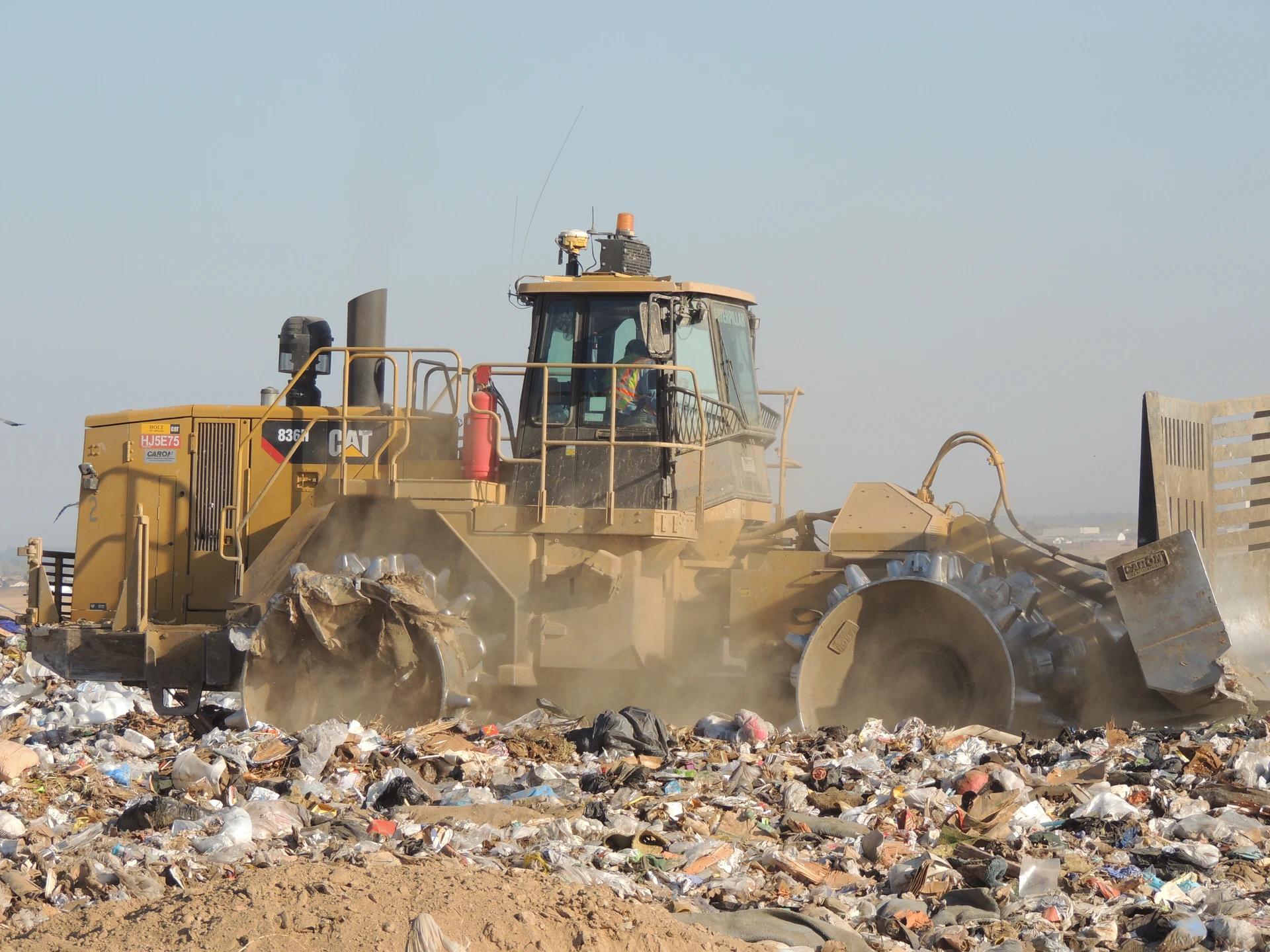
Why does the compactor work on a slope? You know what I mean, the compactor compacts trash on a slope, instead of working on a flat area. Why?
There is really no good reason, except that it’s how it’s always been done. But, why? Here’s some background on the physics and history of working on a slope.
 Imagine that I have a railroad tie, a nice, new heavy one. Then imagine that I laid it down on the ground. This railroad tie has a certain weight (e.g., 150 pounds). that is distributed evenly across the area in contact with the ground (e.g., 8’6” x 9”). Dividing 150 pounds by 918 square inches yields ground pressure of 0.16 pounds per square inch (psi).
Next, imagine that I stood the railroad tie on end. It still weighs the same, but now the surface area in contact with the ground has been reduced to 62 square inches (9” x 7”). That simple change has increased the ground pressure from 0.16 psi to 2.4 psi, an increase of 1,500%!
OK, bear with me …there is a point to this discussion.
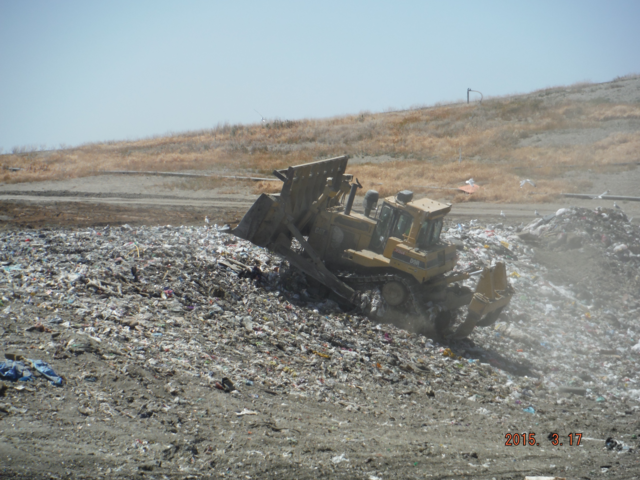
Let’s go back in time, 30 years …or 40. Many landfills operated with only a dozer. Compactors were just coming online as a normal landfill machine. So, if we want to maximize waste compaction, by maximizing ground pressure, we’d want to stand that dozer on end …like the railroad tie. Of course we couldn’t stand it up 90°, but the steeper the slope, the greater the ground pressure. It wasn’t unusual to see a dozer working on steep slope. Over time, 3:1 became a standard as steep but still very manageable.
If you think about the physics and the shape of a dozer’s undercarriage, it makes sense. Back 40 years ago – or even today if your compactor is down and you’re forced to compact waste with a crawler, working on a slope will yield better waste compaction.
But if you look at a landfill compactor, and think about the physics, there is no benefit in putting round wheels on a steep slope. Further, when a compactor works on a slope, it will travel at about 50% slower than when working on a flat area – about 1.5 mph vs 3 mph. This equates to half as many tooth penetrations for a compactor working on a slope, compared to a compactor working on a flat area.
OK, let’s summarize. Operating a compactor on a slope will not increase ground pressure, it will not increase compaction, and it will yield half as many tooth penetrations into the trash compared to the same machine working flat.
So …why are we operating the compactor on a slope? Well, the only answer is, “that’s the way we’ve always done it.”
Here’s a fact. The landfills that are achieving the greatest waste density are working on a flat area. In landfill lingo, these facilities subscribe to the “Flat Pack,” concept.
They have identified a positive change, they have justified why it makes sense, and they have effectively rolled out the new process. They flat pack.
Oh, and they and their crew have overcome the impact of Metathesiophobia.
Latest from Waste Today
- Worn Again Technologies unveils Accelerator plant to advance polycotton recycling
- Nashville Waste Services launches new digital route system
- ACUA landfill expansion project unanimously approved
- Clean Energy announces multiple RNG deals with fleets nationwide
- Interchange 360 to operate alternative collection program under Washington’s RRA
- Waste Pro files brief supporting pause of FMCSA CDL eligibility rule
- New Way Trucks expands US network with Joe Johnson Equipment
- Tire Industry Project publishes end-of-life tire management guide