This past summer, I had the opportunity to work with the Montana Department of Environmental Quality (DEQ), to conduct a day of Landfill Operator Training, but more importantly—and certainly more fun—to help out with a Heavy Equipment Rodeo at the Missoula Landfill in Missoula, MT. The primary coordinator for this class and the rodeo was Fred Collins.
Collins is an Environmental Science Specialist with the DEQ, but that’s just his formal title. His real position is maven. Now, you older folks might have to Google that term, but people under 40 probably know that a maven is an expert and a trendsetter. Someone who has networked with a lot of people and is able to motivate specific groups within society by their knowledge, personality, and ability to identify what is the next new cool thing to do. I’ve worked with Collins on a number of projects and can confirm that he is a great organizer and motivator.
Managing municipal solid waste is more than landfilling: publicity, education, engineering, long-term planning, and landfill gas waste-to-energy are specialties needed in today’s complex environment. We’ve created a handy infographic featuring 6 tips to improve landfill management and achieve excellence in operations. 6 Tips for Excellence in Landfill Operations. Download it now!
The first part of the event—a day in the classroom—was what you might call typical, in that we had chairs, tables, and coffee breaks. But we covered some topics that folks in the landfill business might consider to be a bit non-typical. For example, we talked about process improvement for landfill operations.
Now, if you are not familiar with the term process improvement, it’s, well…it’s a process. It’s also a mindset. It’s a way of looking at specific activities that we might consider normal for landfills, and then dissecting those activities into smaller and smaller pieces so that we can actually evaluate why some of them make sense … and some don’t.
Here’s an example: In the landfill business, many of the things we do are what might be termed, “traditional.” There are things that we do a certain way because, “that’s just the way we have always done them!” Take, for instance, the traditional method for compacting waste. Most landfills use a steel-wheeled landfill compactor to compact trash, and that compactor often works on a steep slope. Usually it’s something close to a 3 to 1 slope.
Managing municipal solid waste is more than landfilling: publicity, education, engineering, long-term planning, and landfill gas waste-to-energy are specialties needed in today’s complex environment. We’ve created a handy infographic featuring 6 tips to improve landfill management and achieve excellence in operations.6 Tips for Excellence in Landfill Operations.Download it now!
This practice of compacting on a slope is so common, it’s so traditional, that most landfill folks don’t give it a second thought—until you ask them why they do it that way. Sometimes that question is met with a very quick response that might include, “It works better,” “It helps the wheels chew up the trash,” or “That’s how we get the best compaction rate.” But when you drill down and ask if they have ever proven out those answers by testing, the answer is almost always, “No.” Sometimes that question is met with blank stares as if to say, “What a stupid question—is there any other way to compact?” Well, the answer is, of course, “Yes, there is another way.”
Let’s go back to the source. Why do we compact trash on a slope? That’s a traditional holdover from 40+ years ago. In decades past, every community had a local dump, and the trash at that local dump was pushed and compacted with a crawler, most often with a bulldozer.
Now, let me sidetrack here for a bit—some pun intended. What if I laid a railroad tie on the ground, and we assumed that the railroad tie weighed, oh let’s say, 150 pounds. Gravity, way down at the center of the earth looking up at that railroad tie, would be able to exert a certain force on it—a force of 150 pounds. Of course, that force is spread over the surface area that the railroad tie covers as it lays on the ground. If we expressed the area in square inches, then we might easily calculate the ground pressure…it’s about 0.2 pounds per square inch.
Are you with me? OK, now let’s take that railroad tie and stand it up on end. As gravity looks up from the center of the earth, it only sees the surface area of the end. It still weighs the same, but the contact area—the square inches of contact—is much smaller. As a result, the ground pressure has been increased significantly—by a factor of 15. It still weighs the same (150 pounds), but now that weight is spread over a much smaller surface area, so the ground pressure is much greater…approximately 3 psi.
Next, picture a bulldozer—and look specifically at where the tracks contact the ground. Certain weight, certain surface area, and a resulting ground pressure we can express in pounds per square inch. Let’s slowly stand that dozer on end—no, not literally, but let’s put it on a steep slope. From the center of the earth, gravity sees that bulldozer. It still weighs the same, but now there’s less track on the ground because it’s starting to stand on end. Operating a bulldozer on a slope will increase compaction because it increases the effective ground pressure of that machine.
My grandfather was an equipment operator for the County Road Department and in the 1960s one of his jobs was to bring the bulldozer out to the local dump every few months to push all of the trash into the landfill. He would compact it by working that crawler on a slope. Granddad wasn’t an engineer, but he’d been a farmer and equipment operator for 40 years, and he just knew that putting that crawler on a slope would increase ground pressure and increase compaction. He didn’t do it for tradition’s sake, but he looked at the situation, thought about it, and understood how it worked.
Let’s fast forward to today. Most landfills use steel-wheeled compactors. It’s no surprise that the wheels are round. But, tell me, how can you stand a round wheel on end? You can’t—the geometry doesn’t work. So, when we operate a steel-wheeled compactor on a steep slope, we don’t gain much in terms of ground pressure, but we give up quite a bit in terms of maneuverability, power, and speed.
Over the years, we’ve conducted scores of Operational Efficiency Studies at landfills, and we’ve found consistently that a compactor working on a steep slope will travel at an average velocity that is about half of what it would be if it worked on a horizontal surface. That means that a compactor working on a slope will—because it’s moving slower—achieve about 50% the number of tooth penetrations that that same machine would achieve if it worked on a horizontal surface.
Granddad didn’t know this, because landfill compactors weren’t invented in the 1960s. But, our experience at landfills throughout North America indicates that switching from working a compactor on a slope, to working it on a horizontal, flat surface, can increase waste density anywhere from 10 to 30%. Granddad didn’t know that either! But if he were still alive, I bet he’d have figured it out. These are the kinds of things we talked about in the first day of our Montana Rodeo during the classroom sessions.
Let’s get on to the topic you are really interested in! When you think about a Montana Landfill Rodeo, you probably think about big tractors and big sky, and you’d be right on target.
The 2016 Montana Landfill Rodeo was hosted by Jim Keeney, General Manager of the Missoula Landfill, in Missoula, MT. This is a Republic Services facility and—as you might imagine—is very well-run. It is a regional landfill—the second-largest in the state—that receives waste from Northwestern Montana, as well as from Northern Idaho.
Jim Keeney was a perfect host for the Rodeo: practical, professional, and packing a good sense of humor. When we showed up that morning, the heavy equipment, the courses, the big white awning, and the food was all set up. He made it look easy, but that’s because he is a good manager.
The fact is, it took lot of work before the Rodeo to get it set up and to organize the entire event. To give credit to Keeney, he did it not once, but twice. The first time, it had been planned for earlier in the summer, but just a couple of days before the date, a big storm had come through and dumped a lot of rain. Conditions made it impossible to host a Heavy Equipment Rodeo. For those of you who manage a landfill of your own, you can read between the lines.
But on the second try, things worked perfectly. Keeney and his crew had set up a very interesting course, with four separate stations. For those of you who might want to set up your own Rodeo at some point, here’s a rundown on what those stations were:
Station 1 was the landfill compactor. For this event, landfill operators had to operate a CAT 836H landfill compactor. To successfully complete this first course, operators had to push a 55-gallon drum down a narrow lane without losing the drum to one side or the other, picking up an excessive quantity of soil, or crushing the drum. True disclosure: Not every drum made through the entire day.
Then, operators had to back the compactor into a 90-degree, hammerhead turn around, pick up a portable litter screen (with the blade) and reset it into another location. This station, like the other three stations, was timed, with a penalty applied if the course wasn’t completed properly.
Station 2 required operators to use a Caterpillar D6N Dozer to, again, push a 55-gallon drum along a course, make a 90-degree right turn, and then push that drum up onto a 4-foot-high ramp of soil. The dozer then had to back away while leaving the drum in place, on top of the ramp.
Then, the dozer had to back up about 50 feet, to where two scraper tires were laying on the ground, side-by-side. The goal here was to use the dozer’s blade to get one scraper tire on top of the other, and then, once they were stacked, to push the tires into a small, narrow cul-de-sac marked with cones. After watching several operators go through this course, it became very clear that there was a lot of strategy involved, especially in terms of getting one tire on top of the next.
The final step in this competition was to knock a golf ball off a traffic cone, without knocking the cone down. This took a good bit of hand/eye coordination from hands that were used to pushing a 5-ton load of waste. It’s called skill.
For Station 3, operators used a Caterpillar 336E excavator to pick up balls that were sitting on top of traffic cones. Different types of balls were used, ranging in size from a small kickball, to a basketball. The goal was to pick them up and deposit them into stationary 5-gallon buckets.
This event in particular required steady nerves and a significant amount of strategy to get the balls into the excavator’s bucket, and then to roll out into 5-gallon buckets. Again, sadly, some buckets didn’t survive the day.
At Station 4, operators used a Caterpillar 420E backhoe to pick up golf balls and place them in very small containers. They didn’t use the bucket of the backhoe; they actually used what was, in essence, a spoon. One of the teeth on the backhoe’s bucket had been replaced with what would most effectively be called an eye bolt. The diameter of the eye was such that it could pick up a golf ball in the same way you might balance an egg on a tablespoon.
The golf balls were set in a small sandbox and the idea was to use the backhoe and this little eye bolt to pick up a golf ball, keep it level, so it didn’t fall off, and very slowly and gently…swing to the left and then deposit that golf ball into a cup. Again, this was a timed event, with points applied based on how many golf balls made it into the cups.
It took most of the day for 20 or so contestants to run through this course, and, not surprisingly, there were some real superstars. There were winners for each individual event—first, second, and third—and then there was an overall group of winners who scored the highest cumulative points. Shawn Plakke took the first place trophy on the backhoe and compactor, while Lucas Cutburth took first on dozer and excavator. Cutburth, who hailed from the Lewis and Clark County Landfill in Helena, MT, was also the overall Rodeo Champion. In rodeo terms, he would be termed the All-Around Cowboy. But, in the heavy equipment world, Cowboy isn’t the right term…I’d say Cutburth would be better described as a Professional. As an equipment operator, he is cool, calm, and good…real good.
So, while the competitors with the highest scores walked away with trophies, everybody got something. Thanks to the graciousness of the local Caterpillar dealer Mike Billet, the participants received a variety of gifts that included sweatshirts, hats, water bottles, and insulated lunch boxes.
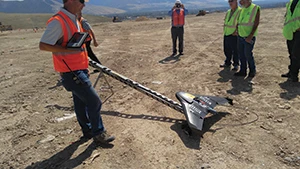
Finally, to round things out, everyone got to watch a demonstration of a landfill mapping drone.
As the pilot was preparing to launch the drone, I leaned over to one of the operators and asked, “Hey, I wonder if he has to worry about eagles, taking that drone out?” Then, I went on to explain how when I lived in Montana, I had been driving—not too far from Missoula—when I looked out my truck window and saw two ducks that were keeping pretty good pace with me as I traveled down the freeway. As I watched them, an eagle streaked out of the sky above them and grabbed one of those ducks in midair!
Less than a minute later, the drone pilot announced to the group, “Hey, I need you guys to help me watch for eagles, because I was flying earlier this year when an eagle streaked out of the sky and hit the drone!” He proceeded to show us the talon marks on the top of the drone where the eagle had grabbed it. I’d been kidding, but the drone pilot wasn’t. Apparently to an eagle, a drone looks like food.
Only in Montana…
So, if you are looking for something new and fun you can do for your local landfill operators, consider hosting an Equipment Rodeo. While you may not have any mean bulls or wild horses, you may find that there are more cowboys at your local landfills than you realized.
In any event, an Equipment Rodeo is a great way to build camaraderie and let the landfill folks in your region get to know each other. Yep, big tractors, big sky, big fun—that’s a Heavy Equipment Rodeo…Montana style!