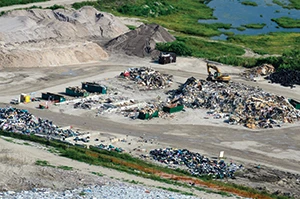
What looks like a landfill from the outside might be something entirely different on the inside. Let me give you an example. Let’s suppose you have a cellphone factory.
That’s right, you manufacture cell phones. Parts go in on one end of the building, and cellphones come out on the other. Yep, that’s a cellphone factory alright…but then we walk inside. We sit down, and we watch. What we see is an assembly line. You know, it’s a slow-moving conveyor belt and on the far end is the empty body of a cell phone. And we watch as it moves down the line from one station to another.
Managing municipal solid waste is more than landfilling: publicity, education, engineering, long-term planning, and landfill gas waste-to-energy are specialties needed in today’s complex environment. We’ve created a handy infographic featuring 6 tips to improve landfill management and achieve excellence in operations. 6 Tips for Excellence in Landfill Operations. Download it now!
At the first station, someone picks it up and snaps on the screen. At the second station, someone attaches a little circuit board with four tiny screws. At the next station, someone puts two wires in there, connecting the screen to the circuit board and solders the wires into place. At the next station, someone inserts a battery, the next person snaps the cover in place, and at the final station someone picks it up and wipes it clean with a cloth. Then, at the very end before it is dropped into the box, someone inspects the cell phone.
After inspecting it, they drop it into a box, and there we have it—a completed cell phone. But we keep watching, and we see something odd. The inspector picks up one of the cell phones, puts it next to his ear, and gives it a shake. Then he frowns, gets up, and walks back to the circuit board station. He drops it into a little box. We notice that there are a lot of cellphones in that little box. And we keep watching. We see the inspector periodically pick up a phone, walk back up the line, and drop it into someone’s box.
Maybe it is the battery station, maybe it is the soldering station, and maybe it is the circuit board station. Yes, every station has a little box with several rejected cell phones in it. We keep watching. Then we see the entire assembly line shut down.
Managing municipal solid waste is more than landfilling: publicity, education, engineering, long-term planning, and landfill gas waste-to-energy are specialties needed in today’s complex environment. We’ve created a handy infographic featuring 6 tips to improve landfill management and achieve excellence in operations.6 Tips for Excellence in Landfill Operations.Download it now!
We see all the workers reach into the little boxes beside their stations, each pull out a cell phone, and start taking it apart. They fidget with it. We are curious. We walk over to see what is going on. At the circuit board station we see the worker take a phone apart, tighten the screws—or maybe add a couple of screws that he forgot to put in the first time it came down the line. At the battery station we see the same thing.
The battery worker pulls the battery out, turns it over, and inserts it the right way this time. They are redoing their work! We see the same thing at the screen station, and at the soldering station—they are all fixing prior mistakes. And while they fix, the line is down for nearly an hour.
Then, as suddenly as it began, the fixing stops and the main factory—and the conveyor belt—starts again, and lo-and-behold those phones go back down the line. When they get to the end, the inspector picks up each one and smiles as he puts it into the box to be shipped out. Yet he will still occasionally reject a phone, walk it back up the line, and drop it into someone’s box.
During a course of the day, the main assembly line stops three times to rerun phones that were not assembled properly the first time. Inside that cell phone factory are a lot of hidden factories—one at each station. Each is doing things twice, even three times, because they were not done right the first time. From a distance, the cell phone factory looks great…but when we look closer we find that it is not just a cell phone factory, it is a lot of hidden factories within a factory.
Got it? Good, now let’s apply this to your landfill.
A load of trash comes in, the spotter directs it to dump on the left side—or maybe the spotter does not direct it and the driver just happens to dump on the left side. Or, maybe you don’t have a spotter at all and the driver just dumps on the left side. Then, the dozer operator takes that material and pushes it up onto the face. You are listening on one of the landfill’s radios, and you hear the compactor operator say, “Hey! Don’t dump that load of C&D over there! I just finished that area, and it’s ready for cover. I’m still filling a deep hole over here, so push it this way!”
Then, as you watch, the dozer operator moves that load that he just put on the left side of the face and pushes it across to the right side. You are still listening to the radio, and you hear the compactor operator say, “OK, that’s better, thanks!”
You just saw a hidden factory inside your landfill…a little hidden factory. Is that it? Sorry, no, there is more. It is spring time, and you are working over in the northwest corner of the landfill.
It was a relatively easy winter, things have dried out, and now you have a chance to get back up in that far northwest corner and fill a few low spots left over from last year. You made it through last winter, and next winter is many, many months in the future. You haven’t given it much thought, in fact, you haven’t thought about it at all.
That means you have not developed a Fill Sequence Plan so you don’t know where you are going to be operating next winter.
It’s no big deal—you’ve got eight months before you have to worry about it. And every day for the next eight months truckloads of broken concrete and asphalt come into your landfill. You’ve got some of this material left over from last year—it’s piled out near the front gate. And so that’s where every load of rubble gets dumped in that stockpile. That’s what happens, that’s what always happened, and you just don’t give it much thought.
Then spring rolls into summer, and summer passes into fall, and you find yourself checking that weather report a little more often. Winter will be here soon. Hey guys, where are we going to put our wet-weather tipping pad? As you brainstorm about it, you decide it should go up in the far northeast corner.
You’ve got a decent road going out that direction, and there is a pretty deep fill yet to be completed. Yep, you all agree, that would be a great place for this winter’s wet-weather tipping pad. So you get a dozer in there and smooth up an area.
Next, you need something to surface that pad with. “No problem,” you think. “I’ve got this great big stockpile of broken asphalt and concrete way out by the front gate. We’ll just rent a loader, hire four trucks, and start moving material. Ah, heck, in a week or so, we’ll have it all moved over there.” So you do.
A week later, all that material has been moved over to the northeast corner, and you are building a new wet weather tipping pad.
Things are looking great.
Then someone calls from downtown—at accounts payable. They have a bill for a loader and for four trucks, totaling $17,000. They ask you if they should pay it.
“Of course,” you say. “That’s money we had to spend to build the wet-weather tipping pad—it’s all part of running the landfill….”
Well, no it really isn’t. It’s all part of running a hidden factory inside your landfill.
You see, if you had taken time in the spring to plan ahead, develop a fill sequence plan, and figure out where you’d be filling next fall, you could have foreseen that you would need a wet-weather tipping pad in the northeast corner of the landfill. You could have sent the dozer over there in April to shape up that area. And then, all spring and all summer and on into the fall you, could have directed every load of concrete and asphalt rubble up to that northeast corner of the landfill to dump that material right on top of where you are going to have your next wet-weather tipping pad.
If you had done that you wouldn’t have needed that hidden factory within your landfill and you would have saved $17,000. After years of performing operational reviews, we’ve found that most landfills have a number of hidden factories. Some of them have dozens. They all waste resources, they all cost money, and the fact that they are hidden factories means that you could avoid them if: (a) you knew about it and (b) you did something about it.
So the next time someone asks what you do for a living, stop and think about it before you say, “I run a landfill….” Because the fact is, if you have not carefully evaluated your system and streamlined your operation, there is a real good chance that you are running more than just a landfill. You may have a nice little collection of hidden factories.
Latest from Waste Today
- My Green Michigan expands depackaging capacity
- Washington selects Circular Action Alliance as PRO
- Ten-8 Industrial opens new central Florida service center
- Triumvirate Environmental acquires Environmental Waste Minimization
- Official NYC Bin availability expands ahead of deadline
- US Food Waste Pact’s 2025 Impact Report shows decrease in food waste
- Coastal Waste & Recycling expands recycling operations with Machinex
- Reconomy acquires German-based GfAW