Tonnage is down, revenue is down. You can blame it on recycling, blame it on a poor economy, or blame it on the competition, but the bottom line is there is not enough money coming in to cover all the bills, financial assurance for closure, and setting money aside for that next tractor or that next few acres of liner.
And, don’t feel like you’re all alone. This situation is shared by most landfills today. But, before you run to the board for a rate increase, consider the following: Unless your facility is in a very isolated market or unless you have some type of flow-control in place, raising rates could be counter-productive. Yep, that’s right. If you are the first landfill in your market area to raise rates, there is a good chance you could push some of your paying customers elsewhere, and you don’t want to do that.
Managing municipal solid waste is more than landfilling: publicity, education, engineering, long-term planning, and landfill gas waste-to-energy are specialties needed in today’s complex environment. We’ve created a handy infographic featuring 6 tips to improve landfill management and achieve excellence in operations. 6 Tips for Excellence in Landfill Operations. Download it now!
From a marketing standpoint, you are much better off to let someone else raise their rates, and maybe they will push some tonnage and revenue toward your site.
Or, think even further out of the box. What if you could reduce your tipping fees and attract some additional tonnage and bring in some of that nice marginal revenue?
So, what is marginal revenue? You can consider it “extra revenue.” Here is how it works: Your landfill has a lot of fixed costs. It’s what you’d have if you lumped together all of your development, monitoring, permitting, engineering, and administrative costs, along with the cost of your machines and a good portion of your staff. You need that stuff and those people regardless of whether your tonnage goes up or down. You’ve just got to have them. Those are fixed costs.
Managing municipal solid waste is more than landfilling: publicity, education, engineering, long-term planning, and landfill gas waste-to-energy are specialties needed in today’s complex environment. We’ve created a handy infographic featuring 6 tips to improve landfill management and achieve excellence in operations.6 Tips for Excellence in Landfill Operations.Download it now!
Now, imagine what would happen if you could bring in another 50, 100, or 400 tons of waste per day. If you’re like most landfills, that additional tonnage would not require you to buy more machines, hire more people, put in more groundwater monitoring wells, build another scale, or do any of those other things that would add to your fixed costs.
No, that extra tonnage—that extra revenue, that marginal revenue—might simply require you to work a few extra hours with the machines, haul a few extra loads of soil, and maybe move over into the next lined area a little bit sooner than you planned. But the rest of that revenue is gravy because, remember, you are already covering your fixed costs. It is not unusual for a landfill to increase their tonnage by 20% and double their net revenue in the process.
Why? Well, because that additional revenue is marginal revenue; it is extra revenue. Sounds great, huh? It is great, and here is how you can do it. Get on the process improvement train. Process improvement is, itself, a process, a system, a methodology. It is a way of looking at your operation from both a tactical and a strategic perspective, with the goal being to reduce costs, improve efficiency, and make the whole system work better.
Oh and by the way, when you do these things, they will automatically improve safety. “Great!” you say, “Sounds good, but come on, how do I do it?” Well, you start by following the money. Look at your operation with a critical eye. Identify where you spend big chunks of money. No, I would not recommend spending time pricing out paper towels, because chances are you don’t spend much money on paper towels. You need to turn over those rocks that are covering the big bucks. Look at cover soil, equipment utilization, or your staffing. Once you have identified a few places where you are spending a lot of money, drill down. Get specific.
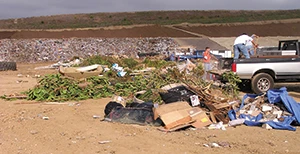
See the photo for an example. It shows trash that has been dumped by self-haul (non-commercial) vehicles. There is $310,000 per year of wasted resources hidden in this photograph. Can you see it? Don’t feel bad, most landfill managers can’t either. Here’s what happens.
Every day, the landfill’s traffic director (a.k.a. spotter) points the way for scores—sometimes hundreds—of self-haul customers. Like the parking lot at Walmart, the customers and the spotter expect each approaching vehicle to take the most convenient space available. As a result, loads of waste are dumped randomly—a load of brush here, some shingles there—eeny, meeny, miny, moe….
Periodically, perhaps every hour or so, a bulldozer pushes the trash toward the active fill area (at the rear of the photo). In order to make a clean push—and effectively remove even the small pieces of drywall, tile, and shingles—the blade must penetrate a few inches into the soil. Otherwise those flat, heavy items will be left on the ground, making the next round of drivers a bit more hesitant to back up, and if left at the end of the day, will lead to a violation of state “daily cover” rules.
So the dozer operator lowers the blade into the dirt…and pushes. But in the process, some soil is removed from the unloading area and pushed into the active fill. This consumes valuable airspace (which is intended to be filled with trash, not dirt). And it also means a scraper or dump truck must go to work to replenish the removed soil.
Based on a typical operation where the value of airspace is $10 per cubic yard, and which may require five loads of new soil each day (at 20 cubic yards per load), the removed soil costs approximately $1,000 per day. If repeated every week (Monday through Saturday), this equates to an additional (unnecessary) cost of $310,000 per year!
Suppose your landfill does not use five loads of soil per day to clean up the self-haul area. Maybe you use three loads per day or one load per day. Whatever the case may be, if your spotter is not strategically placing vehicles, you are wasting soil. That means you are wasting airspace, which means you are wasting money.
That’s it. Process improvement in a nutshell. Follow the money, drill down, and be very specific.
And once you find the root causes—those underlying reasons why you are spending that money—look for solutions. Talk to your crew. Spend some time thinking about it. If you do, you’ll find some hidden opportunities. You’ll find money right there in your operation that you can use to reduce rates, buy a new tractor, pay off some debt, and get ready for closure.
How good can this process improvement thing be? Pretty darn. We have been doing process improvement—we call them CORE Assessments—for waste facilities for more than a quarter of a century.
What have we found? It is not unusual to see a landfill, transfer station, or other waste facility reduce their operating cost by 5, 10, sometimes 20%, or more, by simply following the money, identifying problems, and then solving them. And in the process you will create a leaner, more competitive operation. Yeah baby, that’s the ticket. Process improvement.
Latest from Waste Today
- Vecoplan to present modular solutions at IFAT 2026
- Terex Ecotec appoints Bradley Equipment as Texas distributor
- My Green Michigan expands depackaging capacity
- Washington selects Circular Action Alliance as PRO
- Ten-8 Industrial opens new central Florida service center
- Triumvirate Environmental acquires Environmental Waste Minimization
- Official NYC Bin availability expands ahead of deadline
- US Food Waste Pact’s 2025 Impact Report shows decrease in food waste