Case Study #1
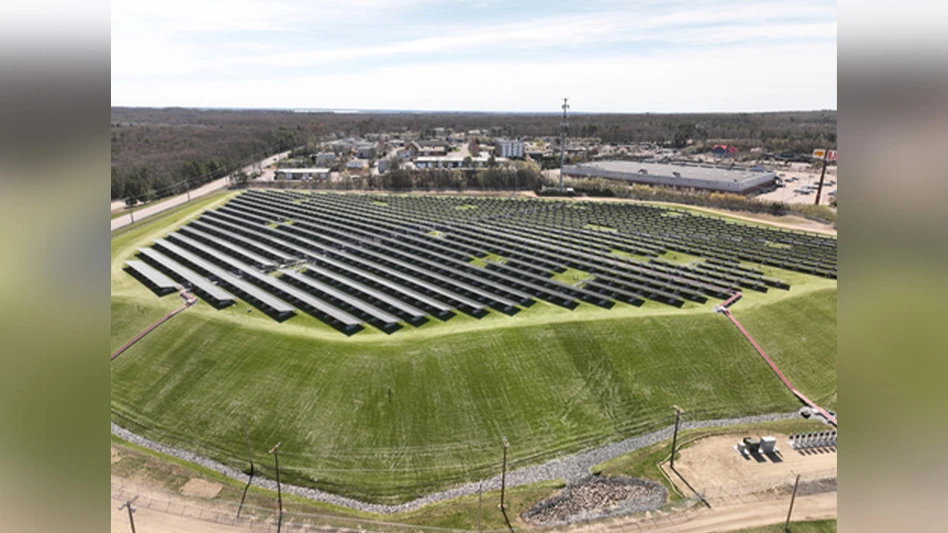
After conducting a comprehensive operations review (CORE), a 900-ton-per-day regional landfill identifies excess machines and generates $880,000 in auction revenue. Non-productive equipment hours with the remaining machines were minimized, resulting in additional savings of $20,000 per month in reduced fuel consumption. Associated staff reductions efficiencies in fill sequence planning and a drastic reduction in cover soil usage, along with increased waste compaction, netted this county savings of $4 million dollars the first year…and projected savings of approximately $2 million per year ongoing…throughout the life of the facility.
Oh, and they are currently running at a 13.5:1 cover ratio!
Case Study #2:
A 2,700-ton-per-day landfill was able cut their D9 dozer fleet in half…going from five D9 frontline pushing dozers to two—along with a part-time backup dozer. During that same time, they increased their Airspace Utilization Factor (AUF) initially by 28%…with the latest figures indicating it may be trending even higher—perhaps approaching a 45% increase.
Both of these examples show improvements that resulted in tremendous financial savings…and because they established standard operating procedures, they also made their sites much safer. These landfills didn’t just go on a diet, they lost 400 pounds—and then won an Olympic marathon!
These number aren’t just real, they are real good.
Okay, these changes sound dreamy—maybe not quite the right word, but you get the point. So how did they do it?
They did it by applying various process improvement techniques—techniques such as Six Sigma, Lean, Value Stream Mapping, and a host of comprehensive time motion studies. These are the same tools used by Motorola, General Electric, Toyota, and hundreds of other companies—and municipalities—to improve their operations and become world-class competitors.
Applying process improvement techniques to landfill operations is not a canned process. Every site is unique, and thus each facility must be evaluated by specific tools and in a specific way that specifically identifies inefficiencies and provides practical and economical solutions.
This process is known as a CORE Assessment. CORE is an acronym for Comprehensive Operations Review.
Conducting a CORE Assessment is not a quick fix. They take time to conduct, and even longer to implement. For small, simple operations a CORE Assessment can take several weeks; for large, complex operations with lots of ancillary activities the process can take months. But, in the end, you’ll be applying numbers to those operational black boxes that heretofore have simply been based on our personal opinions—most folks call them guesses. Here is an example:
Determining the Appropriate Width for the Tipping Pad
How wide, or more specifically, how many unloading slots should a landfill’s tipping pad provide in order to allow adequate space for vehicles to unload even during peak hours of the day? Typically, if there is standard width assigned to the tipping pad, it is based on tradition and simplicity. Think about it, we seldom hear of tipping pads that offer an unloading area of 133 feet—or 215. Instead, it always seems to be 100 or 200 feet. Why? Because the grooves in our brains will more readily jump to nice, round numbers. But if we actually figured it out, isn’t it likely there’d be an actual number…you know, a real number.
Here’s a quick example of one of the many factors that must be considered when determining the appropriate width of a landfill’s tipping pad.
Factors to Consider
Commercial and self-haul vehicles bring waste into the landfill where it is dumped at the landfill’s tipping area (a.k.a., tipping pad or unloading area). Waste is then pushed to the active face (a.k.a., open face) where it is spread and compacted into a “cell.” The term “cell” refers to the basic (daily) building block of the landfill.
As each day’s cell is created, the landfill staff must safely and efficiently manage the inbound flow of waste—as it varies widely throughout the day—carefully balancing many important factors. Those factors include:
- Inbound waste tonnage
- Inbound vehicles per hour
- Location and size of commercial tipping area
- Location and size of self-haul tipping area
- Type of vehicle(s)
- Type of waste
- Typical size of load (average tons per load)
- Weather conditions (e.g., wind, rain, etc.)
- Size/number of bulldozers
- Production rate of bulldozer(s)
- Size/number of compactors
- Production rate of compactor(s)
- Size/number of dozers pushing from the tipping area
- Minimizing wait time for trucks
The manner in which the landfill crew addresses these factors has an obvious short-term impact on daily operation, but the greatest impact is long-term. Those ultimate, long-term goals include:
- Achieving optimum waste density,
- Reducing the receipt of non-waste materials (i.e., soil, recyclables, etc.),
- Maximizing the life of the landfill,
- Minimizing environmental impacts, and
- Maintaining a safe workplace.
Clearly, the process of cell construction isn’t simple as ABC—but it’s not rocket science either. The analysis begins with Inbound Tonnage.
Inbound Waste Tonnage
When it comes to operating a landfill efficiently and economically, most activities are related to inbound waste tonnage. Because inbound waste is processed in small increments, essentially one load at a time, the most useful tonnage information is tons per hour. These two charts show details regarding inbound tonnage. (See Figure 1 and Figure 2.)
Based on the information provided to us, it appears that daily (weekday) tonnage, while averaging nearly 3,000 tons per day, varies some throughout the week—especially in the afternoon. Of the predictable waste stream patterns, one of the most noteworthy is the late-morning tonnage peak. Regardless of when/how the tonnage arrives, the landfill must provide adequate space for waste vehicles to safely unload without creating (unsafe) crowding or excessive wait times. Many of the vehicles are equipped with dump bodies
Vehicles Per Hour
Most waste vehicles follow a certain procedure at the tipping area, including:
- Pull up to the tipping pad and make eye contact with the spotter.
- Receive direction from the spotter.
- Back into position at the edge of the tipping pad.
- Set the truck’s parking brake.
- Unlatch/open the rear of the truck.
- Operate the controls to unload the truck.
- Walk to the rear of the truck to affirm the load has discharged.
- Return to the cab, release the parking brake, and pull to the cleanout area.
Based on some detailed video analysis, we determined this process takes approximately six minutes. At that rate, each unloading slot could accommodate a maximum of 10 vehicles per hour. Thus, during the peak periods (i.e., 50 vehicles per hour), the tipping area could theoretically function with a minimum of five unloading slots. But, as they say, “In theory, there is no difference between theory and practice—but in practice there is.”
This is, of course, based on an ideal work flow, where all vehicles dump quickly, no trucks break down, drivers don’t stop to visit with each other, and there are no other unforeseen delays.
Also consider that when a load is dumped, a bulldozer must move into that truck’s slot and push the load to the active face. While the load is being removed, that slot—and perhaps adjacent slots—is not available for the next truck.
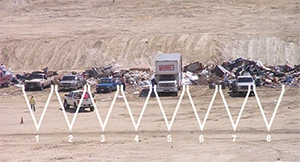
Thus, we would plan to have seven slots (the one being pushed and one on either side)—plus one for a contingency—for a total of eight. Finally, we would allow 10 feet for each truck, and a 15-foot safety clearance between vehicles.
That’s eight 10-foot slots, with seven 15- foot gaps in between, which works out to a total width of 185 feet.
Putting numbers to and optimizing the simple process of establishing an efficient tipping pad width provides us with a glimpse into how process improvement can provide practical answers to common and even abstract questions about landfill operations.
Now, imagine extrapolating that sort of detail across the entire operation from processing individual customers at the gatehouse to directing traffic, pushing, spreading, compacting, covering, sequencing…right on through closure and post-closure.
Applying process improvement to your landfill operation takes time, effort, money and a strong dedication to follow-through, to make sure that the improvements stick. So, because of the work required to implement process improvement, it may not be everyone’s “cup of tea”. The fact is Process Improvement only applies to those facilities that want to improve operations, increase efficiency, increase safety, and save money.
Latest from Waste Today
- Vermeer announces plan to build new facility in Des Moines metro area
- Buffalo Biodiesel shares updates on Part 360 application to DEC, Tonawanda facility progress
- Capstar Disposal expands roll off dumpster rental services
- Supreme Court strikes down IEEPA tariffs
- Casella details facility closures, expansion efforts
- Zero harm: Building a SIF prevention program for waste and recycling operations
- Casella posts a loss in Q4 2025
- McNeilus names Haaker Equipment first Dealer Partner of the Year