On your shelf, there is a plan. It’s a Safety Plan. It’s there because all waste-handling operations are required—by OSHA or a State-specific equal—to provide their workers with what we’d consider to be a basic Safety Plan. Those plans must include things like Lock-out/Tag-out, PPE, Heat Stress Prevention, Hearing Protection, and such exotics as Bloodborne Pathogens and Hazard Communication.
The goal, of course, is worker safety. Unfortunately, the waste industry ranks as the 5th most dangerous in the US. Lots of concerned people have put a ton of effort into solving that problem—hoping to lift the waste industry out of its current slot between roofers (number 4) and agricultural workers (number 6). With a full-court press search to find the right combination of safety slogans and culture-altering programs—Safety is the Topic.
Managing municipal solid waste is more than landfilling: publicity, education, engineering, long-term planning, and landfill gas waste-to-energy are specialties needed in today’s complex environment. We’ve created a handy infographic featuring 6 tips to improve landfill management and achieve excellence in operations. 6 Tips for Excellence in Landfill Operations. Download it now!
Recently, a number of national surveys have revealed what we believe may be a smoking gun—evidence so compelling that it leaves no doubt in terms of a direct cause and effect. Those surveys indicate that more than 90% of waste operations do not have current, applicable safety plans and (written) Standard Operating Procedures (SOPs). As operations consultants, we’ve been reviewing waste-related safety procedures for 30 years and can attest that—in our experience—most facilities do not actually have these documents.
Do the math: that means that 90% of our workers are out there doing it, doing it, doing it . . . without the basic guidelines they need to do it safely. As an industry, what are we thinking? Are we thinking?
Managing municipal solid waste is more than landfilling: publicity, education, engineering, long-term planning, and landfill gas waste-to-energy are specialties needed in today’s complex environment. We’ve created a handy infographic featuring 6 tips to improve landfill management and achieve excellence in operations.6 Tips for Excellence in Landfill Operations.Download it now!
And of those who do have something they call a Safety Plan, most of those documents haven’t been updated in decades or they are extremely general—often limited by the understanding of a Human Resources staffer who wouldn’t know a tipping pad from a seat cushion.
Now to give credit where due, there is value in complying with rules that require you to address OSHA-mandated safety topics—including those previously listed. But when’s the last time you heard of a landfill worker who died from exposure to a bloodborne pathogen? Yes, I know it happens, but like lightning bolts and meteors, it’s not a common threat.
However, pathogens notwithstanding, every month or so, someone is killed at a landfill—and it happens in ways that are not directly addressed by the most obvious OSHA topics. In our business, workers get run over by a tractor or crushed between two trucks. Often—alarmingly often—workers are killed in a manner that was never addressed by a Safety Plan.
So, when we are tasked with updating a facility’s safety plan, we are pleased to see that many of those OSHA topics are included, but we are disappointed to find that the most common contributors to worker death are not only omitted from the documentation; they’re not even on most managers’ radar.
We’re talking Standard Operating Procedures (SOPs)—those all-important guidelines that tell everyone on the crew how to do their job. Most of the people on your crew are thinking—all the time. And if you met with each one of them—individually, and asked them if they had a plan for how to do their job, most of them would say they did. Problem is, they don’t all have the same plan.
Imagine a football team in a huddle, and the quarterback tells each player, “Run your favorite play.” Each player would likely run a doozy of a play—but they wouldn’t run the same play. Sadly, sometimes it looks as if my favorite team has actually tried this method!
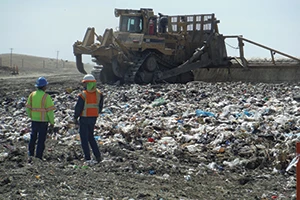
After working as an expert witness on well over 50 waste-related cases—most of which involved an injury or fatality—a common theme has become evident: Landfill workers and customers get killed at the interface between big trucks and heavy equipment. People get killed at the active face—where they are on the ground, in close proximity to trucks and tractors.
Think about it: if you ride a bicycle, a minor flop could earn you skinned elbows and knees. Extreme crashes may result in a concussion or broken wrist. But in a landfill, it’s much more serious. As one manager said while talking about our dangerous industry, “We don’t have injuries . . . we have fatalities.”
He was right, of course. Workers who go one-on-one with a dozer, landfill compactor, or roll-off truck report very few skinned elbows.
Now at this point, you should be thinking about your safety plan—that’s good. And you may even decide it’s time to do something about it—that’s even better. But in the midst of creating another plan, don’t forget the most important goal: to translate that plan to your crew so they can all work together—safely.
Yes, you need a current, robust safety plan. But you also need some bomber SOPs.
Here’s a simple exercise that will help you understand what I’m talking about. Take a digital photo of your active face—where you can see a truck or two lined up to dump, and where there are still several open slots for other vehicles. Then ask each person on your crew—individually—where the next truck should park. I’ve gone through this little skit dozens of times, and it’s as predictable as bad news on the front page: you will see lots of variation. It’s not necessarily because your crew is inexperienced—it’s often because they are experienced and they’re each running their own play!
You’ll find this exercise, or another one like it, to be very revealing. At the most dangerous location on your landfill, the members of your crew—through no fault of their own—can’t even agree on where the next truck should park. That comes from a lack of procedures.
Sure, some facilities use a typewriter method, while others use a back-and-forth alternating system to keep trucks moving safely. But most use the traditional first-come/first-served system—which is, of course, no system at all. And we wonder why our industry’s safety needle is stuck on number 5.
Albert Einstein is credited with saying, “Insanity is doing the same thing over and over and expecting different results.” Well, if your current safety performance is making you crazy, perhaps you need a change. Perhaps it is time to develop some SOPs.