Transfer truck cycle times are an important factor in waste disposal costs. And while the average person may not see where transfer truck schedules have much to do with landfill operations, landfill managers know otherwise. Here’s an example.
In an ideal world, transfer trucks may be released from the transfer station at 10-minute intervals…with the intent being that they arrive at the landfill every 10 minutes. And because an average live-floor trailer takes about 10 minutes to unload, this represents the perfect system, where one truck arrives, unloads, and leaves, just as the next one shows up.
Managing municipal solid waste is more than landfilling: publicity, education, engineering, long-term planning, and landfill gas waste-to-energy are specialties needed in today’s complex environment. We’ve created a handy infographic featuring 6 tips to improve landfill management and achieve excellence in operations. 6 Tips for Excellence in Landfill Operations. Download it now!
Okay, so much for the ideal world.
In the real world, trucks arrive in groups. Sometimes this is a result of drivers playing the route so they can visit with other drivers at the landfill or as an attempt to stretch a normal day into some overtime. Other times, truck bunching is a result of an inefficient load-out at the transfer station or such negative highway conditions as bad weather, construction, accidents, or rush hour traffic.
Regardless of the underlying cause, truck bunching causes inefficient rushes at the landfill and often requires extra hours or even days of hauling in order to maintain a manageable waste volume at the transfer station.
Managing municipal solid waste is more than landfilling: publicity, education, engineering, long-term planning, and landfill gas waste-to-energy are specialties needed in today’s complex environment. We’ve created a handy infographic featuring 6 tips to improve landfill management and achieve excellence in operations.6 Tips for Excellence in Landfill Operations.Download it now!
So what’s the answer? Well, it depends on the question, but finding it always begins with identifying why the problem is occurring. We’ve conducted efficiency studies for a number of transfer stations, and highway traffic is often a factor. Sometimes it is overstated and used as an excuse for poor truck cycle times, and at other times it is truly a serious constraint. Along that line, here’s a look at how rush-hour traffic can affect transfer truck cycle times.
The transportation departments in most states conduct periodic traffic flow studies. We’re all familiar with those black rubber hoses stretched across the road and connected to a little metal box. These are simplest type of traffic counters, and they provide vehicle count data over a few days or weeks. Real-time traffic counts may be provided by radar-based units. Both can provide useful information in terms of traffic loading.
In many cases, you’ll be able to find several points of measurement along the route between the transfer station and the landfill. These may include major intersections, on-ramps, or off-ramps. This information can provide great insight into when heavy traffic is most likely to affect cycle times…and when it isn’t.
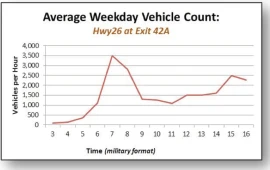
Here’s an example that shows traffic counts at a specific exit. Note that the heaviest traffic occurs between seven and eight o’clock in the morning. Obviously, your truck release schedule should avoid this time period. It also shows that traffic increases from lunchtime on. This may suggest the scheduling of additional trucks to work midday to avoid both heavy periods.
In addition to various types of tables and charts, you can also view traffic count maps, showing numerical or color-coded traffic volumes at various locations on your route.
It’s probably no surprise that you can actually view traffic count maps through some versions of Google Earth.
Regardless of the format you choose, the important point is that you can often improve transfer truck efficiency by understanding how the traffic load changes during the day.
Latest from Waste Today
- Worn Again Technologies unveils Accelerator plant to advance polycotton recycling
- Nashville Waste Services launches new digital route system
- ACUA landfill expansion project unanimously approved
- Clean Energy announces multiple RNG deals with fleets nationwide
- Interchange 360 to operate alternative collection program under Washington’s RRA
- Waste Pro files brief supporting pause of FMCSA CDL eligibility rule
- New Way Trucks expands US network with Joe Johnson Equipment
- Tire Industry Project publishes end-of-life tire management guide