If you are in the landfill business, you probably spend a lot of your time trying to make your landfill look natural, organic, and environmentally sustainable. Sounds like some kind of health food supplement, doesn’t it? The fact is, our image of a well-run landfill is one that is well vegetated and appears to be environmentally friendly. And we put a lot of time, money, and resources into achieving that.
So we prepare the soil, carefully select a native seed mix, add fertilizer and mulch, and try to time it all so the seasonal rain will help those seeds germinate and grow. Yes, a well-vegetated landfill is a happy landfill. And then the dry season comes, and all that lush, green vegetation dries up and becomes a very serious fuel source for wildfires.
Think about it—a wildfire at your landfill can do significant damage to your infrastructure. Your fences, monitoring wells, and heavy equipment can be at risk. Your organics processing operations can represent hundreds of tons of flammable material, but for many landfills, the greatest risk is associated with your landfill gas collection system—those wells, laterals, and headers filled with flammable, explosive gas. The thought of a wildfire raging across your landfills, methane wells, laterals, and headers is not something that gives landfill managers restful sleep.
Managing municipal solid waste is more than landfilling: publicity, education, engineering, long-term planning, and landfill gas waste-to-energy are specialties needed in today’s complex environment. We’ve created a handy infographic featuring 6 tips to improve landfill management and achieve excellence in operations. 6 Tips for Excellence in Landfill Operations. Download it now!
The flames of a grass fire can reach 1,800°F, and though a grass fire moves quickly, it may have enough time to impact your landfill gas system. HDPE pipe melts at approximately 350°F. The auto ignition temperature—the point where methane will burst into flame without an ignition source—for methane is around 1,000°F, but that’s really irrelevant because at 350°, the pipe melts and methane is ignited by the wildfire.
Any way you look at it, those numbers don’t work. So, to avoid the potential devastating impact of a wildfire, you should have an effective vegetation management plan.
Several options come to mind; the first is herbicides. The correct herbicide applied at the right time will stop that vegetation from growing in the first place. But that’s really a bit counterproductive considering the effort you went through to try to get it to grow. Plus, you want that vegetation to establish a good root structure in order to minimize soil erosion.
Managing municipal solid waste is more than landfilling: publicity, education, engineering, long-term planning, and landfill gas waste-to-energy are specialties needed in today’s complex environment. We’ve created a handy infographic featuring 6 tips to improve landfill management and achieve excellence in operations.6 Tips for Excellence in Landfill Operations.Download it now!
Herbicides applied too late may still kill the weeds and grass, but can actually increase the risk by creating a swath of dead vegetation along the pipelines.
So, removing the above-ground portion of that vegetation, through mowing or weed whacking, is perhaps a better and more common option. But that can be labor intensive and costly. It can be difficult to get that equipment in and around your methane well’s piping and other infrastructures without causing damage.
But here’s the real kicker: surveys indicate that nine out of 10 wildfires are caused by humans, and a high percentage of those are caused by people using machines to perform vegetation management.
Is there any good solution out there? In fact there is, and coincidentally, it falls under the category of natural, healthy, and environmentally sustainable.
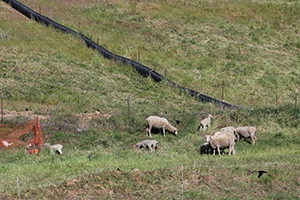
An increasing number of landfills are using sheep and/or goats to control vegetation, whether it’s a herd of a goats, a flock of sheep, or what our Australian neighbors might call a mob. The bottom line is that when you put a bunch of grass-eating critters on your landfill, they can remove that vegetation quickly, effectively, and safely. And because landfills are, among other things, in the business of public perception, a flock of sheep can munch that grass and provide you with some very cool PR. So how does this process work?
Well, it’s really quite simple. Somewhere between a few dozen and a few hundred sheep or goats are released at your landfill and are constrained by a simple, portable, electric fence. They are rotated section by section across your landfill, and left in place for whatever duration is required to eat down the grass before being moved to the next section.
The contractor who provides the sheep or goats also provides the electric fencing, water, and management for the entire process. In some cases where there are no local predators, a single electric wire is sufficient to keep them in a specific section. In areas where there are predators, a more substantial electric fence is required, not just to contain the sheep, but to keep predators out. In either case, the system is quite simple.
Temporary fence posts are installed around the perimeter of the area, wire is stretched across the posts, and the fence is connected and energized by a small control box. The electricity is most often provided by a battery that may or may not be connected to a small solar panel to help maintain an adequate charge.
Depending on the size of the flock and how long they’re left in a specific area, they can thin the vegetation or eat it right down to soil. It’s really up to you. The cost is really quite reasonable, especially considering that sheep and goats can remove vegetation from the nooks and crannies around your monitoring and gas collection wells with very little risk of damage.
According to landfills that are using this type of vegetation management, the cost compares favorably with laborers armed with weed-wackers. It’s kind of funny when you think about it: while sheep herders have been grazing their flocks for thousands of years, for us in the landfill business this newly discovered natural approach to vegetation management is state-of-the-art.
Latest from Waste Today
- Vecoplan to present modular solutions at IFAT 2026
- Terex Ecotec appoints Bradley Equipment as Texas distributor
- My Green Michigan expands depackaging capacity
- Washington selects Circular Action Alliance as PRO
- Ten-8 Industrial opens new central Florida service center
- Triumvirate Environmental acquires Environmental Waste Minimization
- Official NYC Bin availability expands ahead of deadline
- US Food Waste Pact’s 2025 Impact Report shows decrease in food waste