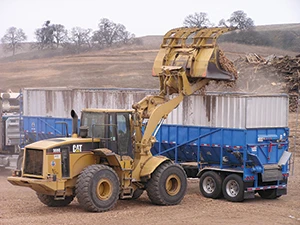
Sure you’ve all heard this phrase before, but that’s not really the question—not if you operate a wood processing facility at your landfill. No, we’re less interested in how much wood he can chuck, and more concerned with how many times he chucks the same piece of wood.
While conducting operational efficiency studies at wood/green waste processing operations—including compost facilities—our team often finds that the crew handles the same material too many times…way too many. These are classic examples of the hidden factory concept we talked about in a previous article.
Managing municipal solid waste is more than landfilling: publicity, education, engineering, long-term planning, and landfill gas waste-to-energy are specialties needed in today’s complex environment. We’ve created a handy infographic featuring 6 tips to improve landfill management and achieve excellence in operations. 6 Tips for Excellence in Landfill Operations. Download it now!
We evaluated a wood/green waste processing facility at one landfill and found that the laborers or machines at the facility actually touched the same material 17 times! Please note that this was not a compost operation—and no, we were not counting windrow turning.
Managing municipal solid waste is more than landfilling: publicity, education, engineering, long-term planning, and landfill gas waste-to-energy are specialties needed in today’s complex environment. We’ve created a handy infographic featuring 6 tips to improve landfill management and achieve excellence in operations.6 Tips for Excellence in Landfill Operations.Download it now!
You might be thinking, “No way!” So do most people, until they see the results of a detailed process flow analysis.
Come along as we review a typical operation—and see how quickly those touches can add up.
The contractor comes in with a load of (mostly) wood waste. The scale attendant directs him to the wood unloading area. So the contractor obligingly drives to it and unloads his wood. Your crew probably doesn’t help them unload, but a lot of operators do. These are known as pull-offs—you know, where the contractor has pre-placed a rope or chain in the bottom of his trailer which he hooks to your tractor so your operator can pull it off…thus saving the contractor a lot of manual (unloading) labor. That’s touch number 1.
But, the laborer realizes some of that trash is down underneath the wood, and he can’t get to it without a tractor. You tell the loader operator to roll that material over so that the laborer can get to it and extract the rest of the contamination. That’s 3.
Once the material has been cleaned, the loader comes over and pushes it up into a big pile. That’s 4. If you were thinking ahead, that pile is right next to your grinder. If not, then you have to move the material to the grinder. That’s 5.
Once it is at the grinder—or the grinder is at the pile—a loader or excavator picks up the material and drops it into the grinder. It is ground up, the material comes off the end of the grinder’s conveyor into a small pile. The loader is there to take that material and push it up into a bigger pile. That’s 6, 7, and 8.
Later you bring over the trommel. Now again, if you were thinking ahead, the trommel is close to the pile of ground up material. If not, you have to pick it up and move it over to another stockpile adjacent to the trommel. That’s 9.
Then at some future date you use a loader to pick up the ground wood material and dump it into the trommel where it is screened. That’s 10 and 11.
The material comes out of the trommel—fines on one end, overs on the other. Then, using a loader, you push those materials into separate piles. That’s 12.
Now, depending the type of grinder, how it’s adjusted, how the material was handled prior to grinding, how much dirt is mixed with the wood, and a lot of other factors, you may be using the fines (or the overs) as your final product. If you are using the fine material, then the overs may go back into the system (at step 5) and run through 6, 7, 8, 9, 10, 11, and 12 all over again—which for this material is 13, 14, 15, 16, 17, 18, and 19.
Then, you pick that material up at some point with a loader, dump it into a truck, and haul it…someplace. For material that made it on the first pass, that’s 13 and 14. For the overs that required a second pass through the system, that’s 20 and 21. Now we’re getting somewhere!
But perhaps at the front end of the operation you are performing a floor sort to extract wood, set it aside, push it into a bin, load it onto a roll-off truck, and haul it down to the wood pile. Or maybe on the back end, your loader operator is not careful with the stockpile of screened material and gets some dirt mixed with it as he’s loading the trucks; that material might have to go through the screen again.
…Oh my, things are really getting out of hand—and you thought touching it 17 times was an overestimate!
Finally, if you’re composting that material, you’ll need to account for the turning, watering, temperature-monitoring, transporting, final screening, stock-piling, curing, and loading. By the time you get that compost out the gate, you may have touched it 30–40 times!
Once you recognize the scope of processing required for wood/green waste, the term hidden factory will begin making sense, and you’ll see the danger in generalizing the process. Your organics processing facility is not just grinding or composting, it may actually include dozens of individual tasks. And with each one, you touch the material—and every touch costs you money. If you’re not paying close attention, this process can really get away from you.
At another facility we evaluated, we found that while transporting a typical 5,000-cubic-yard batch of material from the grinder to composting windrows, the hauling unit (a scraper) was logging more than 60 miles per batch! What an opportunity for improvement—simply by having customers dump the unprocessed feedstock in large windrows, then using the grinder (a track-mounted mobile unit) to process the material in-place…while creating a windrow with the grinder’s discharge conveyor.
So what can you do about this incredibly labor intensive process? Well, first you have to identify the problem. It helps if you know what to look for. Sometimes inefficient handling is obvious…but not always. As you process material, it’s a good idea to ask yourself, “Why am I doing this particular step of the process—and how can I avoid it?”
Let’s talk about the very first touch—removing contamination from the feedstock. Here are some ways to avoid contamination (with trash) in the first place:
- Change your rate structure to make clean wood disposal cheaper than your normal trash rate.
- Charge more for mixed loads—same as trash.
- Put a spotter at the unloading area to keep an eye on customers as they unload.
- Locate the unloading area adjacent to the entrance area so the scale attendant can watch what’s being dumped.
- Install a portable, wireless camera at the unloading area. You’d be surprised how cheap it is to put in a camera.
- As an even lower cost alternative, consider putting a pole in the ground and mounting a fake camera that has a little red light that flashes off and on so that people think someone may be watching them as they unload.
- Make sure your scale attendant is telling everyone that, “We don’t want trash and other contamination in that pile—it is just for wood.”
- Put a big sign up at the unloading area reminding people not to dump trash with the wood.
- Put a “trash” bin next to the unloading area to make it easy for customers to keep feedstock and trash separate.
- Put that kind of thoughtful effort and creative problem-solving into every step of the process. That means every time you touch it, think about why it’s necessary…and try to find ways to avoid touching it.
Finally, are you making the right product? Sure you can grind that stuff and screen it, and haul it to a power plant. We did an operational assessment for one facility and found that they were spending $71 per ton to get the material sorted, ground, screened, and hauled to a nearby power plant. Yes, $71 per ton! Once they got there, the plant paid them $15 per ton.
Maybe instead of processing that material to the point where you can sell it to a power plant, or before you take it all the way to a finished compost
material, you should look for alternative markets or alternative uses, things that don’t require as many touches or cost as much money. Can you simply grind that material up into mulch and spread it on your landfill slopes for erosion control?
At some facilities that mulch can be a welcome addition to the soil, to help promote vegetation and minimize erosion. What’s more, it can be a continual market for that material. No, you might not get paid for it, but the off-setting savings in not having to process it so much may be more cost effective.
You may wonder, “How is it an ongoing market?” Well, if you put that material on a slope this year, it will decompose (i.e., oxidize), and in two or three years you can do it again. A large landfill can use a lot of mulch—especially if you expand its use to include offsite stockpiles and excavation slopes.
We in the waste industry often think of MRFs as the most labor-intensive process in the waste industry—and certainly recycling does require lots of labor. But, in terms of multiple-handling of material, a MRF isn’t in the same league as a typical wood/green waste facility.
The good news: you can improve your organics processing operation by evaluating/improving it—one touch at a time.
Latest from Waste Today
- Interchange 360 to operate alternative collection program under Washington’s RRA
- Waste Pro files brief supporting pause of FMCSA CDL eligibility rule
- New Way Trucks expands US network with Joe Johnson Equipment
- Tire Industry Project publishes end-of-life tire management guide
- Vecoplan to present modular solutions at IFAT 2026
- Terex Ecotec appoints Bradley Equipment as Texas distributor
- My Green Michigan expands depackaging capacity
- Washington selects Circular Action Alliance as PRO