As air-quality regulations tighten up, landfill managers often find themselves caught between doing what’s right…and being able to pay for doing what’s right. At first glance, it seems to be a no-brainer. It’s pretty hard to complain about having clean air…but, still, it seems, the cost of keeping that air clean is almost enough to make you choke.
As we’ve climbed upward through those air-quality standards and passed each successive compliance date, many landfills have steadily upgraded their fleets of equipment by changing exhaust systems, by replacing engines, or by making full-scale replacements of machines.
Managing municipal solid waste is more than landfilling: publicity, education, engineering, long-term planning, and landfill gas waste-to-energy are specialties needed in today’s complex environment. We’ve created a handy infographic featuring 6 tips to improve landfill management and achieve excellence in operations. 6 Tips for Excellence in Landfill Operations. Download it now!
So where are we headed? Well, that too is a no-brainer: Advances in technology, greater environmental concerns, and higher energy costs are sure to lead to ever more stringent air emission standards. And from a practical standpoint, as industry proves its creative ability by achieving current compliance goals, it’s a slam-dunk that the bar will be raised—again.
That initial bar was firmly set high by the EPA and the California Air Resources Board (CARB), when the 1996 Statement of Principles (SOP) was established and the Tier 1 standards were set. Then, in 1998, the provisions of that SOP were signed into a final rule, and Tier 2 and Tier 3 engine standards were established.
Managing municipal solid waste is more than landfilling: publicity, education, engineering, long-term planning, and landfill gas waste-to-energy are specialties needed in today’s complex environment. We’ve created a handy infographic featuring 6 tips to improve landfill management and achieve excellence in operations.6 Tips for Excellence in Landfill Operations.Download it now!
And, while compliance dates may vary depending fleet size, state regulation, or other factors, every landfill is headed down the path toward reduced diesel emissions.
We can probably say that, “For the most part, landfills have reacted appropriately to these deadlines.” But even an appropriate reaction is still a reaction. And once we stop running to catch up, I propose it makes more sense to deal with air-quality regulations proactively, rather than reactively.
Along that line, somebody has to get out in front, scout the trail, and help lead our industry into the future. Are you wondering what that might look like? Here’s a peek.
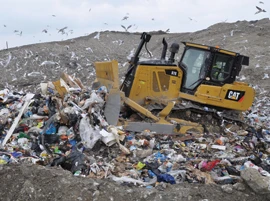
Caterpillar has recently developed a D7E Bulldozer with electric drive. Powered by a 235-horsepower diesel engine, the D7E’s electric drive power train is smooth, efficient, and consumes 10%–30% less fuel than the D7R—while boasting a 10% increase in productivity.
In 2009, Caterpillar sent a D7E on a road show tour, with stops at 14 Cat dealerships across the US. The machine used in the 2009 tour was equipped for dirt operations. In 2010 another D7E—one equipped for waste applications—will spend time actually working at various landfills in the US.
According to Sam Meeker, product application specialist with Caterpillar, “Another D7E has been working at landfills in several European countries.” He goes on to say that, “Operators speak highly of the machine’s fast, smooth operation during turning and direction changes.” This is a unique characteristic of the electric drive system. This machine can actually perform a lock-track pivot turn, a sharp turn in which the inside track stops and the outside track turns the machine. Reminiscent of the steering-clutch system, this allows the D7E to make a 180-degree turn in the space of two machine widths.
Operators also praise the D7E’s faster, more responsive hydraulic system. Using a large, single hydraulic cylinder to raise and lower the blade means fewer components, less downtime, and lower costs.
But from the operator’s perspective, the most important feature is the D7E’s distributed electro-hydraulic system, where hydraulic valves are placed closer to the work tool. One valve at the front controls the blade. Another valve at the rear controls the ripper. This reduces hydraulic line length and results in faster, more responsive controls.
Want more information on this machine? Check it out at www.cat.com/d7e. Or better yet, climb aboard the D7E at this year’s Waste Expo in Atlanta.
Finally, keep in mind that while the current push toward green machines is a result of air-quality and other environmental regulations, any time you can reduce emissions and cut fuel consumption by 30%, you’re putting some green back into your pocket, too.