Alternative daily cover: As a term, it sounds pretty straightforward, and most folks in the landfill business agree that it’s a good thing, even going as far as saying that every landfill should use ADC. I agree. But my issue is that it’s not being used to anywhere near its full capacity.
Like the smartphone in your pocket: The benefits it offers are miles beyond those you are using. I have a handful of apps-with a couple I regularly use. But at last count, there were more than 1.3 million apps available for the average smartphone. Talk about an underutilized resource!
Okay, now you’re wondering, “Wait, am I talking about ADC or smartphones?” Yes, but let’s focus on ADC.
| Covering trash with ADC preserves a huge amount of valuable airspace. |
We’ll put this into perspective by first going back to the origin of ADC. I remember seeing-back in the 1970s-innovative landfill operators setting aside loads of yardwaste to be used at the end of the day to “brush the slopes.” Was that ADC? You bet, but it wasn’t noteworthy. It was just something done to save the cost of hauling soil-primitive but effective. It was ADC.
Officially, however, the first national reference to an alternative for daily cover was proposed by the EPA in August 1988. Those rules, which became effective in October 1991, are commonly known as Subtitle D. More specifically, they are
Code of Federal Regulations-Title 40, Part 258-Criteria for Solid Waste Landfills, Subpart C 258.21-Cover Material Requirements, Sections (a) and (b).
And within Sections (a) and (b), the EPA first defines “daily cover,” and then goes on to present the option of using “alternative materials”:
§258.21 Cover material requirements.
Except as provided in paragraph (b) of this section, the owners or operators of all MSWLF units must cover disposed solid waste with six inches of earthen material at the end of each operating day, or at more frequent intervals if necessary, to control disease vectors, fires, odors, blowing litter, and scavenging.Alternative materials of an alternative thickness (other than at least six inches of earthen material) may be approved by the director of an approved State if the owner or operator demonstrates that the alternative material and thickness control disease vectors, fires, odors, blowing litter, and scavenging without presenting a threat to human health and the environment.
It should be noted that daily cover-and those alternative materials-are presented as both prescriptive standards (i.e., 6 inches of soil) and performance standards (to control vectors, fires, odors, litter, and scavenging).
The EPA is not only telling us what to do…it’s telling us why.
Now fast-forward a couple of decades, and you’ll find that most people in the landfill industry endorse the use of ADC. Most of them have smartphones, too. Unfortunately, most of them utilize only a small fraction of the capability of their phones, and only a fraction of the capability of their ADC. Are you seeing a similar pattern here? Of course, but there is also a big difference.
Not using smartphone apps effectively may make you less efficient and could cost you points on the “coolness” scale. Not using ADC effectively could cost you millions.
Here’s a common scenario:
A landfill historically used 18 loads of soil every day for daily cover. Then one day they heard that other landfills were using ADC. It was new, it was great-and they thought, “Why aren’t we using it?” So they took the plunge and starting an ADC program of their own. Maybe it was spray, film, tarps, or processed greenwaste. It didn’t matter: It was ADC and they were using it. Life at the landfill was good.
After adopting the ADC program, things went back to normal…and the landfill continued to haul 18 loads of soil every day for daily cover. Oh, and the manager also got a smartphone.
I’m trying to make a point, really I am. And here it is: ADC is a tremendous resource, and it is frequently underutilized. When it comes to ADC, we’ve been told what to do and why to do it. But we weren’t told how.
Perhaps a landfill is overusing processed greenwaste as ADC to pump up its recycling numbers…or to avoid paying a per-ton fee on disposed waste. Or maybe the crews just don’t know how to use if effectively.
Another landfill could be using a tarp or a spray or a film to cover just a small portion of the active face, while still using too much soil. Sure, it’s ADC, but is it making things better and saving money?
Here’s the test. If your daily cover soil usage hasn’t decrease dramatically since you started using ADC, something isn’t right. You should be using a fraction of the soil you previously used-maybe going days without using any soil at all.
As a goal, consider the 100-plus-ton-per-day landfill that started using ADC and went from a 1:1 cover ratio, where soil consumed 50% of the airspace, to a 4:1 ratio, where soil consumes only 20% of the airspace.
Or look at the 1,000-ton-per-day landfill that started using ADC effectively and went from 46% soil down to 10%.
Bottom line: Using ADC should reduce your soil use.
Part of learning how to use something effectively is having someone show you what the right way looks like. I recall working in the shop with my dad and having him stop and take time to explain, What, Why, and How to do something the right way. He’d do it as I watched him…then after a bit he’d watch me as I did it. Most often it was less talking and more showing. He’d just look at me and ask, “Savvy?” When I did, it would be a pat on the back, “Good job,” and back to work. This was repeated hundreds, if not thousands of times. My dad was good teacher.
I’ve had the rare honor of meeting with hundreds of great landfill managers across the US, Canada, and abroad. In most cases this was while conducting operational efficiency studies. But while I was helping to improve those operations, I was also seeing hundreds of examples of How-albeit some better than others.
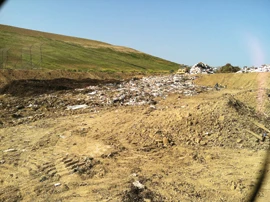
So here on these pages is a look at some ADC photos, representing before and after. The right way should be clearly evident if you look closely-savvy?
Latest from Waste Today
- Vecoplan to present modular solutions at IFAT 2026
- Terex Ecotec appoints Bradley Equipment as Texas distributor
- My Green Michigan expands depackaging capacity
- Washington selects Circular Action Alliance as PRO
- Ten-8 Industrial opens new central Florida service center
- Triumvirate Environmental acquires Environmental Waste Minimization
- Official NYC Bin availability expands ahead of deadline
- US Food Waste Pact’s 2025 Impact Report shows decrease in food waste