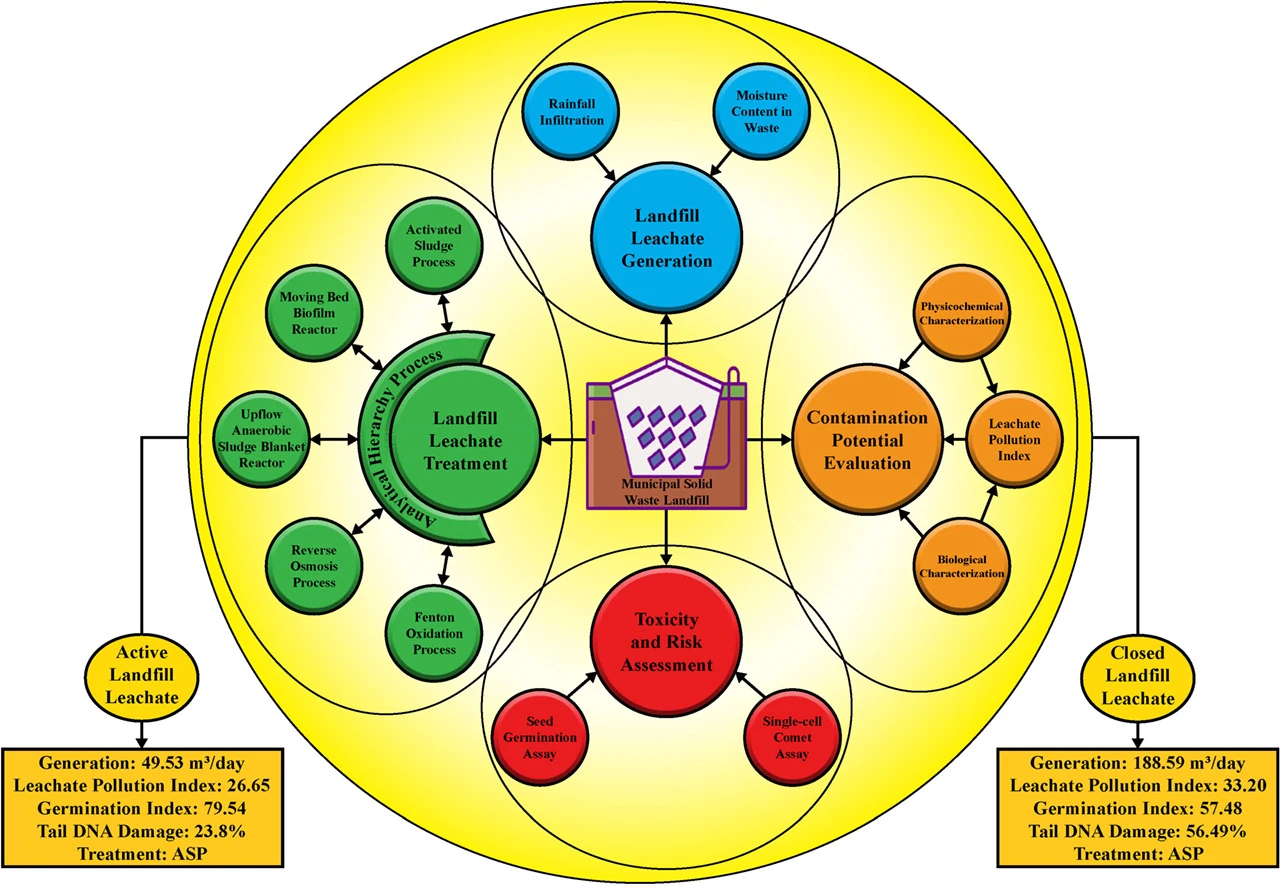
An article investigating landfill leachate toxicity was recently published in an issue of Science of the Total Environment, a multi-disciplinary natural science journal. The authors conducted a study to determine that closed landfills generated more leachate than active landfills. And while leachate from either type of landfill has the potential to induce phytotoxicity and genotoxicity, the leachate generated at a closed landfill was found to have higher ecotoxicity and contamination potential.
The article includes evaluations of the most common methods of landfill leachate treatment. Their findings showed that activated sludge process was the most preferred method, while the Fenton oxidative process, also called Fenton’s reaction, was the least preferred method.
The results of a study on advanced treatment of leachate from landfills older than 10 years will be published in an upcoming issue of Chemical Engineering Journal. The authors explain that electrochemical technology is an alternative method for removing high-concentration ammonium-N and refractory organics from old landfill leachate, or OLL. To apply this solution practically is complicated due to the limited performance of a single electrochemical process, as well as the long tertiary treatment time that is necessary to meet water quality standards.
“This study demonstrates that the sequential ECP-EF [electrochemical peroxidation-electro-Fenton] process can realize two-step advanced treatment of OLL,” the authors write. “The organics in OLL are mainly removed by ECP process and further mineralized or converted to small molecular hydrophobic components in EF process. The sequential ECP-EF process can reduce the aromaticity and complexity of organics, as well as can decrease the acute cytotoxicity (ACT) and hydrophilicity.”
The authors of the study believe that these findings serve as a basis for scaling up this new approach for the electrochemical treatment of landfill leachate.
Latest from Waste Today
- Vermeer announces plan to build new facility in Des Moines metro area
- Buffalo Biodiesel shares updates on Part 360 application to DEC, Tonawanda facility progress
- Capstar Disposal expands roll off dumpster rental services
- Supreme Court strikes down IEEPA tariffs
- Casella details facility closures, expansion efforts
- Zero harm: Building a SIF prevention program for waste and recycling operations
- Casella posts a loss in Q4 2025
- McNeilus names Haaker Equipment first Dealer Partner of the Year