All traditional MSW landfills produce litter. But not all landfills control it effectively. The difference between those that do-and those that don’t-is in the approach.
There are many possible sources of litter, starting the moment a route truck dumps a customer’s can or an individual loads his pickup for a trip to the dump. But today we’ll be focusing on the airborne litter that originates at the tipping pad and active face.
In simple terms, two things are required for litter to blow: wind and debris. Some things, such as plastic shopping bags or dry-cleaner plastic bags, require very little wind and can move considerable distance when wind is almost imperceptible. But as the wind velocity increases, a greater volume and range of materials will blow.
This list shows the relative impact of increasing wind speed on various types of materials. This generally makes sense…but mattresses? Read on.
| Credit: Neal Bolton The discharge area of the tipper, where waste is airborne, can be considered a single-point source of litter. |
Most of the ranking comes from observation, some from more direct experience. Many years ago, two of us were conducting a compaction density test at the Durham Road Landfill. This was a large landfill located on the shore of the San Francisco Bay, near Silicon Valley. We had just one more day of surveying to finish up.
We’d set up the Topcon total station on the edge of the tipping pad and, because of the high wind, had anchored it quite firmly. I’d filled a large plastic shopping bag with about 20 pounds of soil and hung it from a hook located at the center of the tripod, the legs of which I’d spread wide to increase stability. I’d even staked down the upwind leg of the tripod to keep the instrument from blowing over. It was windy…very windy.
All of this effort to anchor the instrument wasn’t so much to keep the crosshairs from jiggling around-that was a given. Rather, it was to keep the darn thing from blowing completely over. Clearly, it was not a day for doing high-accuracy surveying, but still feasible for checking elevations over a small area.
Anyway, I was focused on taking shots and really not much of anything else. It was a rugged day for surveying, and we just wanted to finish quickly. We’d set up to the side of the unloading area, so as not to be downwind of vehicles that were unloading trash-even an engineer has some sense. The only vehicle upwind of us was a large box truck with a load of mattresses.
Suddenly, there was a shout, and I turned around just in time to see a mattress tumbling toward me-and the instrument. There was no box spring, no headboard, not even a small nightstand-just the mattress, so I guess it could have been worse. Using my best blocking move, I dropped my shoulder and leaned into the impact just as the mattress hit the instrument and me. The mattress stopped, and the tripod and I both stayed on our feet.
Coach Bill was right: The skills I learned in high school football had become useful in later life.
Anyway, that’s a roundabout explanation of why I listed -mattresses in the table. Oh, and you may be wondering how hard the wind was blowing that day? It was gusting up to around 50 miles per hour.
But let’s get back to more normal conditions, where the heaviest windblown material you’ll be dealing with is cardboard. And let’s look at the type of control that is most effective.
Establish Litter Control Zones
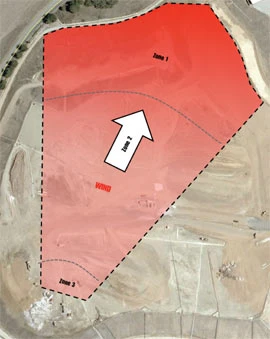
Most landfills have several types of litter screens, each intended to control litter within a different zone, typically:
Zone 1-This is the area closest to the source, and which is most often controlled with portable litter screens. These are the backstop-type screens, the ones that can be pulled, pushed, or carried into place as needed. Some landfill operators build their own screens,
but a good number purchase manufactured screens. Among -manufactured fences, Bull Fence (manufactured by Metta -Technologies) is an excellent choice. These purpose-built fences are durable…and they work.
Zone 2-This area includes the bulk of the landfill footprint, where litter is typically controlled with temporary fencing. The most common design is also the simplest: T-posts and chicken wire. These types of fences are main fighting force in the war on litter.
Zone 3-Zone 3 is the perimeter fence around your landfill, which often serves double duty as site security and litter control fence. This fence is the defensive safety in your litter control effort. It’s there in case everything else fails.
So now, this zone 1-2-3 thing sounds pretty basic, and in a way it is. But simple as it might be, there is room to think. Along that line, think close.
Think Close-Think Zone 1
Basic geometry tells us that while distance is a linear function, area is a squared function. So what, exactly, does that have to do with landfill litter? Plenty.
The distance from the source (of litter) to the point where it is stopped (i.e., the litter fence) can be measured in feet, a one-dimensional measurement. However, the intervening area where litter is distributed is a squared function. What’s more, as the length distance from the sources increases, the disbursement of litter broadens into an ever-widening downwind fan.
Consider for example, a landfill that uses a single tipper to unload transfer trailers. The discharge area of the tipper, where waste is airborne, can be considered a single-point source of litter. If you controlled litter at the source, you would need several portable screens-and, admittedly, there is a cost. But if you did a good job of containing it in this small zone, your cleanup area might be 5,000 square feet-or 10,000 square feet-which might be considered large, as far as houses go, but a very small footprint in terms of litter cleanup.
But if you aren’t aggressive in terms of controlling litter at the source, allowing it to move into Zone 2 or 3, you may still be in compliance in regard to containing litter onsite…but just think about how much more it will cost to clean it up!
Like an infected cut on your hand, aggressive response/control in the early stage is much better than allowing it to spread into a more serious condition.
Want to spend less money on litter control-and do a better job? Focus on controlling it as close to the source as possible. Don’t let that infection spread across the entire landfill.
Think close-think Zone 1.
Latest from Waste Today
- Vermeer announces plan to build new facility in Des Moines metro area
- Buffalo Biodiesel shares updates on Part 360 application to DEC, Tonawanda facility progress
- Capstar Disposal expands roll off dumpster rental services
- Supreme Court strikes down IEEPA tariffs
- Casella details facility closures, expansion efforts
- Zero harm: Building a SIF prevention program for waste and recycling operations
- Casella posts a loss in Q4 2025
- McNeilus names Haaker Equipment first Dealer Partner of the Year