The recycling arena, like every other business sector, has felt the impact of unprecedented events. However, challenges to this market from the current COVID-19 pandemic come as an added measure to the already shifting landscape coping with three years of Chinese National Sword. But according to experts, despite current downturns, the future of recycling may be better than ever.
Cleaning Up Our Act
The effects on recycling from two very different events—a global health crisis and an international regulatory policy—would seem to be unrelated. Yet in a conversation with The Recycling Partnership, a national nonprofit headquartered in Falls Church, VA, experts assert these influences are not single line items to consider separately.
Dylan de Thomas, The Partnership's Vice President of Industry Collaboration, comments that despite their differences, “The impact on US recycling speaks to the same demands placed on the market.
“In terms of National Sword, it was interesting because we have had a few years to absorb its effects, and yet, the questions we were getting about COVID had the same message: how to cope with dramatically changed and reduced recycling markets,” he says.
“When China elected to refuse to import our recycling output, it was for good reason; the contamination was very high and harder to process. Ten years ago it was, but it isn't now. Producers are demanding a very high purity in recycled products and if the majority of your input ends up being wasted and unsuitable feedstock, everyone loses.
“The upside is that we were forced to clean up processing, but the downside is that there is no replaceable market for China. So, the new normal of lower prices has had an impact on all our MRFs who are responding to the need for processing at much higher purity levels. Then in the last few months, we have seen further volatility with the effects of COVID,” reports de Thomas.
At the beginning of the COVID crisis, de Thomas says that some municipalities stopped collection and some saw workforce impact, and "then we saw volatility with a shortage of materials.
“Cardboard and other recovered paper, for example, became in high demand with an increased need for home delivery packaging.
He cites what he calls “three silver national linings” that mandate the cleaning up of contamination and are the organization's focus.
The first one is the national directive to clean up our contamination.
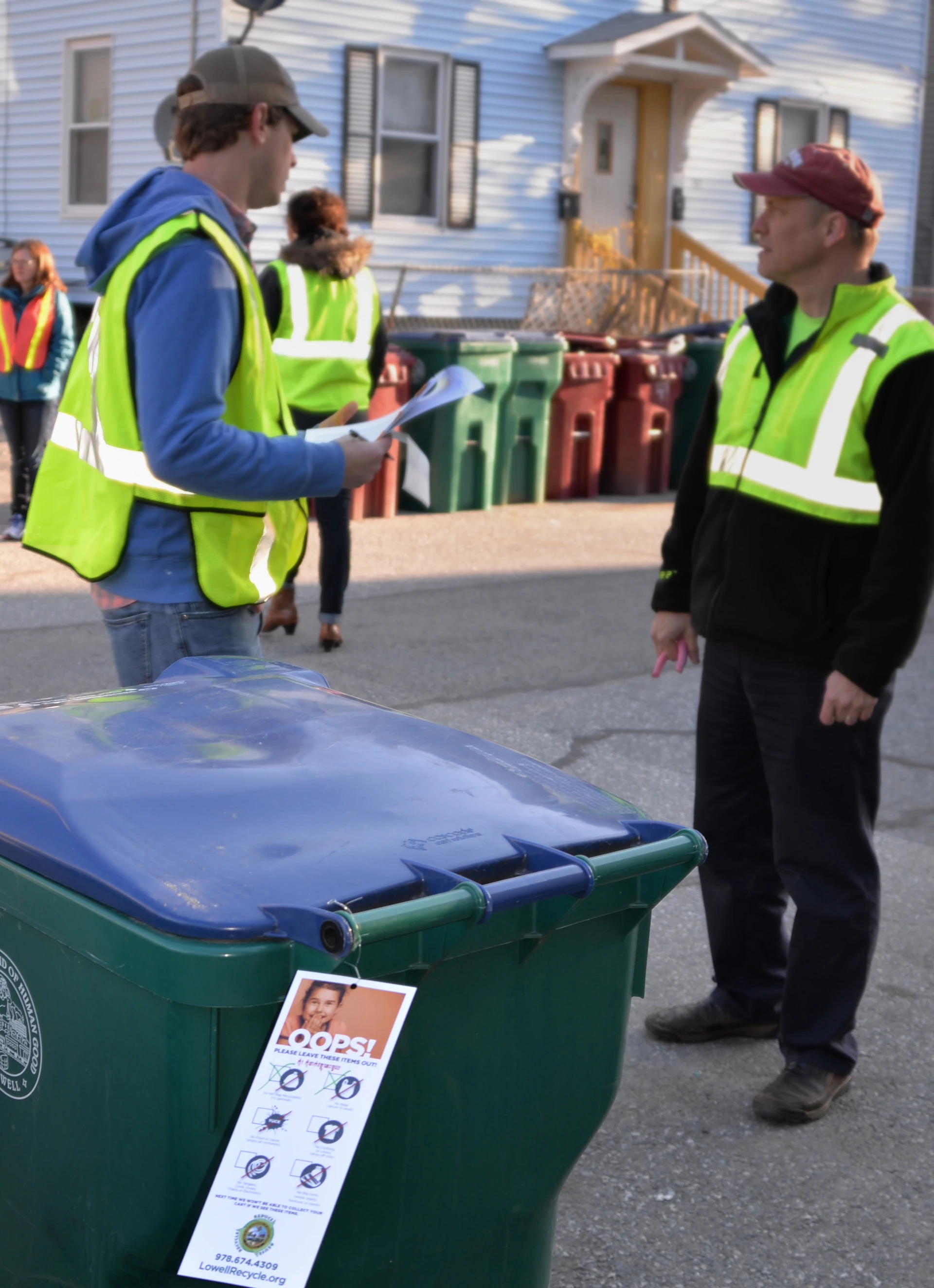
“So far, we have worked in 1,500 communities providing them with a toolkit to reduce contamination by an average of 40% with our powerful best practices guidance.
“The second one is seeing investment in new reclamation facilities for paper and plastic, and the third is our working with MRFs to build equitable contracts with communities.
“Right now, we are seeing great conversations to advance the recycling infrastructure with proactive solutions for real national legislation. These include funding for education and infrastructure for expanding curbside collection.
“The Partnership is at the forefront of promoting and making a reality the circular economy. We’re doing this through public education and legislative support to support the economy and jobs at home. It’s a powerful narrative that in the post-National Sword environment will spur profitability through innovation.”
The Partnership's chief community strategy officer, Cody Marshall, further relates the outcome of their July 2020 quarterly meeting where some surprising data was reported from COVID effects.
Recycling as an Essential Service
“We had a virtual meeting that meets quarterly and includes recycling stakeholders from various agencies working in environmental management and recycling. This quarterly meeting is one way we stay up to date with state and local recycling issues. In March at the beginning of the stay-at-home orders, we did start tracking COVID information and although this was a regular quarterly meeting, not one focusing on COVID, we did learn some great insights from participating states.
He says that from their tracking of COVID they learned that "During the late spring, there were only 20 MRFs that had suspended operations temporarily as a result of COVID, which have all since restarted with the one or two possibly still suspended.
"This is out of 375 MRFs in the US that sort commingled residential recyclables."
He adds that through the pandemic he was happy to see that states and local government continued to deem recycling an essential service throughout the COVID-19 shutdown period.
"This was very good news for the supply chain that relies on this material," he says.
“The primary two reasons we heard for suspending curbside collection were to protect the health and safety of drivers, and shortage of labor affecting services. In many places, when schools were closed there were other unforeseen responsibilities and people had to stay home. But mainly it was an effort of putting policies in place to protect people from undue risk.”
One outcome from this pandemic is that recycling has been highlighted as critical and essential for manufacturers who rely on this material.
"Sometimes we forget about the core to recycle and this has certainly reminded us. What we are seeing is an impact on local government in two broad categories: one is in operations and the other is on funding."
He explains that those overlap to some degree and, "We see communities who have had to suspend or postpone recycling because of operating challenges as they are trying to protect staff.
"On the financial side there is a shortfall of public revenue in sales tax; cities have had to adopt belt-tightening by changing their recycling services.
"To anticipate long-term effects [of COVID] on this economy will require changes to keep this service going. We are getting calls from local governments looking for answers and direction.
“One issue at hand is finding the means to continue and improve collection and processing automation. To improve safety and efficiency, we are continuing to support communities in need with grants that will allow important transitions.”
Marshall describes one COVID-related scenario where the importance of feedstock became very much front-page news.
“In terms of specific cause and effect, when toilet paper supply was flying off the shelf, things escalated a big demand for recycled paper. The market for recycled fiber shot up and some producers of tissue had a difficult time keeping up with that demand. This really hit home and underscored how we need to have a more sustained and improved system,” says Marshall.
But while putting employees first and using safety precautions such as taking temperatures at the workplace and requiring social distancing, “The organization sees collection and processing automation as a necessity to keeping operations going."
But automation costs money, and “We need sustainable funding and relying on tax dollars for collection in a time of crisis isn’t always an option. Local governments need to have funding that can keep the wheels in motion. This recent and unprecedented situation highlights the need to make sure we are set up properly and implement a good foundation operationally to push material and get it through the supply chain.”
The big picture, he adds, is that across the country cities and citizens have recognized it is an essential service.
"By prioritizing secure funding sources, this essential service can continue operating as a robust system in times of stress."
Refining Purity for Profitability
With more than 6,000 TOMRA Sorting Recycling systems installed in 80 countries, TOMRA is ever responsive to the changing market needs for purity and profitability.
Nick Doyle, Recycling Area Sales Manager, West, says that China National Sword “reinvigorated the company’s innovation for sorting equipment used in MRFs and plastics recycling facilities.
“Before National Sword was implemented, recycled product of up to 10% impurities was acceptable, but that changed when China mandated an impurity content of only 0.05% for recycled materials, like paper.
“Since then, other countries followed their lead and this has impacted how we refine our recycling process. The recycling companies have made clear they want upgraded hardware and software to do the majority of the sorting, which then allows labor to be deployed for better use within the system. And recently the coronavirus only served to underscore this need."
Doyle adds that in response to this shift in market need, TOMRA has upgraded both hardware and software, introducing new technologies that are key factors for increased efficiency.
“Our SHARP EYE has our enhanced FLYING BEAM technology that is the market’s first near-infrared (NIR) scan system that performs point-scanning without the need for external lamps.
“FLYING BEAM has an integrated light source positioned inside the scanner which enables homogenous light distribution across the conveyor belt. This distinguishes the finest molecular differences in materials flowing down the recycling line while reducing power consumption by up to 70%.”
Then for paper sorting applications, Doyle says that SHARP EYE's new optical sensor for higher light intensity has been calibrated to identify materials suitable for drinking, and "the recovery rates are as high as 96% in just one step.”
SHARP EYE technology also makes it possible to distinguish multi-layer PET bottles and trays from monolayer PET bottles.
Doyle says the TOMRA DEEP LASER originating from Laser Object Detection (LOD) was developed “for a wide range of uses for a deeper sorting sharpness to significantly improve the performance of the sorting process.
“This laser technology detects items such as black plastics and rubber, glass, and other waste items that NIR cannot detect. The benefit to recycling operators is its low-energy alternative to sort glass, plastics, and black plastic from paper; it can increase final product purity by as much as 4%.”
Doyle comments that rising demand led TOMRA "to our June introduction of a new generation of AUTOSORT technology.
“This is the most advanced AUTOSORT system to date and brings the very latest of TOMRA’s technologies together, giving you advanced accuracy of complex sorting tasks at high throughput rates.
“And by incorporating SHARP EYE technology into AUTOSORT, your light efficiency is increased. This enhances sorting sharpness to improve the separation of difficult-to-target fractions.”
Doyle explains further that the new AUTOSORT also includes the improved version of FLYING BEAM sensing technology whose better light efficiency delivers high performance at low operating costs.
Doyle says, “DEEP LASER can be fully integrated into AUTOSORT as an option and it is one of the first fully integrated Deep Learning systems on the market.”
Finally, along with the new AUTOSORT, “TOMRA has introduced the AUTOSORT SPEEDAIR.
“This is a highly customizable system incorporating speed-controlled, fan-driven air inlets that generate a constant air stream over the conveyor belt. As this technique stabilizes light materials like plastic films or paper at conveyor speeds reaching 19.7 feet per second, it generates higher throughput and enhanced sorting quality,” says Doyle.
These innovations and others are the response to market influences, and Doyle affirms that. “We are always in an ongoing development mode seeking new solutions. To that end, our engineering team invests heavily into R&D, leveraging the latest software and hardware innovations toward ever-increasing purity levels, across multiple recycling platforms.”
Carlos Manchado Atienza, regional director Americas for TOMRA Sorting also emphasizes multiple drivers that influence innovation of the recycling market.
"Even today, single-stream only collects less than 40% of recyclable material on average. The rest is landfilled. In the face of what we are now defining as the "new normal" our industry is working through concerning the coronavirus, it remains very important to focus on recovery at MSW plants before the material is landfilled.
“We don’t want the rest of the good material just buried in the landfill if we can capture it to good purpose.”
Antiquated Systems Pose the Biggest Roadblock
With the advent of broadband, everyone was happy to see the back of the glacially slow performance of dial-up. Yet today, despite the impressive menu of technology choices, many MRFs are still stuck in a "dial-up mode" churning out suboptimal products with antiquated equipment poorly suited for today’s needs.
Mark Neitzey, director of sales for Connecticut-based Van Dyk Recycling Solutions, says that for any processor working in this environment of post-China National Sword and ongoing COVID pandemic, "Having your facility operate at the top of the recycling game is imperative."
He considers first the labor force affected by COVID that saw the bottom drop out, temporarily.
“This is a tough job. It's dirty, you are sorting through tons of other people's trash, and for safety reasons, people are staying away. This was, and still is causing the MRF to run dramatically slower.”
Neitzey says that, for example, in a standard operation processing 30 tons per hour, “You need about 30 people, each one processing a ton per hour. If it is highly automated, maybe you can get by with 20 people. If only 15 show up, they have to run the system slower but your input is still the same, so you are risking the quality and risking labor safety.
“This is where we come in and can assess your situation and guide you to solutions. There is a real need to take many of these facilities and make them more automated. But you’ll never get rid of labor entirely just by installing an optical sorter or robotics as we still need that human element as an overarching manager.”
But updating to new technology in the face of labor shortages is not like unplugging one device for a newer one.
“These MRFs are a factory and they have been operating 24 hours a day for years, and you can’t just go drop in some piece of equipment. It’s a substantial effort that requires a retrofit and design improvements to fit the building footprint and your dropoff accessibility. We are often called in to fix a plant and for many reasons, it makes more sense to do this incrementally."
But there are new unanticipated impacts.
“Right now, with National Sword and COVID, the MRF is stuck in the middle with cities losing revenue and recycling costing more than ever. The MRF is taking in bad material and can’t sell their outbound material for the prices they once did, and increasing quality is a huge concern. You have to make clean, sellable material and this takes a combination of a higher-level skilled worker, capital to spend on new technology like robotics and optical sorting, and continuous screen upgrading.
Neitzey adds that with most systems designed from 2000 to 2010, “These were made to process primarily old newspapers, bottles, and cans. What's happened now—no one reads newspapers. The system wasn't designed for the cardboard boxes of online buying and home delivery. And people put yard waste, food waste, anything and everything from Christmas lights to garden hoses in recycling.”
He says that while the activity of recycling has increased, what was once 20% inbound unusable recyclables “has now grown to well over 30% in some places. And the system is being killed by plastic film bags,” a problem he illustrates with compelling statistics.
“It takes 76 bags to equal one pound and if you are processing 30 tons an hour and 2% of that product is film bags the system is seeing 91,000 bags an hour. So then, if you have a human sorter working as fast as they can, they could maybe handle 45 bags a minute.
"Now, divide 91,000 by 60 minutes—with each minute processing 45 bags—you would need 35 people to handle just the bags alone. Most plants have less than 30 people for everything, so those bags flow in with the paper. They are so light and then they unavoidably get into the bales as a contaminant,” he explains.
Finally, in assessing impact pressures on the market from both the virus and constraints felt from China, Neitzey offers what he calls "the 37,000-foot high view."
"The MRFs must upgrade to today's world if they haven't done so already. The challenge is to make this a profitable endeavor within your means, and if there are budget constraints, start small.
“You don’t have to build a new facility; you can start putting in upgrades at the very least. For example, put in new screens that can handle this challenging material, screens that don’t wrap with film bags.
“A screen that is designed to sort newspaper doesn't work for today; you need a non-wrapping screen and then an optical sorter that can intelligently separate two different materials like cardboard from everything else, or white paper from everything, or bottles and cans from everything else.
“But we have to keep in mind that anything we are talking about in terms of robotics and optical sorting is only as good as the material is prepared and presented to do this,” he cautions.
He affirms that processors need materials to come through in a single layer and homogenized with the same size and shape.
“This is what can make the technology successful.
“You can have all the robots in the world working for you but at the end of the day, they can only do the job with information you have given them to work with. As we go forward amidst the new market demands and constraints, the successful future of MRFs and the recycling industry overall will be the combination of good workers, quality control, and practical technology.”
Latest from Waste Today
- My Green Michigan expands depackaging capacity
- Washington selects Circular Action Alliance as PRO
- Ten-8 Industrial opens new central Florida service center
- Triumvirate Environmental acquires Environmental Waste Minimization
- Official NYC Bin availability expands ahead of deadline
- US Food Waste Pact’s 2025 Impact Report shows decrease in food waste
- Coastal Waste & Recycling expands recycling operations with Machinex
- Reconomy acquires German-based GfAW